Self-Portrait in Watercolor pencil and Graphite pencil using the grid technique.
This is the blog for the UCLA Chicanx Latinx Art and Artists course offered by the Cesar E. Chavez Department of Chicanx Central American Studies (CCAS M175, also Art M184 and World Arts and Cultures M128). This course provides a historical and contemporary overview of Chicanx Latinx art production with an emphasis on painting, photography, prints, murals and activist art.
Showing posts with label 2020XochipilliMiqtlayohually. Show all posts
Monday, March 16, 2020
Sketchbook cover stencil design
My sketchbook cover stencil design was based on my love and remembrance of my dog who has been missing for several years after a nasty dispute with my neighbor that resulted in restraining orders that have been renewed and are still in effect against him.
Sunday, March 8, 2020
Reflection
This Chicana Art and Artists course has been very interesting for me. I enjoyed learning about so many female Chicana artists and their different styles of artwork. I love art. It was great learning how to draw all of the different positions of the hands for the American Sign Language alphabet assignment in our sketchbook. I also enjoyed the extra credit assignment of drawing our own version of the Virgen de Guadalupe in my sketchbook. The sketchbook cover stencil assignment was kind of challenging for me. Because I chose such an intricate photo to create a stencil design for my sketchbook. I had to carefully cut out the design for the stencil several times using different types of materials, until I was finally satisfied with what I created. I also enjoyed the drawing self-portrait. My only problem with that assignment was the fact that I had used a darker graphite pencil when I was drawing and part of the image transferred over onto the next page. I have noticed that happening on other pages in my sketchbook. I guess it might be because I am applying too much pressure onto the paper when I'm drawing. Maybe, I should probably keep a blank piece of transfer paper in between the pages of the sketchbook. The other assignment that I really enjoyed was the one about the free draw/write. I felt like that assignment helped me to vent about what was going on in my life at that particular moment. Art is such a powerful tool, that transcends restricted boundaries. It is a means of expression that is conceptualized and visualized.
Wednesday, February 26, 2020
Artist - Monica Kim Garza
The presentation on artist Monica Kim Garza was very interesting. I think that her art could qualify as a form of erotic art. Her artwork is kind of "pornographic", because of the depiction of nudes who might be actively engaging in sexual activity. This type of artwork goes against the social norms. Erotic art tends to be restricted by laws implemented by society. These types of laws make this type of art style a taboo, that aims to restrict the production, distribution, and possession of it. Monica Kim Garza is a talented artist who is influenced by her cultural upbringing. Her work is very graphic in nature. There are powerful representations of ethnic people shamelessly engaging in daily activities that are meant to stimulate the senses.
Artist - Monica Kim Garza
Thursday, February 20, 2020
Presentation on Artist: Martha Ramirez-Oropeza
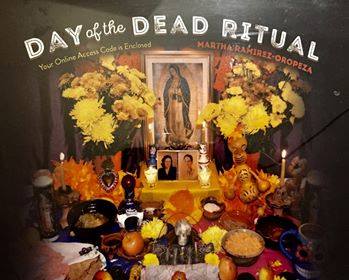
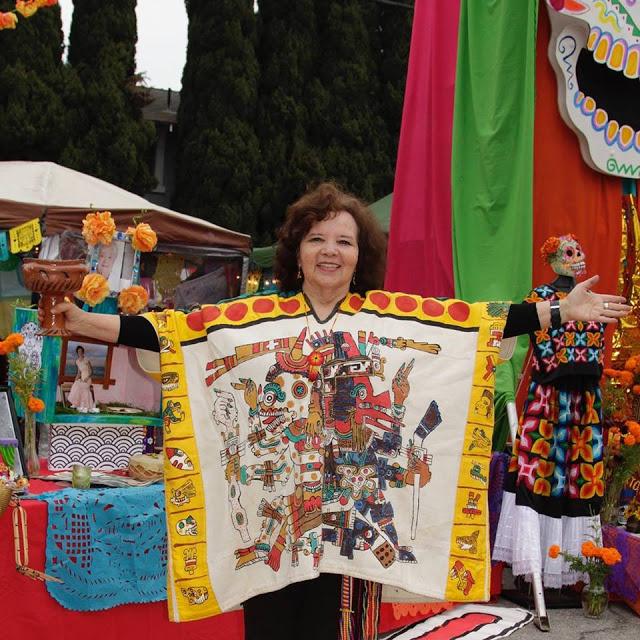
My presentation will be on Chicana Artist Martha Ramirez-Oropeza who is a muralist, philosopher, teacher, visual and theater arts practitioner and instructor. Martha Ramirez-Oropeza is also a professor in Mexican Indigenous Nahuatl Philosophy, and Spanish Language immersion. She was an apprentice to the great Maestro David A. Siqueiros in México. As a resident artist at the Social and Public Art Resource Center (SPARC) in Venice, CA., Martha Ramirez-Oropeza enacts a sacred ritualistic ceremony for the Day of the Dead every year, for ancestor worship Día de los Muertos at SPARC. At this special event there are many elaborate altars set up representing different regions in México with specific items placed on or around the altars that may vary by regional locality.
Martha Ramirez-Oropeza
|
|
Ceremony led By: Martha Ramirez-Oropeza
|
In the Fall of 2019, Martha Ramirez-Oropeza was the tlamachtihquētl (teacher) for Chicano 113 - Day of Dead Ritual, here at the University of California, Los Angeles. I really enjoyed that class and I believe that it has a lot to offer to people interested in learning about the Day of the Dead.
From what I learned in my Chicana / Chicano courses artist Martha Ramirez-Oropeza utilizes images that are associated with pre-Columbian origins. The indigenous Mesoamerican influence in her work is so important. Because it has strong ties to a historical past that was almost eradicated by the European / Spanish conquistadors. Through her artwork she connects to our ancestors and is able to tell stories and myths from the past that are relative to our present.
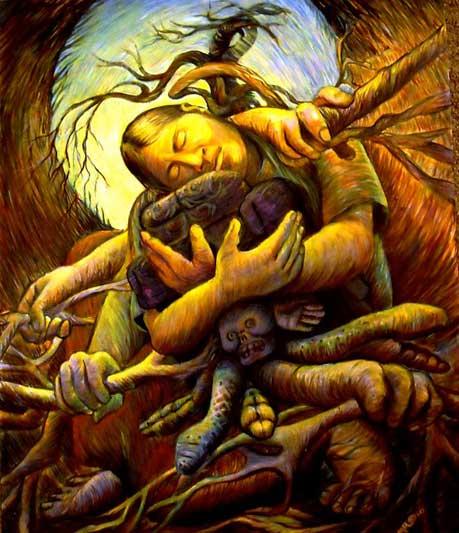
“Sosteniéndome de mis raíces”
Martha Ramirez Oropeza
|
I really like how artist Martha Ramirez-Oropeza’s work is closely tied to indigenous pre-Columbian culture. And I consider her to be a talented artist because her work has an important story to tell, a sacred myth that is meant to be preserved and passed onto future generations to keep our history and traditions alive through Topializtli (what should be preserved). She is an amazing tlacuilo (artist) and a Tlamatini (wise person).
Thursday, February 13, 2020
Sketchbook Stencil Cover
I will design an animal skull for my sketchbook stencil cover. The animal that I have chosen is a dog. I want the skull to be white and the shadows of the skull to be the black from the actual sketchbook cover. I love animals. Several years ago I had a dog that was 13 years old who ended up missing after there was a dispute with my neighbor. My neighbor had made many threats to kill my dog and me, by chopping off our heads with a machete that he was brandishing in the driveway. My neighbor threatened that if the dog would go onto his property again he would kill him and me. Shortly thereafter my neighbor assaulted my life-partner and continued to make death threats towards both of us. When we called 911 and the officers responded they did not arrest our neighbor. One of the officers suggested that we get a restraining order against our neighbor, while the other officer was reluctant to offer such advice because of our properties proximity to each other. The other officers statement was that there would not be a Judge who would be willing to grant such an order because of the location of our property and our neighbors. And that there would be no way to determine how many feet my neighbor would have to stay away from us, so that he would not be violating such an order. Well, I chose to go and seek legal aid and I ended up getting two restraining orders against my neighbor that are still in effect today and have been renewed in the past.
So, the dog skull is a symbol for a piece of my heart that has been damaged by the lack of consolation. Till this day I still don't know what happened to my dog? I don't know where he is, or if he is still alive and suffering? So, it's the simple fact of not knowing that bothers me. I had this dog since he was born, my family had his parents and grandparents who have all passed on. I miss my dog because he was a special part of my family. I will never forget him. The memory of my dog will live on, in my drawings on my sketchbook that are ultimately an extension of myself.
![]() |
| https://www.etsy.com/listing/724449555/pitbull-skull?ref=shop_home_active_15 |
![]() |
| https://rescuecritters.com/product/pit-bull-dog-skull/ |
![]() |
| https://br.123rf.com/photo_44756567_skull-of-purebred-doberman-dog-isolated-on-a-white-background-opened-mouth-all-teeth-are-presented-b.html?fromid=VFY3QS9BQk12cGRDektnQVdEeVhKZz09 |
Thursday, February 6, 2020
Esparza,Ofelia
Our guest speaker Ofelia Esparza came to our class CSM175: Chicana Art & Artists, on Friday January 31, 2020 at the University of California, Los Angeles. Esparza is a Chicana altarista (Mexican-American altar maker). She is an amazing artist that has earned many awards for her talented artwork that has been exhibited in different museums. She is a National Treasure. Her first publicly displayed altar was exhibited in 1979 at Self Help Graphics. She has contributed so much to the Los Angeles Community.
Esparza has shared her art experience about building altars and ofrendas for the special Mexican celebration of Dia de los Muertos (Day of the Dead). Her knowledge has played a vital role in informing public audiences at community centers, parks, schools, museums, and prisons, about spiritual beliefs and indigenous traditions that should be passed onto future generations. She was an elementary school teacher for 30 years where she incorporated her talents as an Chicana artist. Esparza was also a cultural consultant for the Disney PIXAR film “Coco” https://movies.disney.com/coco , which was about remembering your ancestors, preserving traditions, and enacting cultural customs.
Ofelia Esparza’s work consists of various types of intricate materials that are culturally significant. Some of her altar creations are composed of mixed-media that are harmoniously balanced resulting in an arrangement of elements that are aesthetically pleasing to the eyes, heart, mind, and soul. The altars may consist of carefully arranged photos of departed loved ones, traditional foods & drinks, personal items that belonged to the deceased, items they enjoyed, hand crafted items, and most importantly the Cempasúchil (marigold “Flower of the Dead”). The Cempasúchil flower is one of the main items used for an altar. The name of the marigold flower originated from the Náhuatl (Mexica / Aztec) word known as “Cempohualxochitl” which translates into “twenty-flowers”. When all of the items are arranged on and around the altar it creates a spiritual portal that guides the spirits of the dearly departed back to our physical realm to celebrate their lives, to enact historical customs, to preserve cultural traditions, and to remember them (our ancestors). Ofelia Esparza truly is a “Warrior Woman” that has fought to preserve our cultural traditions so that future generations can experience them.
![]() |
| ofelia esparza |
![]() |
| ofelia esparza |
![]() |
| https://www.arts.gov/honors/heritage/fellows/ofelia-esparza |
![]() |
| https://movies.disney.com/coco |
![]() |
| https://www.arts.gov/honors/heritage/fellows/ofelia-esparza |
Thursday, January 30, 2020
Rasquachismo and Domesticana
Rasquachismo, I don't believe that I have ever heard of this word before. It's quite an interesting term that defines a specific type of Chicano perspective about an aesthetic attitude towards what one has or does not have. I think that it is also about a type of decorum that is exhibited. It goes against societies established protocols and creates it own sense of style that is adaptable to its surroundings. The content is related to its context. The Rasquachismo attitude is mindful of the contextual environment and allocates appropriate resources to establish a dynamic harmonious Chicano aesthetic.
I grew up in poverty, so I know what it is like to have the mindful concern about what others will think or say about my appearance. But the one thing that separated me from others was that I was not trying to adapt to please others, I was adapting to please myself. I desired to have a powerful sense of pride and style that was convenient for my egotistical needs.
I remember several times I went to court for family matters, and strangers in courthouse automatically assumed that I was the family attorney. I always dressed well to suit the specific occasion and the particular environment, even though I did not have money to purchase the particular type of clothing I wanted, I always found something similar to the article of clothing that I wanted, or I simply found a way to make it into something that I wanted to wear. Like a player on the stage or jester who performs to please the crown. I wanted that sense of power and authority to influence others.
Thursday, January 23, 2020
Yolanda M. López, “Nuestra Madre”.
I really liked Yolanda M. López's work because I felt like it connected some of our Mesoamerican indigenous religious symbols and deities with modern day Mexican religious icons. For example, the Aztec creation deity Coatlicue is a powerful symbol of a strong feminine figure that has the ability to create life or destroy it. Coatlicue is an ancient ancestor deity who gave birth to the sun Huitzilopochtli and the moon Coyolxauhqui. While the image of the Virgen de Guadalupe is more passive and docile than the Aztec creation deity Coatlicue, she is still powerful and has become a well known icon over the years. Both of these images combined are powerful female symbols of Mexican and indigenous identity and faith.
Yolanda M. López incorporates the empowering anthropomorphic symbol of the Aztec deity Coatlicue superimposed over a simplified depiction of the Virgen de Guadalupe. An important religious image of the patron saint in Mexico City, is the Virgen de Guadalupe who is Catholic. This creative representation of our indigenous ancestral deity Nuestra Madre (Our Mother) Tonantzin, creates a powerful contextual message between the art-piece and the viewer who might be a religious Catholic person. I like this connection between the past and the present, indigenous Aztec deity and Mexican Patron Saint. Coatlicue is a fierce creation goddess that is respected, revered, and at times feared. This deity is a great example of a great balance between the forces of good and evil, because one can not exist without the other.
Chicana feminist leader Yolanda M. López is a powerful creative female political artist. I believe that art is a powerful tool that has the ability to transcend restricted boundaries. And artist Yolanda M. López has managed to transcend socio-political boundaries that deal with sexism, racism, and immigration. Her work addresses relevant social issues concerning gender, racism, migration, religion, womanhood, and femininity in a male dominated society.
![]() |
| “Nuestra Madre”
Acrylic and Oil paint on masonite. 48 x 96 in., 1981-88.
Yolanda M. López
|
Thursday, January 16, 2020
Martha Ramirez Oropeza
Chicana Artist Martha Ramirez Oropeza is a muralist, philosopher, teacher, visual and theater arts practitioner and instructor, she is also a professor in Mexican Indigenous Nahuatl Philosophy, and Spanish Language immersion. In the Fall of 2019, I enrolled in Chicano 113 - Day of Dead Ritual, here at the University of California, Los Angeles, and Martha Ramirez Oropeza was the tlamachtihquētl (teacher). She is an amazing tlacuilo (artist)and a Tlamatini (wise person). She was an apprentice to the great Maestro David A. Siqueiros in Mexico. She is currently a resident artist at the Social and Public Art Resource Center (SPARC) in Venice, CA. Artist Judy Baca is one of the founders of SPARC. I really like how artist Martha Ramirez-Oropeza’s work is closely tied to indigenous Pre-Columbian culture. And I consider her to be a talented artist because her work has an important story to tell, a sacred myth that is meant to be preserved and passed onto future generations to keep our history and traditions alive through Topializtli (what should be preserved).
I will attach some photos of some of her powerful work.

Professor Alicia Gaspar de Alba's essay on the CARA exhibition, “Out of the House, the Halo, and the Whore’s Mask: The Mirror of Malinchismo”, is quite politically charged. I thought that it was an interesting description of the term “espejismos (a Chicano machismo-like self-image portrayed onto a woman’s body)” in the performance piece of Las Tres Marías by Judy Baca, was a powerful experimental medium to be utilized, that was successful at expressing the art principle of visual economy. The simplicity in the design of the Chola, the mirror, and the Pachuca, was a brilliant idea that I believe would have automatically elicited a response to one’s questions about self-identity within a prejudicial society.
I will attach some photos of some of her powerful work.
![]() |
| "Sosteniéndome de mis raíces" Martha Ramirez Oropeza |
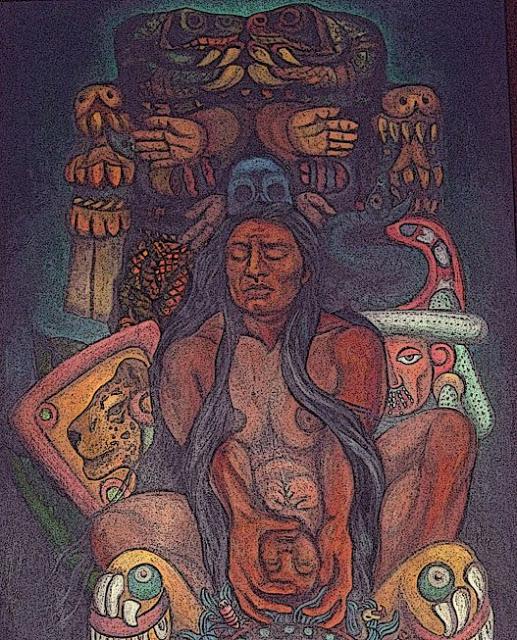
![]() |
| "Ce Acatl Topiltzin Quetzalcoatl" 1987 Martha Ramirez Oropeza |

Martha Ramirez Oropeza
Professor Alicia Gaspar de Alba's essay on the CARA exhibition, “Out of the House, the Halo, and the Whore’s Mask: The Mirror of Malinchismo”, is quite politically charged. I thought that it was an interesting description of the term “espejismos (a Chicano machismo-like self-image portrayed onto a woman’s body)” in the performance piece of Las Tres Marías by Judy Baca, was a powerful experimental medium to be utilized, that was successful at expressing the art principle of visual economy. The simplicity in the design of the Chola, the mirror, and the Pachuca, was a brilliant idea that I believe would have automatically elicited a response to one’s questions about self-identity within a prejudicial society.
Wednesday, January 8, 2020
Xochipilli, Miqtlayohually (Isabella)
2020XochipilliMiqtlayohually
Hi my name is Miqtlayohually Isabella Xochipilli. It's easier for people to call me by my middle name Isabella. My pronouns are she/her/hers. My major is PrePsychology and a minor in Chicana/o/x Studies. I am currently enrolled in 18 units this Winter term at UCLA. I transferred last year from Los Angeles Mission College. I consider myself an artist. Art was one of my major's at Los Angeles Mission College. Years ago, I sold some of my work at La Galeria Gitana (http://galeriagitana.com) in the San Fernando Valley. I love to learn new things. I like to draw, paint, sculpt, and create things. I believe that Art is a powerful tool that has the power to transcend boundaries. I am interested in learning about the indigenous Mesoamerican culture and Chicana/o/x culture. I am currently learning Elementary Nahuatl, which is basically an introduction to the language of the Mexica/Aztec/Nahua people of central Mexico. I am also interested in learning about the myth of Aztlán and how it is represented in many works of Chicana/o/x Art.
My areas of interest in research include underrepresented ethnic minorities who are survivors of abuse, poverty, and miseducation. In the future I would like to become an Art Therapist or a Psychotherapist, to help people who suffer from mental illness and other types of disorders recover and maintain proper treatment to assist them in pursuing their goals. Mental illness is a serious topic that is often overlooked or ignored. I would like to be able to raise awareness on this topic, with efforts to make a difference and contribute to our community. Various members of my family are afflicted with irremediable mental illnesses that has brought a great deal of stress into their lives. I would like to develop a treatment program that would help patients suffering, cope with their illness or disorder, and strive to attain a successful recovery.
Subscribe to:
Posts (Atom)