Showing posts with label 2021FCalderonJuliana. Show all posts

Sunday, December 12, 2021

Calderon, Juliana: Extra Credit (MCASD)

     The extra credit assignment provided me the opportunity to view artwork up close at the Museum of Contemporary Art in San Diego. I was able to see the extent of Yolanda Lopez's work and how it seems to translate to modernity. During the lecture, we engaged in dialect concerning her notorious painting of the Virgen de Guadalupe running while holding the piece of dress that she is typically clothed with, while holding the snake in her hand. To me this has always stood out because it demonstrated the concept of mobility and freedom. Not only does she have the power to take hold of the snake, which is representative of all the evil and toxicity of the world, but she also appears to run over the baby or male figure. This was something that I had not really paid attention to before because I had always focused on the hand lifted up with the snake and the act of her running. But focusing on the child, it implied to me a sense of dependency. The child is not seen uplifting her or guarding her as typically seen in most images of the Virgen. Instead, she almost tramples over him because she is quite capable on her own. She no longer needs him to hold the train of her dress because she is not conforming or aligning with the standards. 

A second image that stood out to me because of its modern take was titled, Runner: On My Own. This image was of a Chicana running almost off the page as well. To me it was also indicative of the Virgen or a form of her. Here in the image she was dressed in the same colors of pink and green. In the typical image, Virgen has a green tunic and pink dress. While here, the woman is in a pink top and green shorts. It shows a different era where women are more free and aren’t confined to a set expectation. Additionally, because I thought of her as a representative of a more modern Virgen, it also stood out to me that here she is not accompanied by an angel or any other symbol. The focus is set to be on her. I also thought it represented the Virgen in a way because all the colors were still incorporated. For example, the green and yellowish color usually exuding from the background of the Virgen, is now seen as the backdrop of the runner image. But here she is running from that backdrop, almost as though she is leaving that conformity behind.

Overall, the exhibition helped me to learn more about Yolanda Lopez’s ideas and I was able to take notice of more that I had previously glossed over.


Sunday, November 28, 2021

Calderon, Juliana (Week 10: Paloma Montoya)

            This quarter I had the opportunity to learn about many new artists. The artist that stood out to me from the ones we saw during presentations was Paloma Montoya. She attempts to include symbolism in her work. She focuses on implementing feminism and sexuality into her pieces. For instance, in the image “Look at Me” it is an image of a Chola style woman on a bike. This contest in which she submitted this work, was intended to depict the representation of Boss Lady. She included this woman donned in Chola attire on a bike. The image shows that this is what power or respect is in her community. I liked this because oftentimes people in our communities are overlooked. Most don’t think of marginalized groups of people, especially women, as the Boss type or carrying any authority. But here, Montoya accentuates the power women yield. It is not a specific type of woman, it is any woman. Any woman who holds confidence in whatever she does, exemplifies the idea of Boss Lady. The image helps to convey the concept of Latinas/Chicanas being the boss type in whatever they set their focus on. I particularly enjoyed the drawing of someone who people in our community can identify with. The woman is dressed in her athletic wear and Nike Cortez shoes that resonate with many young women. It is something that many can give attention to because to them it is a representation of something they understand.


            Another image was titled, “I’ve Lost my Head Before 1”, and it was that of a wolf. The wolf represented herself and the struggle of her life coming to a head. The image shows that the wolf was encroaching upon her. The wolf is something that is usually viewed as a danger and threat. But here, by presenting it on canvas, she depicts the fear she no longer has. The wolf, or the struggles in her life, are no longer impediments. She has taken hold of them all and now has the control. I liked the color contrast she uses. The purple is such a dark color that helps in depicting the wolf as something dark and volatile. Additionally, the background highlights the overcoming of such a dark creature. Overall, by being able to draw this, she shows that she has overtaken this obstacle and is no longer being consumed by it.


Sunday, November 21, 2021

Calderon, Juliana: Week 9 (Presentation on Ayala Vanessa)

The artist that I enjoyed learning about was Ayala Vanessa. I liked how she created the Chola Lisa. It is a representation of modern culture. It strays away from the image of perfection and gender expectations in a patriarchal society. Instead, it draws rebellion against this system, giving power to women.  This image evoked the idea of breaking from the expected attitudes of gender. We see the Chola Lisa with tattoos and heavy makeup, something that is often frowned upon or at least it was at some point. By including these aspects, it showcases the artist’s feelings concerning the norms. I thought it was very interesting to see an iconic image recreated to represent the aspects of a totally different culture and time. 

The Hindu Guadalupe also was curious to look at. It was interesting to see how though Hindu is not connected to Catholicism, she still drew a connection. It’s as though she feels that both cultures are more similar than different. She painted it in a way where there aren’t many noticeable differences between this image and the original, so the audience is compelled to look at the similarities rather than the differences. She felt so compelled to unite and bring awareness to a whole new culture on the opposite spectrum. 

I also found it interesting to use the Virgen de Guadalupe because as seen before in lecture, artists use this as a point of inspiration, then further the illustration with their own experiences and feelings. Here, we can see that the artist has some sort of reverence for the image, while yet adding her own ideals such as unity. By including the Virgen, it is intended to draw an audience who might not otherwise pay attention with just a new or random image of united people. Through the Virgen, she calls upon her audience who also find this as symbolic.

Overall, I liked these images because the colors were very vibrant. It reminded me of pop art because of it’s very noticeable expression. The use of these colors and techniques forces audiences to look at the image and take its intended message with you. It demonstrates how Ayala feels responsible to present her art to a new era. Her identity has changed and formed through the media and she expresses this through her artwork.. She presents these new identities as her duty to her people.


Sunday, November 14, 2021

Calderon, Juliana: Week 8 (Harlow Robles presentation on Mel Rodriguez)

            Each piece that I learned about during this week’s presentations remains instilled in my mind. One particular artist who I enjoyed learning about was Mel Dominguez. This artist stood out to me because of the vibrant colors used by the artist. The colors helped to highlight the image being displayed. Additionally, each work we saw in class was something of easy recognition in Chicano culture. I liked that when I looked at the images, I am able to understand what every image or symbol represents because it stems from my culture. For instance, the art titled, Nuestra Raices, has the image of an Aztec in traditional attire. I am able to recognize this and am able to see how the artists attributed the Aztec to the act of creating the calendar. It serves to draw importance and recognition to the fact that the Chicano people come from innovators often overlooked or forgotten once assimilated here. 

Furthermore, that particular piece depicts the start of the Mexican people and it shows the gradual progression from field laborer, to students, to activists on the other side of the wall. It accentuates where Chicanos come from and who they come from. The purpose is to highlight culture.

I felt that all three pieces had the concept of focusing on Chicano culture in order to gain pride that might have been lost. All three images by the artist gave exposure to aspects of culture that others may not know of. This is a great way to give them recognition because of how bright and full these pieces were. The pieces also inspired through their inclusion of how everyone within the paintings were a community and served together.


Saturday, November 6, 2021

Calderon, Juliana (Week 7: Claudia Zapata)

     The essay by Claudia Zapata was inspiring for me because when I usually thought of advocacy I usually connected it to protests and marches. But this reading demonstrated to me the different forums through which ordinary people can become involved in activism. The storyline of Barbara Carrasco and Cesar Chavez was interesting because it illustrated how the artist was able to express a message of urgency through art. It was vital because this message needed to be viewed by all those affected such as the workers and consumers. To read that Carrasco was given this platform in New York and used it for a political purpose, makes me happy to know that she continued to voice her opinions and did not muffle them down for the sake of not offending. 

    Another part that stuck out to me was the section on Favianna Rodriguez and her artwork. She presented symbols such as a butterfly to depict the message of migration and how it is something beautiful. Rather than presenting the same images of suffering and hardships the immigrants may face, she felt this was just as effective, if not more. I had never thought of this before, but she did bring up a good point. Instead of focusing on the ugliness of the injustice, she brings out the beauty of the issue of migrants. This may help more in the message of acceptance and tolerance. 

I also found it fascinating to learn of the effects the web had on Chicana artists. Overall, I felt that the creation of the web and new forms of technology, allowed for the creation of new forms of art and ways to share them. This has allowed for Chicana artists to have more accessible means to present their art, when before they might have remained unknown.  


Sunday, October 31, 2021

Calderon, Juliana (Week 6: Xandra Ibarra)


        Xandra Ibarra’s work is very direct and to the point of causing a reaction. Based on the art, readers are able to gauge that Ibarra has no shyness about herself or voice. A particular collection that stood out to me was from the Ecdysis collection. The first piece has an image of Ibarra in a pool with a cockroach. To me it demonstrated a sameness with the cockroach. She was not in disgust of the cockroach. Instead, she was relaxed. The additional photo was of the artist laying on the floor with the cockroach. For me it stood out because it illustrated the connection she finds with the creature. All we can see is the skin of the cockroach. The photo helps to imply that the skin has shed off the cockroach, but not just any cockroach. It helps point viewers to see her as the cockroach having evolved or matured. In this new state of maturity, she is comfortable and confident and unapologetic. I thought it important to create a parallel between something we normally deem as ugly and something we see as beauty, that being ourselves.

        A question I would like to bring up is what was the process in coming to choose a cockroach? I would be curious to hear of how Ibarra came to the realization that a cockroach would be the object that would reflect what she feels she experienced. Additionally, I would like to know whether this image of the cockroach is meant to apply to more than one type of person? For example, can this cockroach fit to represent the maturing of a child as they come to the realization of the reality of things. Or would this image be able to represent the individual that has shed the perspective of an ideal and toxic world, who is finally coming to grips with their own ideals?


Sunday, October 24, 2021

Calderon, Juliana: Week 5 (Carmen Lomas Image)

             Throughout the book, I took notice that Carmen Lomas incorporates the motif of family into all of her artworks. This stood out to me for the very fact that all her stories and experiences always seem to involve family. Even if her art pieces were meant to be political, they still include aspects of family or community traditions.

A particular artwork that stood out to me was titled, Para la Cena. This painting was that of a family consisting of a mother and father with their three well dressed children. The family is waiting outside as they catch a chicken. The image is showing the family preparing themselves for dinner by going outside to their yard to catch their own food. It stood out because of the contrast in the children’s appearance and the activity they are participating in. 


This image draws viewers to notice the cultural difference. We are able to read the title and think of a typical family who is getting ready for dinner. I think of the daily supper preparations in the households seen on television and how the white family usually defines what most imitate. Likewise in this image we see that a Latin family attempts to eat and prepare together. However, they mix their own culture and traditions with that of the typical American family. The way in which they prepare is totally different than that of those seen on television. Going out to catch a chicken is something I think of with small villages in non American countries. By creating this visual, it shows the mixing of the two cultures as best as possible. Additionally, the parents are dressed more old fashioned while the children are dressed in more formal attire. It conveyed to me the assimilation the parents would like their children to make into American culture. They want their kids to become more immersed in the new culture though they still hold onto some common or old habits.


Wednesday, October 20, 2021

Calderon, Juliana ( Week 4: Wikipedia Draft)

Ruth Leonela Buentello (1989– current) is a visual artist known for her incorporation of her personal Chicano/a culture into her work.

Biography

    Ruth Leonela Buentello was born in 1989. She is from San Antonio, Texas. Her family has lived there for three generations after her grandmother migrated from Mexico to settle in the Southern area of Texas. In 2008, Buentello earned a Bachelors of Fine Arts from the School of the Art Institute of Chicago.

    In 2009, she along with three other women created the organization, Mas Rudas. It was an organization that sought to showcase artwork inspired by their intersectionality of their identities being  part of both the Chicano and feminist groups.

    She has had her artwork exhibited at museums and galleries across the country. In 2017, she was the recipient of the Joan Mitchell Foundation. This award was granted to up and coming artists, not yet in the spotlight. Recipients are awarded a cash grant aimed at helping to further the artists’ drive and commitment to their art. Additionally, it provides artists with the networking and support they need to help further their legacy.

Art  

·        Entre Fronteras: Memory Migration Maps, was her most recent work in 2019 that has been permanently exhibited in San Antonio’s City Hall. It recounts her own personal experience of coming from migrants and their experiences spanning three generations of women.


·        Desaparecidos en el Río Bravo, was an artwork entered in the 2019 Outwin Boochever National Portrait competition that was chosen as a finalist. This image gave attention to the migrants who vanish after crossing the Rio Bravo. 

·        A new project announced will be on display in October 2022 and will be showcased as part of the National Portrait Gallery exhibition.


References

1.     Buentello, Ruth Leonela, et al. “ARTISTS’ STATEMENT: Más Rudas: To Be Tough, to Be Defiant, and Without Apology.” Chicana/Latina Studies, vol. 11, no. 2, Mujeres Activas en Letras y Cambio Social (MALCS), 2012, pp. 8–13, http://www.jstor.org/stable/23345339.

2.     “Entre Fronteras Memory Migration Maps - Getcreativesanantonio.com: The Cultural Calendar for the City of San Antonio, Texas.” Getcreativesanantonio.com, events.getcreativesanantonio.com/public-art/entre-fronteras-memory-migration-maps/.

3.     “Ruth Leonela Buentello.” Joan Mitchell Foundation, www.joanmitchellfoundation.org/ruth-leonela-buentello.


Further reading

·        https://www.ro2art.com/ruth-buentello--bio-2018.html

·        https://www.joanmitchellfoundation.org/journal/in-the-studio-ruth-leonela-buentello


External links

·        https://ruthlbuentello.com/about-3/

·        https://portraitcompetition.si.edu/exhibition/2019-outwin-boochever-portrait-competition/desaparecidos-en-el-rio-bravo-disappeared-rio-brav?lang=eng


Sunday, October 17, 2021

Calderon, Juliana (Week 4: Rasquache)

         What I grasped from the text, to be rasquache means to circumvent the rules set in place by society. These rules are usually unspoken rules regarding a person’s outside appearance and how well they present themselves. Anything that is seen as pertaining to the characteristics of the lower class people is seen as rasquache. These behaviors are inhabited by Chicanos and they are ways of performing tasks that the better off people would deem demeaning or unfitting. But to the rasquache it is a way of life.

This rasquache is not a style or a sudden phase someone decides to stick with for a bit. Rasquache is a way of life that you adopt and adhere to. It is a person making the conscious effort and decision to maintain an attitude and style of non conformity in society. 

In regards to art, it refers to the art that was created by the lower class people, which wasn’t fine art in the Anglo Saxon context. This is the art not deemed art so it stays out of museums. Though in doing so, many artists go unnoticed and without credit or notoriety. However, it remains art to an entire community. 

I think rasquache may have started off as members of a community not fitting into the ideal role that an Anglo society envisioned. Some may have been viewed as outsiders and as a result they chose to make this a lifestyle instead of an obstacle or constant reminder of their otherness. In doing so, they, the underdogs, came out as spunky or rebels.

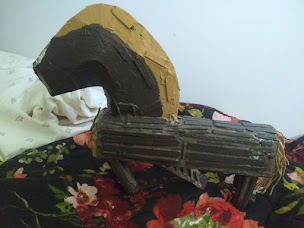
A personal example is the manner in which my family lived. Things like bookshelves most families would buy. But my family would look for leftover pieces of wood and use it to construct an entirely new bookshelf. Or instead of going to Michael’s to buy the box with the supplies to assemble the models for school projects like the Trojan Horse, my father would build it with us from scratch. I didn’t understand it then, but he was trying to instill these values of resourcefulness in us. He wanted us to find pride in doing the work ourselves instead of purchasing already completed projects from crafts stores like the other kids. It wasn’t because we couldn’t go out and buy one, but instead my family was trying to instill in me the pride of being able to use my own hands to build instead of going out to spend. I realized the importance of being proud, not ashamed of the way I grew up.


Tuesday, October 12, 2021

Calderon, Juliana: Abstract on Ruth Leonela Buentello

“Ruth Leonela Buentello.” Joan Mitchell Foundation, www.joanmitchellfoundation.org/ruth-leonela-buentello.

In              In this artwork publication, it is explained that the artist and philanthropist, Joan Mitchell, created the Joan Mitchell Foundation with the intent to give notoriety to up and coming artists. One of these artists who was given a spotlight through the foundation was Ruth Leonela Buentello. According to the foundation page, Ruth Leonela Buentello graduated from the University of Chicago with an Art’s degree and has presented some of her work in local art exhibits. The showcasing of her artwork inspired her own desire to create her own foundation called Mas Rudas, with the intent to focus on Chicana perspectives. Like the Joan Mitchell Foundation, Ruth aims to give voice to the often overlooked individuals through her artwork.


Buentello, Ruth Leonela, et al. “ARTISTS’ STATEMENT: Más Rudas: To Be Tough, to Be Defiant, and Without Apology.” Chicana/Latina Studies, vol. 11, no. 2, Mujeres Activas en Letras y Cambio Social (MALCS), 2012, pp. 8–13, http://www.jstor.org/stable/23345339.


                 In this journal article, the Chicana artists and authors, Ruth Leonela Buentello, Sara Castillo, Kristen Gamez, and Mari Hernandez, describe what the organization Mas Rudas is and its purpose. The authors express that the name derived from the idea of distinguishing themselves as women who were noncompliant with the typical role women had been forced to accept. The conditions of being both women and part of the Chicano group, created the conditions for them to design art that illustrated their experiences as both. Like the women before them who were their inspiration, these women look forward to telling the stories of their cultures.


“Entre Fronteras Memory Migration Maps - Getcreativesanantonio.com: The Cultural Calendar for the City of San Antonio, Texas.” Getcreativesanantonio.com, events.getcreativesanantonio.com/public-art/entre-fronteras-memory-migration-maps/.

                    In this publication, the City of San Antonio Department of Arts and Culture, described the artpiece of Ruth Leonela Buentello. The specific entry in the spotlight was titled, Entre Fronteras. According to the publication, the art depicts the struggle that Latinx families endure while immigrating to new lands. The existence of such illustration provides audiences the visual of Buentello’s backstory and her family’s journey. Through this art, Buentello aims to highlight the traumatic tale she shares with so many south Texans. In presenting the three generations of women, she asserts the progress made through each generation of the women after arriving in the United States.


Sunday, October 10, 2021

Calderon, Juliana (Week 3: Virgen de Guadalupe)

     Growing up in LA, I heard about the Virgin Mary and knew her association with Catholicism. I, having grown up Christian, knew of the background concerning her. From what I read I knew the angel Gabriel had appeared to a young woman named Mary before she had any relation with Joseph, the man she was betrothed to. She was told that she was going to have the child that she should name “Jesus,” Who would be the Son of God. I know she was very present in that part of the Bible, as well as when Jesus is at the cross. Additionally, she went on to have children other than Jesus, so she did not stay a virgin forever, though the term virgin continues to be attached to her name.

Apart from a few select passages, there is not a lot of mention of her. She is known solely for her role as giving birth to Jesus, but I think the focus is more on Jesus, rather than her. Because of the very limited information provided concerning Mary, I was always confused as to why people in the community I grew up in celebrated her. I wanted to know why they celebrated her but the few I asked did not have a strong understanding of why they did so.

I know that the Virgen de Guadalupe stems from the Virgin Mary and is a vision of her that appeared in Mexico to an Aztec. In addition to religion, she is also used in nationalism, specifically when her image was represented during the Mexican Civil Wars.


I also briefly remember a friend watching the “Virgen de Guadalupe,” a show where the character in dilemma would pray to the Virgin and their issues would be resolved accompanied by a rose somewhere. But it always struck me as odd as to why they didn’t just pray to Jesus or God the Father. I am interested in learning about the significance of the Virgin and her role in Chicano culture as well as the beginnings of her incorporation in this movement.


Thursday, September 23, 2021

Wednesday, September 22, 2021

Calderon, Juliana

 Hello everyone!

My name is Juliana Calderon and my preferred pronouns are she/her. I am of Spanish and Mexican descent. I was born and raised in Inglewood, California. 

I am a fourth year Political Science major, with an emphasis in American Politics. After having changed majors four times from STEM to non STEM, I can finally rest assured knowing that I feel comfortable having settled with Poli Sci.

Additionally, I have been on a pre med track with the goal to apply to medical school. I am pursuing a career in medicine in order to help establish a greater presence of minority women in the health field. Sometimes seeing a familiar face or identity in the hospital is enough to set someone at ease and that is what I would like to do.

 I am a first generation college student, my parents having started but not completed college back in the day. I am so excited to graduate this upcoming Spring!


I am taking this course because as someone of Spanish descent, it does interest me to learn of the culture of Mexican Americans before me and the struggles they went through while balancing two identities. 

In regards to the reading on women artists by Nochlin, I felt it resonated very much with our present age. Many times we, or society in general, will question why there are no great women in art as mentioned in the text. However, by raising this question, we add to the problem. There were and are great women artists. But by judging and using the patriarchal and binary standards, we will never find a woman who society deems as “great.”

I look forward to learning about the different Chicana artists in past and modern day society. Additionally, I would like to see their real influence in society and how to make their presence more visible.