Showing posts with label 2021FMadrigalStephanie. Show all posts

Saturday, December 4, 2021

Madrigal, Stephanie (Extra Credit: The Cheech @ RAM Exhibition)

 This extra credit assignment gave me the opportunity to learn about artist Sonya Fe and even hear from Sonya Fe herself with the Son Cuatro: In Conversation podcast. One of Sonya Fe's most notable work is La llorona which were 6 panels where she told the whole story of how La llorona came to be. She has been complimented on her ability to vividly tell a story visually and the viewer is not simply expected to know who la llorona is and why she killed her children. Sonya Fe talked about how she has been told before to not let her work be political, the issue is that her work includes standing up for her community such as when she made a black and white mural to protest against putting the children at the border in cages. Fe refuses to let herself be silenced so in an effort to make it seem like the mural was not a political piece she called it chickens and children do not belong in cages. Fe does not shy away from making statements through her work about present day issues at the border.  Fe makes a powerful statement when addressing why it is Chicana artist who make art to standup for the community. She says, "Women give life, all children are their children", this too is the reason why she has made numerous projects to shed light on the children being put into cages, and brought on over by coyotes and then separated from their families where they are put into detention centers with horrible living conditions. She has been told before that her d drawings and paintings look like they were done by different people, but Fe believes that of course her work will look distinct because different materials are meant to give a different effect. Fe prioritizes the public having access to her art over being interested with solely making profits. I think it is also important to note how Fe does not speak Spanish but is learning, I think this can be used against her by the public because there are some individuals who think that if a person does not speak Spanish then they are not a true Chicana/o. Despite the fact that some feel she is not a true chicana, she still advocates for the children at the border more than other artist who are considered "real" chicanos just because they speak Spanish. 


Sunday, November 28, 2021

Madrigal, Stephanie (Week 10)

 This course has been amazing in introducing me to many Chicana artists and it is a shame many of them are not widely recognized. One of the artists we learned about was Carmen Lomas Garza, I enjoyed her art because it reflects many Chicanx experiences such as family gatherings in Tamalada. Garza explores family dynamics and also shines a spotlight on the role of spirituality in many Chicanx lives. For instance, the practice of limpias, although religion and church are important they are separated from spirituality which sometimes is looked down upon. I liked seeing these practices being highlighted because there are times where our beliefs are not understood by others who do not have a similar upbringing, I never thought I would see a piece of art that included the depiction of Chicanx spiritual practices. Last week I enjoyed learning about artist Paloma Montoya, presented by Kim Lepe. Montoya grew up in the city of South Gate, I found this interesting because I am from a neighboring city and I love seeing individuals from my community succeeding and doing what they love. Her art is inspired by graffiti and street art which is why she works in predominantly working-class chicanx communities. Many of her art pieces show the importance of vulnerability and talk about prioritizing mental health to combat issues like depression. In her piece, seeing red, Montoya explains how it is a personal piece that she made to express what it was like growing up with her anger. She felt ashamed and acknowledged she would express herself through anger. It was difficult for her and her aggressive nature would also cause her to have depression. But now as an adult, she has been figuring out how to balance these emotions and uses her anger through her artwork to defend herself and others. Her art shows us that is completely normal to have these types of emotions and that there is not a singular way to get rid of these emotions, but rather learn to channel emotions like anger and use them to bring positive change. Another amazing piece by Montoya is, I've lost my head before, here she touches upon how she was dealing with depression and suicidally idealization. The piece shows a wolf that is tall and half human half demon, showing this small part of her that she will always have, this wolf part of her. Montoya finds it important to not keep this wolf bottled up and this is important for viewers who may relate to these experiences, they are able to see they are not alone and find healthy ways to keep these feelings and thoughts from being bottled up. 


Monday, November 22, 2021

Madrigal, Stephanie (Week 9)

 The artist I chose to write about this week is Sand One presented by Mara Higuera. Mara talked about the interview sand one had with perolike where she talked about how she grew up with a single mother and began making her art in east Los Angeles. She felt like there was a backlash from the Chicanx community especially since she did not attend college and is self-taught she began to feel a lack of respect. Sand one's art caters to single mothers, strippers, and in general women who go through hardships. Sand one has faced many tribulations throughout her career including racism and classism as a Chicana artist. It was interesting to find out how every doll has a story behind them because they are representations of women that she has met. She even gives the dolls a horoscope sign, for example, her work Doll represents girls that have daddy issues, is 22 years old, and her horoscope sign is a Capricorn. It is clear that for Sand one, it is not just about creating the art to generate profits but rather putting in the thought and creating a story for each of her pieces. Another art piece discussed by Mara includes a teddy bear and Sand one mentioned she includes bears because she likes to think that boys are toys. Sand one finds it important for her art to convey the message to her audience that it is important for women to focus on themselves and that women are in control of themselves and their sexuality. The Carlsbad baby mural shows the importance of giving back to the community to Sand one and how she likes to connect with her supporters because while she was completing the work she held conversations with everyone who stopped by. It was upsetting to learn about how she faced theft of her art because they took advantage that she is a first-generation artist and did not know much about how to take legal action.  But with the help of fans, one fan helped her locate her work, and another fan of hers who is a lawyer helped her legally get her art back. It is inspiring to see a first-generation Chicana artist get to have such a big platform and still want to give back to the community and inspire so many women through her art.  I am looking forward to seeing one of her murals in person. 


Monday, November 15, 2021

Madrigal, Stephanie (Week 8)

 One presentation I enjoyed learning about was by Ana De La Rosa on artist Nancy Pili Hernandez. Hernandez is a social justice muralist and she is most famous for participating in hanging the "resist" banner in front of the white house. Nancy and six other green peace protestors were arrested and two weeks after the city gave her an award which goes to show how absurd it was for protestors to be arrested and then awarded for their work. Prior to this presentation, I did not know that this had occurred, and I think it takes great courage to be willing to make such a statement and know that there will be legal consequences. One work I enjoyed learning about was her anti-eviction work, they painted on "Not for sale, families live here" and there were handprints as well to show how many lives were going to be affected if the eviction happened. The tenants had nowhere to go and we learn that the real estate company had taken advantage of the older woman who was the homeowner because she did not have the capacity to make the decision to sell her property. However, they still lost the battle in court because it was ruled nothing could be done because the paperwork had already been signed. Hernandez's work shows us that art is multifaceted and can be utilized for activism to foster change in our communities. I liked learning about how Hernandez believes that creating a mural together is a form of community which is why she does not like to create murals on her own. It is clear that for Hernandez fostering community is pivotal and art can be used as a common ground to form lifelong connections. I am looking forward to learning more about social justice muralists like Hernandez and will definitely be looking into muralists like such in my community.      


Thursday, November 11, 2021

Madrigal, Stephanie (Extra Credit: Manifesto Armado)

 This is the first webinar I have ever attended and it was a very fun and interesting experience, especially since it was held in Spanish. I learned about La Revuelta, a group of women working from Central America creating space and community. I got to hear from the founders of La Revuelta, Jimena Galan Dary and Renata Alvarez and watch the performance Mujeres Armadas which happened almost a year ago. The performance called on feminist women where they encourage us to bring a cutting arm to whatever we would like to destroy, a racial cut, collective of armed women. They begin to talk directly to riotters, fighters and how they are coming together on Friday, November the 13th closed in their homes for the last 8 months.They state, "poetry is not a luxury, love and be armed because the revolution will be feminist and will happen" because our bodies are weapons we will use now. I like how they mentioned that although art and meditation may not solve the problem we can make our voices heard. Even more powerfully, they state that although they will not deliberately use arms, disterbance is the language of those who are not listened to. Their overall message addressed what we want to cut today, that no matter the time, cutting is also a process to bring growth and we must cut to grow a better tomorrow for all women. This is why during the performance we see the women handling knives and cutting items. I also enjoyed Renata and Jimena's powerpoint presentation about how history of art narrarated and protagonized by men is not the true history of art, this is why we must bring a revolution and write this history ourselves in order to be included. They explain what is La Revuelta, which are spaces to tell stories of art and establish dialogues of art where women are able to be represented in the art world. Mujeres Armadas began with four women looking for spaces during the pandemic to share dialogue, they had to figure out how to do performances on zoom but this also gave them the ability to share across social media platforms like facebook. They explained how there was no space for women to enter in the art world so they decided to create it. Out of something like the pandemic, valuable connections were able to be formed, these women did not know each other in person and were able to connect via the internet to creat space and share dialogue. Having this space is vital because we have our own experiences and so do other people, so it is important to talk to one another and share our stories about our art because there is not a single narrative and avoid speaking for others in the diaspora.  


Monday, November 8, 2021

Madrigal, Stephanie (Week 7: Claudia Zapata)

     Zapata writes about the impact of digital platforms and the ability to digitize art. Chicanx artists have used digital art to engage with audiences and form solidarity to advocate for improving education, protesting injustice, and cultural self-reflection. I agree with Zapata when she stresses the importance of recognizing that the definition of Chicanx graphics is not fixed but rather will continue to expand as artists utilize different technology like augmented reality, and virtual reality. As we have technological advances, Chicanx art will also expand to utilize these spaces to share their art for advocacy. In Figure 5 (Zapata 140), we see the work of Rini Templeton, Tax the Corporations, I like how the image itself is simple but yet very powerful and gets its message across clearly. I think it incites action equal to that of a work that may be considered to be more intricate, by using outlines of the protestors it seems to give a message of this could be you out here protesting, we get to put the face to the outline. Another digital image included is by Oree Originol, Justice for Aiyana Jones, where we are able to learn more about the importance of having digital images like such for social movements. Oree Originol created artwork that allows us all to stand in solidarity with efforts to end state violence against the black community and demand justice for victims like Aiyana Jones. Originol produced his social justice project, Justice for our Lives, which are black and white digital portraits of each victim which are downloadable. Having work like that of Originol makes it easily accessible for members of the community to print out the portrait and make posters, stickers, post on social media, and more. It is easier to start the conversation about systemic oppression and state-sanctioned violence towards the black community. It is important to have digital art like such because it brings engagement and acknowledges victims. We learn their names, and they are not just another name added to the list of black individuals who lost their lives. Having Aiyana Jones's image on the poster makes the audience think that Jones was someone's daughter, sister, niece and we would want people to advocate for our loved ones if something like this happened to them. We are able to put a face to the name and ensure that she will not be forgotten and we will not rest until we get justice for Jones who was shot by a SWAT team member who raided her family's home. It is clear that embracing technological advancements and digital media is important because we can use it to produce a commentary on social issues, and support the different movements to bring permanent change in the oppressive systems toward BIPOC.      


   Fig. 7: Justice for Aiyana Jones 

(Zapata 142) 


Figure 5: Tax the Corporations 

(Zapata 140)  

Monday, November 1, 2021

Madrigal, Stephanie (Week 6: Xandra Ibarra)

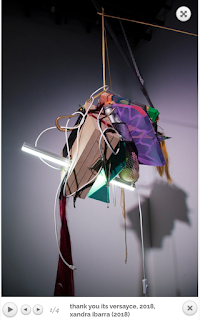
     Xandra Ibarra's work is very unique and captivating, she addresses topics that typically go unspoken of due to society labeling individuals and their work as deviant, for example, sex workers.  A work that quickly caught my eye was, Thank you, It's Versayce (2018), she was able to put together common items used by sex workers to make a statement on the expression of sex and sexuality. I like how she includes the list of the items she uses in her work, it makes the reader do a double-take and look closely at the different pieces. In photographing these items, she is essentially photographing a stripper without having to include their bodies that are sexualized by society. There is a vast stigma on sex work, I think Xandra Ibarra allows viewers to see this work through another lens, it is like we are backstage looking at everything these workers need to be able to provide for themselves. Like Ibarra's work, the stripper's work is a form of art as well, they are dancing and putting on a performance, the only issue is that this art is highly stigmatized. When I first saw image 1, I was very confused and thought to myself what exactly is this, so I went back to read the description and I was able to appreciate the placement of the variety of items as well as the use of the light to create those shadows almost as if we were in a club where the spotlight would be on the stripper only know the focus is on the objects. I also enjoyed seeing the close-up of the pleaser heels in image 2 because it shows the variety and how these workers put in the time to plan out these intricate outfits, they truly are artists. A question I have in regards to this specific work is how did she gain access to these different items? What made her choose to use the fluorescent rube light? A general question I have for Xandra Ibarra is, have you had any backlash on your art? If so, how do you deal with it and not let it impact your motivation to produce more work and continue to challenge highly stigmatized lines of work like sex work?     


   Image 1 


                                                     Image 2 

Monday, October 25, 2021

Madrigal, Stephanie (Wikipedia Draft: Crystal Galindo)


Crystal Galindo (1983 – present) is a visual artist whose paintings are known for celebrating Chicanas and indigenous communities. Her paintings give a strong sense of pride in being part of the Chicanx community and she is recognized for having bright colors, being body inclusive, specializing in portraits, as well as venturing into painting sacred icons like Selena. 

Biography 

Crystal Galindo was born and raised in Tulare County and is now living in the San Francisco Bay area. Growing up she developed a passion for art, she began making art with pens and colored pencils but upon entering community college she learned to use charcoal, watercolor, and oil paints. The decision to pursue the arts came after watching her parents give up theirs to provide for her and her siblings. Galindo graduated from the College of the Sequoias in 2009 and then pursued a double major in painting and Chicano Studies at the Sonoma State University where she graduated in 2013. 

Art  (or Notable Works or Selected Works. Also Exhibitions, Projects, Collections)

  • Plantitas (2021) 

This series features portraits of women of color with floral elements to represent the energy of mother nature and how these women are goddesses too with their unique ethnic features. 


A picture containing text

Description automatically generated

  • Dulceria (2016)

In “Dulceria”, Galindo addresses the issue of society making women feel guilty for indulging in things like sweets and even physical pleasure. Overall, Galindo wants her viewers to know they should not feel guilty for indulging in anything that makes them feel good despite any taboo in the community and society. 


A picture containing text, decorated

Description automatically generated
  • Multifacetica (2013) 

In the series “Multifacetica” Galindo paints women who represent power, strength, and pride in their cultural roots. Galindo features different shapes, symbols, and sacred symbols alongside the different women to inspire us to share our stories and break away from white supremacy by embracing our ethnic roots and how we are a physical representation of our ancestor’s resilience.  


A person wearing a colorful headdress

Description automatically generated with low confidence

References

  1. Calderón, Barbara. “Meet Crystal Galindo, the Painter Centering Chicanas, Chingonas, and Cholas.” Remezcla, Remezcla, 4 May 2016, remezcla.com/features/culture/crystal-galindo-painter-chicanas/.

Abstract: 

In this interview done by the media company Remezcla, we learn about Galindos' take on selfies and how they are an act of resistance by combating the idea of only Eurocentric ideals being beautiful. Galindos' work exhibits body positivity and celebrates women who challenge beauty ideals, which is why she features Chicanas, Chingonas, and Cholas who typically are not represented in media nor art. 

  1. Galindo, Crystal. "Crystal Galindo." Diálogo, vol. 20 no. 2, 2017, p. 32-166. Project MUSEdoi:10.1353/dlg.2017.0044.

Abstract: 

In this article published by the University of Texas Press, Project Muse, we see a few of Crystal Galindo's art pieces and learn more about her background. Galindo was born in Tulare, California, and made the decision to pursue the arts after watching her parents give up theirs to provide for her and her siblings. She began making art with pens and colored pencils but upon entering community college she learned to use charcoal, watercolor, and oil paints. Her artwork challenges white supremacy, Eurocentric beauty standards, and the male-dominated art world by showcasing women of different sizes and races.   

  1.  ARTnews, The Editors of. “'Crystal Galindo' at Studio Grand, Oakland.” ARTnews.com, ARTnews.com, 18 Nov. 2019, www.artnews.com/art-news/news/crystal-galindo-at-studio-grand-3988/.

Abstract: 

On the website ArtNews, we learn more about the exhibition put together by Studio Grand in Oakland. In this exhibition Crystal Galindo's work "Fotos y Recuerdos" was showcased, this collection of paintings features indigenous and Chicanx elements to depict the diversity behind these resilient Chicana women. On specific piece featured is "I'm not your Puppet", this acrylic and colored pencil piece shows a fierce woman with Chola style.       


Further reading

External links 

  • https://www.crystalgalindo.com/

    • This is Crystal Galindo’s personal website where she shares more about what her work focuses on, exhibits a galleria of her work, flyers of her previous exhibitions, and has her contact information for those who may be interested in commissioning a painting from her. 

  • https://www.pbs.org/video/byyou-art-culture-crystal-galindo-art-exhibit/

    • This is a PBS mini-documentary on Crystal Galindo’s solo art show “Multifacetica: Un Cambio De Paradigma” which was on display at the College of Sequoias Art gallery throughout February 27, 2014, in Visalia California where she celebrates Chicanas through self-portrait paintings. 

  • https://www.taftcollege.edu/echo-online/blog/2017/04/03/crystal-galindo-art-of-self-portrait/

    • Taft College newsletter provides an interview with Crystal Galindo where we learn about Galindo’s use of social media as a platform for her artworks which she hopes inspires others to embrace who they are and finally see representation Galindo mentions was missing when she was growing up. Through her artwork, Galindo builds up not only her won confidence but that of the Chicana community. 


Sunday, October 24, 2021

Madrigal, Stephanie (Week 5)


Carmen Lomas Garza's image Curandera, 1977 represents the overlap of spirituality with catholicism many Chicanos experience. The curandera is performing the cleanse with ruda in the home where there are visible catholic elements such as the cross and the small altar for the Virgen De San Juan De Los Lagos in the back on the wall. Healers are a big part of the community and highly respected because many of us in the Chicano community are firm believers in the need to cleanse one's energy. I think it is also important to note the presence of Carmen, and her mother while Mary Jane is getting the cleanse done. The presence of multiple different generations shows the importance of passing down these beliefs from one generation to another. I personally find it interesting that they were allowed by Dona Maria to sit and watch the cleanse being done because I have been taught that one must never be in the same room while such a ritual is being done because you may pick up on the bad energies that the person getting the cleanse done is getting rid of. I think many of our parents do not realize these practices are part of spirituality, this is just something they learned from their parents and continue to believe in. Seeing this image reminds me of how many parents are always looking out for their children and providing protection for them in any way possible. For instance, many of us have grown up wearing red bracelets for protection and el Ojo to protect us from the effects of mal de Ojo (evil eye). This starts at a young age, babies are given a red Ojo bracelet within a few weeks of birth to prevent guests who come over to look at the baby from unintentionally giving the baby mal de ojo. When the baby abruptly gets sick or will not stop crying and the mothers do not know what to do, it is usually an elder in the family that suggests they cleanse the baby with an egg because it is likely the baby is suffering from the evil eye. This continues on through an individual life, whenever facing adversities and tribulations many of us turn to spirituality and decide to get a cleanse. It is interesting to see how there are different ways a cleanse can be performed and with different things such as the ruda plant or the egg. Carmen Lomas Garza gives spirituality in the Chicano community recognition, I personally never thought an artwork depicting such an integral part of the culture was acknowledged especially since there are some individuals who look down on such practices. But this is what Carmen Lomas Garza was trying to combat by showing the bridge between these spiritual practices and catholicism, a person believing in cleansing negative energies has no effect on how much of a catholic devotee they are because they are two separate things that we treat with equal importance. I have learned how it is pivotal to learn more about the meaning behind these practices and consult with the elders in the community because there are times it seems like many of these different beliefs may not be practiced by youth so we fear this intellectual inheritance may be forgotten. Many of our parents may not be able to provide material inheritance, but they do pass on our important cultural and spiritual practices which makes us richer than any sum of money can ever do so.            

Monday, October 18, 2021

Madrigal, Stephanie (Week 4)

     Rasquachismo refers to an attitude or taste that does not follow societal norms. The attitude of rasquachismo includes being resourceful and adaptable but still in a stylish way. To be rasquache indicated that this person may be from the barrio, which is why many Chicanos that are emerging to the middle class avoid any trace of being rasquache because they want to leave behind the barrio lifestyle and move up social standings. Rasquachismo has been a part of my life without me realizing it, in terms of recycling due to limited resources. Containers of sour cream and butter were reused by my grandmother to store leftover food like beans, rice, salsa. It was always known that when reaching for a certain item like butter, one ran the chance of opening up the container and finding something completely different. Most famously, is reusing the Christmas cookie tins to put in sewing supplies. Another element of rasquachismo is being flamboyant and preferring bright colors, this reminded me of the homes back in Mexico. I have always noticed that homes in Mexico are painted bright colors meanwhile here in the United States homes tend to be painted in subtle colors. As a matter of fact, my family home back in Mexico is a very bright blue color and I use to complain to my father why he refused to use a neutral color and even my mother would tell him the use of different colors on the house made it look all "chilaquil", the same term used in the Chicano community when someone wears multiple colors in their outfit. Someone, usually an adult will say "Dios Mio, pareces chilaquil". But now I am able to connect this to rasquachismo and I have a deeper appreciation for these small things that to others may seem as funky or even "chunti". I think it is important to realize that participating in rasquachismo may not be for everyone and not just anyone can ignore outside influences and critiques especially since nowadays what most people want is simply to fit in and make the effort to not stand out and call attention which makes the individual prone to criticism. It is inspiring to see how the Chicano community resilience which results in learning to be resourceful, has a proper term, rasquachismo. But it is a shame that there are times where our resourcefulness can be looked down upon and seen as Ghetto until another ethnic group makes it trendy and part of their aesthetic.  

Reusing Christmas cookie tin for Sewing supplies 


  Colorful homes in Mexico 

Wednesday, October 13, 2021

Madrigal, Stephanie (Abstract on Crystal Galindo)

 Source 1: 

Calderón, Barbara. “Meet Crystal Galindo, the Painter Centering Chicanas, Chingonas, and Cholas.” Remezcla, Remezcla, 4 May 2016, remezcla.com/features/culture/crystal-galindo-painter-chicanas/.

Abstract: 

In this interview done by the media company Remezcla, we learn about Galindos' take on selfies and how they are an act of resistance by combating the idea of only eurocentric ideals being beautiful. Galindos' work exhibits body positivity and celebrates women who challenge beauty ideals, which is why she features Chicanas, Chingonas, and Cholas who typically are not represented in media nor art. 

Source 2: 

Galindo, Crystal. "Crystal Galindo." Diálogo, vol. 20 no. 2, 2017, p. 32-166. Project MUSEdoi:10.1353/dlg.2017.0044.

Abstract: 

In this article published by the University of Texas Press, Project Muse, we see a few of Crystal Galindo's art pieces and learn more about her background. Galindo was born in Visalia, California, and made the decision to pursue the arts after watching her parents give up theirs to provide for her and her siblings. She began making art with pens and colored pencils but upon entering community college she learned to use charcoal, watercolor, and oil paints. Her artwork challenges white supremacy, eurocentric beauty standards, and the male-dominated art world by showcasing women of different sizes and races.   

Source 3: 

ARTnews, The Editors of. “'Crystal Galindo' at Studio Grand, Oakland.” ARTnews.com, ARTnews.com, 18 Nov. 2019, www.artnews.com/art-news/news/crystal-galindo-at-studio-grand-3988/.

Abstract: 

On the website ArtNews, we learn more about the exhibition put together by Studio Grand in Oakland. In this exhibition Crystal Galindo's work "Fotos y Recuerdos" was showcased, this collection of paintings features indigenous and Chicanx elements to depict the diversity behind these resilient Chicana women. On specific piece featured is "I'm not your Puppet", this acrylic and color pencil piece shows a fierce woman with Chola style.       

Saturday, October 9, 2021

Madrigal, Stephanie (Week 3)

     La Virgen De Guadalupe is an important part of my household, but especially for me because she keeps me connected to my roots. My family has never been very big on religion so we were not the type of people to consistently attend church every weekend, rather my parents taught me right from wrong so I do not depend on religion to give me an understanding of that. Even though attending church was never a big part of my life, my family and I have always acknowledged el dia de la Virgen de Guadalupe. I do not consider myself religious but la Virgen de Guadalupe has always been an important figure to me, I have always had jewelry with her image on it and wear a necklace with her on it every day. I love being able to watch las mananitas for la Virgen de Guadalupe when they broadcast it on TV, and I hope to be able to experience this in real life in the basilica in Mexico City. A very clear memory I have is my grandparent's house back in Mexico where we have an altar for her, there my grandparents always have a candle for her and fresh flowers. When I am able to visit, I always make sure to buy a bouquet of fresh flowers to place on the altar upon my arrival and give thanks for my safe arrival to the homelands. Back home in Los Angeles, my family and I like to visit her image in el Mercado de Los Angeles, especially on her day when the entire community gathers to bring her candles and flowers. It is beautiful to see the community gather and share space. 

    At a young age, I have always heard stories from my mothers' friends, some of whom are firmly devoted to her because she helped them through a rough patch in their life or they claim she performed a miracle after they asked for her help with something. I like hearing these stories because it gives insight into why she has been such an important part of Chicano culture. I personally feel more connected to my Mexican identity especially since I am not religious and I know for lots of people in my community attending church regularly is essential. There were times where I felt a bit out of place because I could not relate with that feeling of consistently going to church being a main part of life. I never found church to be important because I realized at a young age that it was always the family members who were not the greatest people to others and consistently gossiping about other peoples misfortunes who attend church regularly. I found it rather paradoxical, so I preferred to not surround myself with such energy and just practice my faith at home, as long as I know I am a good person what others in my family think about me not attending church does not bother me. But I am happy I was able to find common ground in relation to the importance of honoring la Virgen de Guadalupe. I personally love to support artisans and their craft and I was able to get a crystal Virgen de Guadalupe shipped out to me made by artisans in Mexico city. I found it to be the perfect addition to my apartment now that I am living on my own and do not have access to the Virgen de Guadalupe my parents have back home. 


Friday, September 24, 2021

Wednesday, September 22, 2021

Madrigal, Stephanie

Hi everyone! My name is Stephanie Madrigal, I am a first-generation student and my pronouns are she/her. I am a third-year Sociology major and a double minor in Chicanx & Central American Studies, and Entrepreneurship. I am a film enthusiast, love reading, astrology, and music as well; I cannot go a day without listening to music. 

 I took my first Chicano course my first year at UCLA during the fall quarter and I absolutely enjoyed the material, it was the first time I was learning more about my community and self. I found a space in which I felt welcomed on campus. The Chicano studies department gave me a sense of familiarity and I loved being able to take classes where there were students from a similar background and also eager to learn about Chicano studies. I felt at home and so I decided to take on a Chicanx studies minor. I decided to take this course because I am interested in learning about Chicana art and artist. Typically art courses focus on non-ethnic artists and focus on highlighting men, this course does the complete opposite and I simply could not pass on the opportunity. I hope to learn more about how art itself is timeless and can be shared across different spaces and times. As well as how we can support Chicana artists and share their work with Chicano youth so they too can see art as a reachable outlet for expression and do not allow themselves to be silenced. I enjoyed this week's reading by Nochlin, "Why have there been no great women artist". I find it interesting that art produced by women is treated differently from that of men and that it is being spoken about openly. This is not the typical reading where we are told the work of male artists simply stood out more and therefore we should only care for the male experience their art portrays.