Showing posts with label 2021FPlayasNayeli. Show all posts

Wednesday, November 24, 2021

Playas, Nayeli (Week 10 Presentations)

 The artist that stood out to me the most this week was Britnet Garibay. Britney Garibay is a painter and she is using her art to make a difference. Garibay is an 18-year-old first generation Mexican American who was raised in Jacksonville, Florida. Britney Garibay studied at the Douglas Anderson school of the arts and she is currently studying at Rhode Island School of the Art and Design.  

A lot of her pieces caught my attention and they all had an interesting story behind them. The one that stood out to me the most was “Wait for Me.” Garibay was inspired to do this painting after her stepfather was deported when she was in 8th grade. I can’t even imagine the pain she was going through after hearing such news. As a Mexican-American with immigrant parents, it has always been and it will always be my greatest fear to have my parents deported. Therefore, this painting caught my attention. I think it is a beautiful painting although it has a sad story to it. Garibay was there to witness the entire thing when her stepfather was deported. Garibay pushed herself away from her culture and she was trying to fit in with the rest of the people from the country she was residing in. It is quite common for the younger population to push away their own culture to fit in but Garibay was able to take complete control of her identity and culture. 


I enjoyed learning more about Garibay because she is inspirational and I relate to a lot of the things she mentions. She mentioned that a lot of first generation students carry a huge weight on their shoulders trying to make their parents proud because they sacrificed so much by leaving their home country. A lot of my accomplishments were motivated by the sacrifices my parents made. I want to show them that I am grateful for what they have done for their family by taking advantage of all the opportunities they never had. Overall, I really enjoyed hearing more about Britney Garibay. 

Wait for me': Teen's experience inspires beautiful paintings, honors  heritage

Friday, November 19, 2021

Playas, Nayeli (Week 9)

An artist that I enjoyed learning about was Irene Perez presented by Hannah Cornejo. Irene Perez is a muralist from Oakland, California and she is a member of the group Las Mujeres Muralistas.


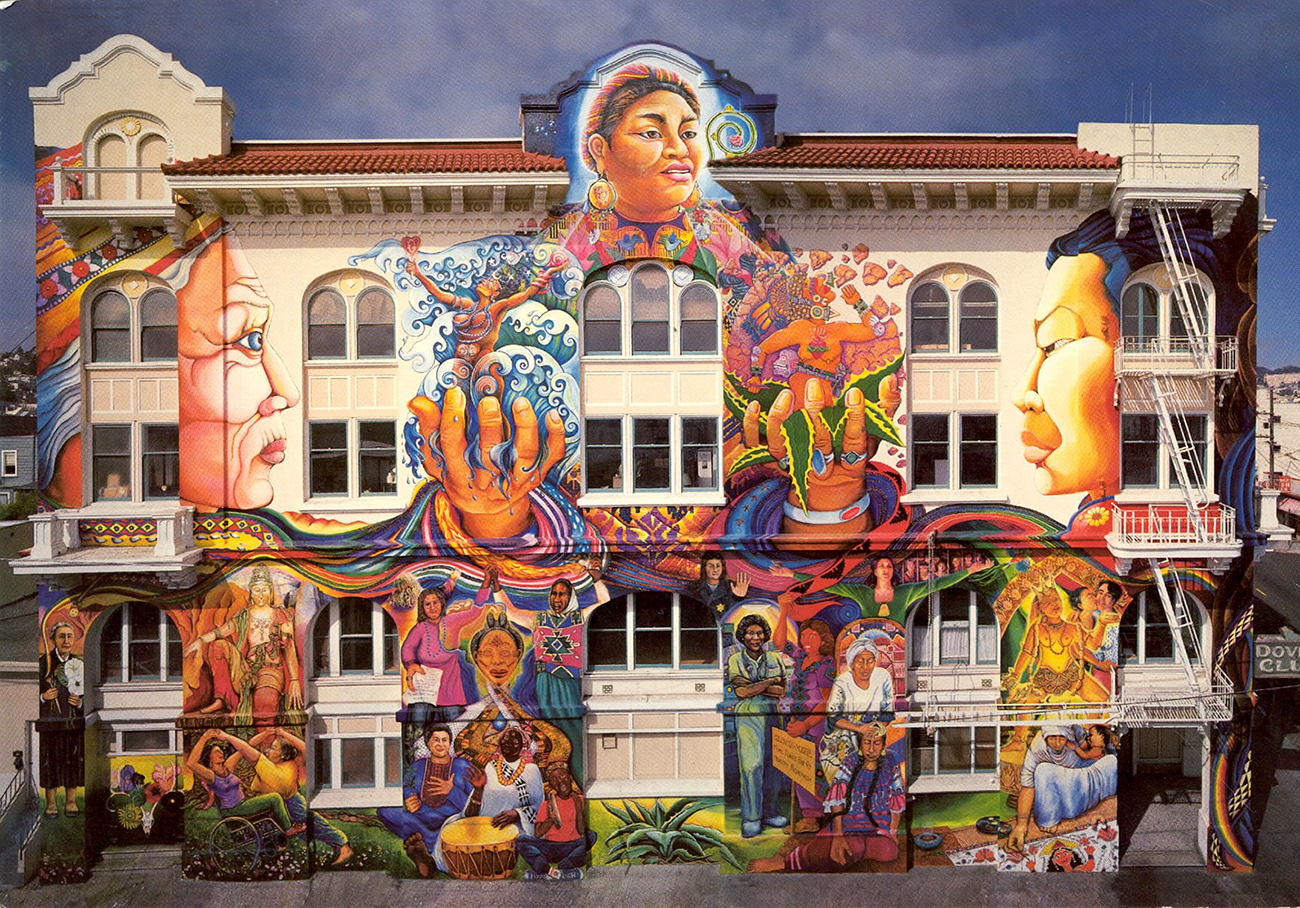
Las Mujeres Muralistas is a group of all female mural artists based in the area of San Francisco. The majority of their work is in the mission district in San Francisco and their most recognized project is Maestra Peace.This piece was started in 1993 and it is on the side of the San Francisco mission Women’s Building. This art piece features a lot of images of important Chicana women including Rigoberta Menchu who is a Nobel Peace Prize winner. This piece features other influential women like Hana Ashrawi, Lolita Lebron, and Georgia O’Keefe. The mural also features spiritual figures: Guanyin the East Asian Goddess, Yemayah, and the Aztec moon goddess. 


Another piece that caught my attention was 500 Years of Native Survival, and it was painted in 1972. This piece was described in the book Street Art San Francisco. 


The next mural that was presented was Panamerica. This piece was painted in 1974 and was in collaboration with the other members of Las Mujeres Muralistas. This piece was commissioned by the mission model cities initiative. This mural features a lot of characteristics that made a lot of their work revolutionary. They focused a lot on celebratory images of women and it shows women engaging in everyday activities such as cooking, cleaning, and taking care of kids. The idea behind the mural is to celebrate Chicana women spiritually, physically, and emotionally. While Irene and the other members of Las Mujeres Muralistas were working on this mural they experienced harassment and it shows how dedicated they were because they were able to finish the mural despite what they had to go through. 

The Mural - The Women's Building

Wednesday, November 10, 2021

Playas, Nayeli (Week 8)

This week, we had presentations on the artist that we chose to do our wikipedia presentation on. This week we focused on public art. There were a lot of great presentations that showcased a lot of great art pieces. Armando presented Brenda Barrios and she had a lot of art pieces that caught my attention. Brenda Barrios is a UCLA Art Student and is a Latinx artist and in 2018 she was hospitalized. When Brenda was hospitalized she realized that she wanted to continue her journey with art in higher education and she also wanted to be the voice for those with disabilities. Brenda would like to use her art as a tool to bring attention to minority groups and the issues they face. Brenda uses bold colors in her art pieces and the use of bold colors were inspired by her Mexican heritage. She has been published in several articles and she is known for her murals. Her work has been displayed in hospital buildings as well as other buildings around Los Angeles. Armando, presented Medicare For All, Vaccines for the Community, and Essential Workers. Pay Them Hazard Pay. These three paintings are all mural sized. Brenda Barrios is a UCLA Art Student and is a Latinx artist. Medicare For All is an image that has traveled to places like London and in several other areas in the United States. Brenda’s mother is a part of this art piece and she is seen wearing a mask. Brenda is representing all the workers and people of color who don’t have the advantage of having coverage for medical facilities and treatment. Vaccines for the community, is promoting vaccines for everyone in the community, specifically San Bernardino because the residents were refusing to get the COVID vaccines. The last image, Essential Workers, was created to represent farm workers who worked during the fires. 

Brenda Barrios – Amplifier Community

Monday, November 8, 2021

Playas, Nayeli (Extra Credit: Manifesto Armado (Armed Manifesto))

This was the first webinar that I have joined and it was extremely interesting from the very beginning. At the beginning of the webinar, there was a performance being done by Mujeres Armadas. The performance was unique and it was something that I had never seen before. 


In the performance, there were four women who were all holding a weapon and speaking spanish. At the very beginning, I was confused as to why there were four women holding a knife, but then I learned that the purpose behind this performance was to show that women also have the power to hold a weapon that is seen as predominantly masculine. Possessing a weapon is considered by many as a way of demonstrating dominant masculinity. They go on to speak about how they have been denied things such as humor and vulgarity. They go on to describe that the weapons that they are holding allows them to bring out their anger and impotence in the face of so much massacre.Their body is the weapon that they have. In the webinar, the knife is a tool that helps cut through their personal insecurities. In the performance they are cutting bananas that have labels on them. They have words such as “urgente” (urgent), “silencio” (silence), “culpas” (fault), and “miedo” (fear). As they are showing the labels on the banana, someone else is saying “Quiero ser cuchillo” (I want to be a knife) over and over. 


In the webinar, they go on to describe what the revolt is. This group of women are looking for ways to make a name for themselves in the cultural, political, and social scene. The main goal of their revolt is to recover the spaces and voices that were silenced in history by using their art as a tool. 

Manifesto Armado (Armed Manifesto)

Wednesday, November 3, 2021

Playas, Nayeli (Week 7: Claudia Zapata)

In this essay by Claudia Zapata, she talks about Chicana/o artists in the digital age. I thought it was interesting how computer technologies and new media were used in efforts of getting a message across. Even though there were technological constraints, artists like Carrasco were still able to get their message across and they were able to increase exposure. While some artists viewed computer technology as an opportunity to spread awareness others viewed digital tools as commercial practice. For example, Rupert Garcia wasn’t a big fan of digital tools, but he has embraced technological change. Another Chicano artist who has used digital printmaking is Daniel Gonzalez. Gonzalez created a screenprint called Arte es Vida and it is a commemorative print for Day of the Dead. In his art piece he wanted to reflect the Mexican paper tradition of papel picado. Claudia Zapata also mentions virtual reality which is a simulated experience that can either be similar or completely different from the real world. Individuals like Nonny De la Peña use VR to promote awareness. In her 2017 project called Out of Exile: Daniel’s Story, De la Peña brings attention to problems that a gay individual may face in a religious household. Zapata mentioned that a lot of Chicanx artists share a lot of the same goals as printmakers of the early Chicano movement. Some of the goals include commenting on temporary issues, supporting social movements, and analyzing and reforming their own cultural identities. Overall, I found this essay interesting because a lot of artists are always on the move and are trying to find new ways of bringing awareness to certain issues to reveal injustices. Zapata did a great job in providing examples and talking about Chicana/o artists and their art and how they have adjusted and adapted to new technology. 

Friday, October 29, 2021

Playas, Nayeli (Week 6)

Xandra Ibarra, also know as La Chica Boom, is an interdisciplinary artist who works in photography, performance, videography, and sculpture. Ibarra uses her art and platform to "address abjection and joy and the borders between proper and improper racialized, gendered, and queer subjects." Her work has been featured in many museums, multiple magazines, and in books. One of her art pieces that stood out to me the most was the print, She's on the Rag. Ibarra had been collecting her menstrual emissions and she turned them into abstract shapes that viewers can interpret for themselves. It grabbed my attention because she used her own menstrual emissions to create these images. Also because the topic of menstruation has been considered a taboo topic because of cultural and religious beliefs. On her website, it mentions that Ibarra sold these prints online and offered a psychodynamic analysis through video to talk about what the images invoke in the reader. I watched the video and it was quite interesting to say the least. I was expecting Ibarra to explain her thought process in creating these prints and describing what it should make the viewer feel. Instead, the video is Ibarra’s analysis of a viewer's interpretation of a menstrual Rorschach-inspired print. The video displays images of menstrual emissions that have been turned into abstract shapes and there is a voiceover that is telling a story that is somehow related to the prints. I was a bit confused and did not see any correlation between the prints and the analysis. In the analysis it mentions things such as masturbation, flying, and never being able to fly. So, a question I have for Ibarra is, what is the meaning behind the analysis and how is it that this is the analysis behind She’s on the Rag.


Works Cited

“About.” Xandra Ibarra, www.xandraibarra.com/about/. 


Thursday, October 21, 2021

Playas, Nayeli (Blog 5: Carmen Lomaz Garza)

 Carmen Lomaz Garza is a Chicana artist that was born and raised in Kingsville, Texas. Her paintings not only show her memories, but they also show hope and tenacity. The painting that caught my attention the most was Cama para Sueños. Garza’s mother was very important to her, which is why she dedicated her Cama para Sueños. Her mother was an artistic role model to Garza because she would paint watercolors on the lottery tablets. In the painting Cama para Sueños, there are two girls on top of a house roof watching the moon, and in the house, there is a woman who appears to be fixing some pink bed sheets. According to Constance Cortez, the painting takes place on a summer evening in South Texas and the mother has no clue about her daughters’ whereabouts. In the painting, the mother is preparing the bed for a “night's slumber” (Cortez 1). This painting referenced two beds, although there is only one bed in the painting: “One is created by an act of parental love inside of the confines of the safe and light-filled home; the other is the shingle-clad roof on which the children gaze toward their future and its seemingly endless possibilities” (Cortez 1). I like this painting because it is something similar that I have experienced. On summer nights my friend and I would sit in her backyard watching the stars and moon while talking about what the future holds for us. Then I would go back home to a warm bed that my mother had prepared for me that day. It felt nice going back home knowing that there was someone who was there to take care of me. The parental love that I experienced from both of my parents helped give me hope for the future, for my future specifically because I knew that I would always have their support. Camas para Sueños | Smithsonian American Art Museum


Tuesday, October 19, 2021

Playas, Nayeli (Wiki Rough Draft)

 Lilian Wilson Grez (born 1953 in Valparaíso, Chile), is a Chicana artist and activist. She was featured in exhibits sponsored by art organizations such as La Peña and Women and their Work.


Biography (or Early Life and Education)


Early Life

Lilian Wilson was born in Chile in 1953 to Chilean parents. Her father worked as a merchant marine and he was in charge of supplies and menus. Wilson's mother was a housewife. She was raised in Valparaíso, Chile and they were a total of five children: two boys and three girls. 

Education

Liliana Wilson attended a nun French School called when she was younger and the catholic church and going to mass everyday helped impact her art. Wilson attended a University in Chile where she chose to study architecture because it allowed her to draw a lot. However, Wilson was not passionate about architecture and she decided to attend the Catholic University of Valparaiso, Chile to study law. She wanted to pursue a career as a judge, but once she started going to trial, she realized that she made another mistake once again.

Religion

Lilian Wilson grew up in a catholic household and it was pretty common for the people in Chile to be catholic. Later, Liliana no longer considered herself catholic, rather she considered herself Buddhist. 


Art  (or Notable Works or Selected Works. Also Exhibitions, Projects, Collections)


  • Maize Girl, Mixed Media on paper, 2010. This painting consists of a girl holding a basket of corn. This piece is meant to inspire hope because corn represents survival.

  • Niña en el Desierto, Acrylic on wood, 1998. The painting portrays a girl in a desert on her path to the United States.

  • El Calvario, Pencil on Paper, 2001. El Calvario, consists of a young girl who has a crown made of thorns hovering over her head with blood dripping over her head. This painting is meant to represent the women who would go missing in Mexico. 


References

  1. ^ Wilson, Liliana. “ARTIST’S STATEMENT: Images of Life: Witnessing Atrocities.” Chicana/Latina Studies, vol. 10, no. 2, Mujeres Activas en Letras y Cambio Social (MALCS), 2011, pp. 8–13, http://www.jstor.org/stable/23015147.

  2. ^ “Oral History Interview with Liliana Wilson, 2004.” Archives of American Art, Smithsonian Institution, www.aaa.si.edu/collections/interviews/oral-history-interview-liliana-wilson-1309

  3. ^ [citation to reliable source, print or e, goes here]

  4. ^ [citation to reliable source, print or e, goes here]


Further reading

External links


Saturday, October 16, 2021

Playas, Nayeli (Week 4)

Rasquachismo is defined as an attitude or a taste and it is generally an underdog perspective. Rasquachismo is associated with the working class and it means “leftover” or “of no value.” When it comes to taste being rasquache means that you prefer the elaborate over the simple. In rasquachismo high importance is placed on making what is do. According to Tomas Ybarrra, rasquachismo is, “An attitude rooted in resourcefulness and adaptability yet mindful of stance and style.” Rasquachismo has a negative connotation associated with it in the United States as well as in Mexico. It can be associated with vulgarity and having bad taste. In the city that I grew up in, it was common to see custom lowriders with the Virgin of Guadalupe painted on the sides of the car. I thought it was nice because I have always been into art and the Virgin of Guadalupe was extremely important to my family, but others would describe it as ghetto. Growing up my parents would always tell my siblings and I that “hacer rendir las cosas” was important and something we had to practice. My family, especially my dad has always been the type to recycle and create something new out of something that someone would consider trash. Growing up, I always wanted a doll house, and my dad bought one from a yard sale and he painted the entire thing and made something new out of it. One of my friends loves thrift shopping and she loves to add her own design to her clothes, so she paints on the jeans and makes them into unique pieces. My uncle, would make wallets or necklaces out of wrappers and it is something that a lot of Chicanas/os do. When rasquachismo is done by a female it is called domesticana. Before this week's reading I had no idea what rasquachismo was but it is very interesting to see how it has been a part of my life. 


Wednesday, October 13, 2021

Playas, Nayeli: Research Abstract for Liliana Wilson Grez

Gonzalez, Xelena. "The Art of Emotion: The Art of Liliana Wilson Grez Transforms the Esperanza into a Serene Temple of Thought." Current Aug 21 2002: 14. ProQuest. 12 Oct. 2021 .

    In this newspaper article, it describes how Liliana Wilson Grez transforms the Eperanza with her art. The images that helped transform this center, depict human reflection, hurting and healing. This articles goes into depth of some of her paintings that occupy the Esperanza Peace and Justice Center. It also describes some of the techniques that Wilson Grez uses in some of her pieces to focus our attention to the human soul and subconscious. The article also talks about some of Wilson Grez’s accomplishments as an artist. 

Cantú, Norma E., and Liliana Wilson. Ofrenda : Liliana Wilson’s Art of Dissidence and Dreams. Vol. First edition, Texas A&M University Press, 2014. EBSCOhost,search.ebscohost.com/login.aspx?direct=true&db=nlebk&AN=906711&site=ehost-live.

    This book was written by Lilian Wilson and it brings attention to injustices specifically towards Chilean artists. This book also has some biographical background and some of Wilson Grez’s work. Wilson Grez grew up in Chile and developed artistically during the 1970s and 1980s and a lot of her work was influenced by those couple of years. Wilson Grez was the third oldest child out of five kids and they were all very close. Wilson goes on to describe the relationship between her and her parents. In the book, it also mentions why Wilson Grez was drawn to the world of art. The book also offers a background on Chilean history and culture in order to fully understand the themes of Wilson Grez’s work. 

“Oral History Interview with Liliana Wilson, 2004.” Archives of American Art, Smithsonian Institution, www.aaa.si.edu/collections/interviews/oral-history-interview-liliana-wilson-13093. 

    In this interview, Liliana Wilson describes some of her paintings. Liliana Wilson is going through a slide of some of her painting and the interviewers is asking her about the meaning of the paintings that are being displayed in the slides. Liliana Wilson then goes on to talk about the stories and experiences that inspired some of her art pieces. In the interview Liliana Wilson also describes her career path and she explains why she decided to go to Law school. Overall, this interview talks about Liliana Wilson’s overall experience and how it influenced her art.


Friday, October 8, 2021

Playas, Nayeli (Week 3)

    Growing up, I was used to seeing the Virgin Mary around my house and family. My parents would buy my siblings and I Virgin Mary jewelry and it was something that we would never take off. In my parents room they had a picture frame of the Virgin Mary and it was decorated with lights and flowers. Every Sunday, my dad buys fresh new flowers for the virgin Mary and it’s been a routine ever since I can remember. Every December 12th, I grew up watching my parents wake up early to pay homage to the Virgin Mary. She was someone who I would look up to and respect very deeply from a young age. 

    Every time, my family was going through a rough patch, they would pray to the Virgin Mary. My dad didn’t always completely believe in the Virgin Mary but one time, my dad was having car issues and when he was on the freeway he lost control and in that moment he began to pray to the Virgin Mary. Ever since my dad has been a firm believer. I was moved by my dad’s experience with the Virgin Mary and I am a firm believer as well. 

    I grew up watching La Rose de Guadalupe, which is a show that consists of reenactments of real life stories. My mom and I would watch La Rosa de Guadalupe every afternoon and we would just discuss life lessons and the miracles of the virgin Mary. I still watch the show every once in a while and I always learn something new. I also grew up watching movies about the Virgin Mary’s story with my family. 

Being part of a catholic family, I grew up with the Virgin Mary being a part of our daily lives. Pictures and little Virgin statues were a part of our house. The Virgin Mary has been very influential and motivational and she will always be a part of my life. 


Thursday, September 23, 2021

Wednesday, September 22, 2021

Playas, Nayeli

 Hello! My name is Nayeli Playas. My pronouns are she/her. I simply go by Nayeli and I am a second year student here at UCLA. I am majoring in Nursing and I would like to obtain a minor in Chicana/o/x Studies. I would like to research Parkinson's disease at some point in my educational career because it is something that has affected my family. I am interested in this course because I would like to learn more about my background as a Chicana and I am interested in learning more about art because it has always grabbed my attention. I think that it would be empowering to see the art behind women with a similar background as mine. 

I am a first generation student and I come from a family of eight. I am the second oldest out of six children. I enjoy having a big family because it is never a boring day at my house. This summer, my family and I got to spend a lot of quality time together and we celebrated the birth of my brother’s first child. I am excited for this year because it will be my first time being on campus and I am looking forward to meeting new people and being more involved in my school. 


One of the many things I found interesting about “Conditions for Producing Chicana Art” was how Jacinto Quirarte neglects to portray Chicana artists as important contributors to the field of art. I think it’s quite interesting how women in general have faced more obstacles when it comes to recognition. As a chicana I agree that Mexican culture is male oriented and dominated. It makes me happy when I see Chicanas making great accomplishments and seeing them get the recognition that they deserve. I am looking forward to learning more about art and about the women behind the masterpieces.