Showing posts with label 2018DeLaCruzCynthia. Show all posts
Showing posts with label 2018DeLaCruzCynthia. Show all posts
Thursday, June 7, 2018
Week 10 Reflection
When i first enrolled in this class, I really didn't know what to expect. I was mostly excited because I noticed we needed a sketchbook for this class, I hadn't drawn in a long time and really missed it so i figured this would be the best way to actually make time for it, even if it was for a grade. I was exited to learn about Chicana artists because I know so little of them and all that ever came to mind prior to this class was Frida Kahlo. In retrospect I came into this class thinking we'd be learning more about the older artists, their techniques, and their impact in political movements.
I was pleasantly surprised when I realized we'd be learning about both the old and the new, and more so the lesser known artist, especially if anyone is like me and has no real knowledge of Chicana artists.
I truly enjoyed coming to this class and basically having two hours set aside to lose myself in sketching while learning about all these incredible artists that have truly left a handprint on the art world and the Chicana movement.
I learned that artists today are still trying to make themselves heard, to break boundaries, and truly change the way Chicanas are seen. I feel a lot more proud of being Chicana knowing that in this day in age, we will make people listen through our work and our art.
I'm a little sad that I only JUST discovered this class in my last quarter at UCLA but I'm glad I at least got to be a part of it while I still had access to a course like this. In the future I plan to continue learning more about the Chicana movement, maybe doing more research in how I can also make some sort of mark, or just get to learn more about artists like the ones I was introduced to in this class.
Being in this class and being surrounded by so many Chicanx students i got a strong vibe of camaraderie that I rarely saw in my four years at UCLA and it truly felt like a safe space. There was a lot of support and passion that I could sense from a lot of my classmates and it only made me want to be as interested in these dialogues.

Presentations pt. 2: Harmonia Rosales

Harmonia Rosales's "The Creation of God" is one that particularly stood out to me in the presentations. I have always been drawn to Michaelangelo's The Creation of Adam because its always been seen as this iconic image where God gives Adam the breath of life. Seeing it now, expressed by Rosales with women of color has produces a new intrigue for me.
I like to think of the outrage this would've caused if it were painted in the same period Michealangelo created his piece, and I think "good". As an afro-latina artist, Rosales is telling her story, the creation of her people, of her god, the way she sees it, and it isn't the traditional man majority of the world would imagine.
I really like this peace because she's expressing the creation as a product of this earth, while the older woman is indeed creating this woman in her image and thus creating humanity, Rosales still ties in the roots, this woman is literally being made from the land she sits on. I think this is very essential to the cultural background of what it is to be afro-latina, more so because of the historical context than anything.
I felt this image was powerful, and definitely a new perspective of humanity, because women of color lack representation, this image allows the reimagination of a different humanity one that is physically different from the traditional sense.
Monday, May 21, 2018
Presentation: Kim Bjanes
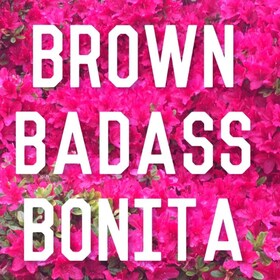
The presentation that has stood out to me thus far was on Kim Bjanes. Her print work and statement pieces are made for the modern feminist. More than anything what I liked from the get go about Bjanes's work is that she uses phrases that would otherwise be seen as negative stereotypes and turns them into empowering wearable pieces. Relatable, and witty, Bjanes has created pieces to fit even the smallest feminist. Following the presentation, I looked more into her work and found her Etsy store where she sells shirts, stickers, and prints of all kinds of phrases like "Brown, Badass, Bonita", "Greñuda", "Me Vale", and more. These stood out to me the most, and I was almost tempted into buying one of each because A. I'm all for empowerment, B. i grew up being called greñuda as well because of my curly and often knotted hair, and C. because "Me Vale" is one of those coming of age Rock en Español songs that will make anyone want to be a carefree person doing their own thing. I really liked that there is someone out there making art that girls like me can wear and be proud of, and in all sincerity claim to be able to relate to it. Most of all the first thing that comes to mind when i think of Bjanes's work is "rebelde", because girls in this day and age are only just starting to realize they are allowed to speak up, to not conform to status quos, and to be proud of who they are and how they think, and Bjanes celebrates these ideas through her work.
Monday, May 14, 2018
Judith Baca - Seeing Through Others' Eyes

Though not discussed in the book, Seeing Through Others' Eyes, 2010, is the final image shown in Indych-Lopez's book. This digital mural, one of Baca's more recent works, is an attribute to Robert F Kennedy here in Los Angeles. This piece is located at the New RFK Community School library, which was formerly the Ambassador Hotel located next to where Kennedy was assassinated in 1968.
The image is of a lotus in which each petal is supposed to represent a social issue Kennedy felt was truly important ranging from healthcare, to war, to education and poverty. This mural along with another titled Tiny Ripples of Hope were designed to be representative of the hopes Robert Kennedy had for the progress of our state and nation, which included equality, and a better way of life. The style used in these murals sticks to the style of many of Judith Baca's other murals, very deliberate blending of several issues in one big picture while incorporating the landscape to express the impact any social movements have had on the nations landscape.
This image stood out to me because of the focal point being drawn to what appears to be Kennedy and Cesar Chavez sharing what seems like "the golden ticket", meaning sharing the same ideas of equality and quality of life. The aim of this mural was not only to remember great figures of our community but also to remind us and generations to come of the values we continue to seek in our lives while still remembering the events of the past.
Monday, May 7, 2018
Carmen Lomas Garza - Curandera

I chose Curandera, 1977, because it stood out to me as a classic Mexican mom or Grandma thing that virtually any person of Hispanic heritage has either experienced, witnessed, or heard of. What many outside of the culture only see or hear of in movies or through the grapevine is something that is at the center of many Latino traditions, either Limpias, sanaciones, or a straight up sacando el chamuco, Curanderas are a typical go to for help in household problems. this piece, like many of Lomas Garza's works can be considered "relatable" whether it be the curandera, la tamalada, loteria, a quince, or a very regular family get together in the back yard, many of her vibrant pieces depict moments in everyday life that virtually any viewer can connect with.
Curandera is a piece that is comical to me because its a depiction of her sister getting a limpia for having a "difficult adolescence" which i personally believe is something every adolescent has gone through, sand limpia. It definitely made me think that was the only thing left for my mom to do when I was experiencing a "difficult adolescence" or now that my sister is entering that phase. A lot of her work as, I've read other posts, has definitely given others that sense of relatableness or nostalgia which I think was part of Lomas Garza's goal through her art, making her personal experiences feel like your own.
Tuesday, May 1, 2018
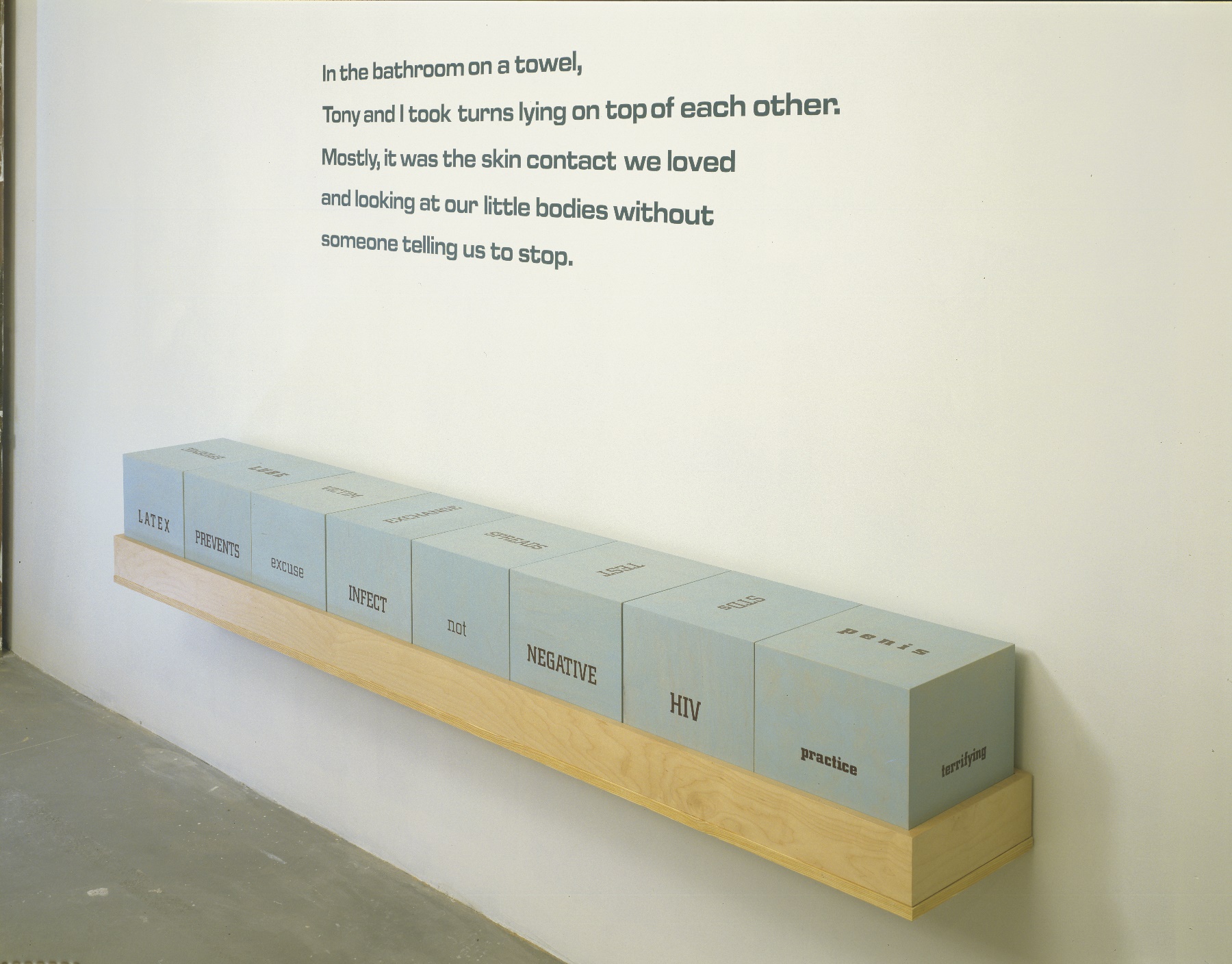
Celia Álvarez Muñoz: A Brand New Ball Game
Monday, April 23, 2018
Alicia Gaspar de Alba & CARA
The chapter on the CARA exhibition really delved into the reality that is the lack of female representation not just in the arts but also in the Chicano movement. As mentioned in the chapter the CARA exhibition was a part of the Chicano movement to share with the communities nationwide the various Chicano and Chicana artists that exist and to exhibit their art as well as their identities via the art. However the imbalance between male and female artists was evident and brought forward the point that while chicanas are on the rise, they still have a long way to go and need all the support from their community to do so.
During Professor Gaspar de Alba’s lecture she reinforced this idea that female representation is still lacking even in the world of Chicanismo, a group in its own that has to fight for identification. When posing the question of feminism and who identifies as feminist I was truly surprised to hear some of the responses. Feminists and feminism is already an almost stigmatized concept and even more so, it appears, in the Chicano sense. I feel like the views expressed in class are almost reflective of society, it’s not that people aren’t feminists or pro Chicana but rather they almost fear the reactions of others for being supportive of chicanas, feminists and female artists.
Monday, April 16, 2018
Debra Blake Quote
“Chicana feminists adopt variable
strategies and subjectivities to negotiate the conundrums of their specific
existence, recognizing the multiple systems of power that affect them, recognizing
themselves and their experiences as transcultural and diverse” (Blake 83).
Through
writing, speaking, painting, or any form of expression, Chicana women are retelling
their narratives in ways that give women of discord such as themselves the spotlight.
The new reimagined versions of women of discourse have somehow given way for
women to not only speak up about mis-told histories but also allow them to
voice themselves on their personal stories of the hardships and abuses they as
individual women have faced in their lifetimes.
Chicana women as told by Blake recognize their experiences now more than ever as these diverse narratives that bring to attention the fact that for centuries, women have been more of a supporting role if at all in the history of Chicanx people. Now women of diverse sexuality, backgrounds, and origins find unique ways to tell their stories, their way using whatever modes of expression that are available to them. they are now seizing opportunities to rewrite their version of history from a perspective that places the Chicana experience at the forefront.
Monday, April 9, 2018
Presentation: Jeaneen Carlino

For my presentation I have selected Jeaneen Carlino an LA based artist and native. I chose her because, of all the artists on the list, her work called the most to me. Her paintings are so vibrant and all feature strong and mystical looking women. While looking through her portfolio I noticed a pattern throughout in which she featured a lot of "Aztec mythology" style themes for the way her female figures looked. The patterns and colors alone captured my attention, but looking more into the style in which she portrays these female figures brought this fantastical vibe that really called to me. In addition to that, she seems to always tie nature into her work too either through incorporating animals, plants, or a lot of earthy vibrant tones. Her warrior goddess theme gave me a strong sense of empowerment and overall strength which any Chicana should feel.
Jeaneen's work is representative of her life experiences while expressing her gratitude to mother nature.
Wednesday, April 4, 2018
De La Cruz, Cynthia (Cynthia)

The essays we had to read for today as well as the activity we did in class really put into perspective the reality that is the disproportionality or female artists to male artists. What made it even realer was the fact that from the women listed, I personally only recognized a handful. The essays on their own reflected on the issues that are that women aren’t given the same opportunities as men in many fields because they’ve traditionally been given the responsibility of the household and family. Through time women have been deemed as incapable of anything greater than maintaining a home and a family which is why women in are are so scarce as compared to the “great men” in art. The essays mention obstacles women face, commonly being their gender alone, their social status, economic status, and mere lack of exposure to art. Men have predominantly been taught the trade of art from their fathers and grandfathers and had been immersed into this world at young ages. But women, women have been limited to other tasks and been made “ordinary”, perceived as unable to produce great works of art like Picasso and Monet.
I found the essays to be very compelling and eye opening. Women have only just begun to make a scratch on the surface of the art world. With advances in technology and a new awakening, women are now finding their voices through many modes of media to express themselves and make themselves heard, that they truly are capable of “genius”.
Subscribe to:
Posts (Atom)