Showing posts with label 2018TorresCristal. Show all posts

Friday, June 8, 2018

Extra Credit: City and Cosmos: The Arts of Teotihuacan


The "City and Cosmos: The Arts of Teotihuacan " exhibition provides findings from Mexican national and international archaeological projects excavating at Teotihuacan's three main pyramids: the sun, the moon, and the feather serpent. As I look at all the amazing and beautiful relics of seashells, jewelry, paintings, and sculptors. One major artifact that stood out to me were the large Shell Trumpets in Tlalocan. The shells come from a species of marine snails that originated in the Gulf of Mexico. These trumpets are among the many of shells that contributed to making the Tlalucan tunnel. Each shell trumpet had an intricate symbol or illustration. For instance, one of the shells had a male wearing a feline headdress and holding a spear-thrower which may have represent a powerful warrior during that period. Each of the illustrations had a significance and meaning behind them. Additionally, it is believed that these shell trumpets were played by supplicants before depositing them in offerings. 
I thought these shells were amazing and really cool since they depict a part of indigenous history that has never been told or known. This exhibit had lots of cool findings that gave the audience a taste of indigenous history and ancient thought. It was enlightening to understand how their artworks relate to place, both above and below ground.  Every single detail and marking had a significance and a purpose. There was a large emphasis on duality which is very important to acknowledge. 

Unfortunately, this exhibit also reminded me of how many detailed and meaningful artifacts were destroyed and stolen due to the atrocities of colonization. Similar, to how LACMA is using these artifacts to make profit. When in reality, these findings rightfully belong to the indigenous population of Mexico City. This is upsetting since it reflects how a lot of indigenous traditions, practices, and history are lost, exploited, and forgotten due to colonialism. However, many of indigenous traditions strive today due to our ancestor's oral history, practices, and art. 

Wednesday, June 6, 2018

Extra Credit: The Black Experience Mural

"The Black Experience" Mural is a powerful mural located in Ackerman Union that illustrates the experience of the Black community during the 1970s.  I learned about this mural through my Censored! Art on Trial class taught by Professor Lopez last year. I learned that this mural was covered for 20 years due to the anti-blackness internalized in our school. This form of censorship  hides the crucial history and the experience that black folks endure in many institutions. I truly believe that the censorship of murals created by people of color is a form of ethnocide since it is destroying and restricting people of colors history from being displayed, published, or told. Censorship is a form of oppression  from white supremacy because it  suppresses valuable history and it is a way to keep people of color from acknowledging their history and continue to marginalize them. This mural is also a reminder of the "diversity" claimed within the school and how many of us black and brown folks continue to be marginalized in our school.

Moreover, the mural illustrates black history and the many atrocities, inequities, and injustice the black community endured in the United States. Unfortunately, the black community today still suffer from these inequities due to the systematic racism and oppression that is embedded in our society. The part of the mural that stood out to me was the one that illustrated the black children incarcerated. This is still relevant today since black and brown children are hypercriminalized and brutally abused and harassed by the police. The criminalization of black children is a significant problem in the United States. This problem is addressed through The Black Lives Matter Movement which fights against police brutality in our society. Therefore, murals like these are needed in order to remind a community about their own history and how their experience is significant needs to be acknowledge. These murals are a reminder that social change is a process and it continues to be practiced throughout generations. Ultimately, this mural reflects the many untold and told stories of the black experience and educated others of their experience and the inequities they have and continue to endure.

Class Reflection

Throughout the course, I learned the power of art and how it can be utilized to express political, cultural, and social issues. Specifically, I learned about many Chicana/Latina artists and how their art is able to preserves history, speak about prevalent issues, and provide an authentic representation of their identity and culture. Their artwork is significant because they challenge hegemonic ideals and promote innovative social change. For instance, Laura Aguilar is a queer Chicana artists who uses her art to explore her queer Chicana identity and celebrate thick bodies. Additionally, Ana Mendieta's artwork addresses gender violence and rape culture. Likewise, Lili Bernard artwork reflects her trauma she endured due to rape and expresses her black Latinx identity. All these artists and many more Chicana and Latina artists are activists and used their creativity and talent to address social issues that continue to be prominent today. This knowledge gained from this course is very valuable and should be taught in multiple institutions because these artists deserve recognition and appraisal for their innovative works.

I found myself more aware about Chicana art and the major impact their artwork has within the community. It is refreshing to know that many of these prolific artists use their work to help their community and relate to their audience. Additionally, this class influenced me to draw more and be more connected to my artistic side and create work that expresses my identity. I want to thank Professor Lopez for being able to provide a creative space for her students to channel their inner artistic-self . Thank you and I highly appreciate the knowledge gained!

Friday, May 25, 2018

Week 8 Presentations: Harmonia Rosales


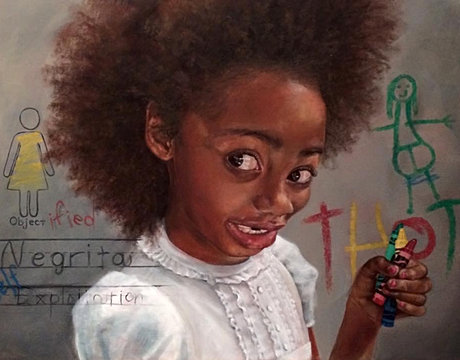
Image result for harmonia rosalesIn this weeks presentations, the artist that stood out to me was Harmonia Rosales. Harmonia Rosales is a Afro-Cuban artist who uses her artistic skills and creativity to empower her black culture and identity while also challenging whiteness.  I really felt that her art was very empowering and beautiful since it challenges and portrays prevalent issues that are present in society. Specifically, the way young black girls are hypersexualized, discriminated, and objectified due to their color of their skin. The painting T.H.OT., showcases the adultification and exploitation of young black girls. It portrays a powerful message to viewers. In particular, the way many black girls experience sexual harassment and interpersonal violence in schools because young black girls are often stereotyped to be  less "innocent", and deemed overly aggressive compared to their white peers. This painting displays the social, racial, and gender issues that continue to be prevalent due to the embedded racism and inequality ingrained in our institutions. Therefore, this painting effectively communicates a discussion about how black women endure oppression and maltreatment at a young age.  Additionally, I admire the fact that Rosales utilizes her platform to represent Afro-Latinas who are often marginalized and questioned in the Latinx culture (which is another issue that needs to be discussed).  Rosales captivates her viewers by representing black women and reinventing and deconstructing many classical euro-centric artwork. Thus, she is able to use her talent into empowering her own identity and challenging hegemony. 

Sunday, May 20, 2018

Week 7: Presentations on Carolyn Castaño

I enjoyed learning about the Colombian visual artist, Carolyn Castaño. I learned that her she challenges social and environmental issues through her art. The image that really stood out to me was Drug Lord, Lover, Confidante, 2009. It stood out to me because I enjoy watching the Netflix series, Narcos, where I learned about the story of Pablo Escobar and his relationship with Valeria Velez. I really like this painting because it displays both the artist's interest on social and environmental issues. The painting consists of many endangered plant species which show her interest in the environment. Additionally, She portrays both individuals in a very comic book character-like style which reminds me of a Bonnie and Clyde movie. The artwork really challenges the way many male-dominated narratives are passed down in history and often marginalizing and excluding women from the narrative. Therefore, the artist brings light to the women involved in significant historical events. Even though, if the history is not very pleasant.  For instance, in this art work she is showing how both Pablo Escobar and Valeria Velez were part of or connected to the narco business. In other words, Castaño wants to showcase how women often play a vital role in significant moments of history. She wants to reconfigure history by providing the whole authentic narrative through her art. To put differently, she expresses how there are two sides to every story told. Her work also reveals that these women should be acknowledged no matter the circumstances because they are significant and an important part of history. Therefore, I really admire her artworks because she showcases the untold stories of many women.

Monday, May 14, 2018

Carmen Lomas Garza: Cakewalk


Image result for cakewalk carmen lomas garzaCarmen Lomas Garza is known for creating positive images of her family and community combating racism. In particular, Cakewalk (1987) showcases the community fundraising for their children to obtain higher education. The painting is made of acrylic in a 36 x 48-inch canvas, and it consists of many dynamic brown figures actively participating in a cakewalk. The figures include many members and children of the community either participating in the actual cake walk or managing the whole event, from distributing the cakes to providing music. In fact, Garza’s parents are illustrated actively involved in the event, suggesting their critical roles in the organization. Additionally, the painting includes Garza as a child drawing on the floor with a twig. Cortez further explains that Garza’s parents were members of the American GI Forum, which consisted of many Mexican Americans fighting together for equality to ensure a good future for the youth (Cortez, 8). This art piece is significant since it displays the upbringing of the artist and her family’s active participation and engagement in community events. Moreover, it depicts the social consciousness and awareness of her community and their involvement in social change. It conserves the Chicano identity by representing the collective memory of the community. The painting represents the unity and culture of the Mexican American community through her own experiences as a child. She is able to provide story-like illustrations that form a connection between many Chicanx individuals. Therefore, her painting is able to authentically depict a social movement in a positive manner. 

Sunday, May 6, 2018

Astrid Hadad

Astrid Hadad is a Mexican Feminist artist who is known for her elaborated costumes and performances influenced by her Mexican culture and feminist identity. Her shows follow the format of cabaret, in which she engages her audience to understand her cultural processing. Through her performances and costumes, she critics the Mexican machismo, corruption, and violence against women. Her outfits are very story telling-like and she utilizes a lot of Mexican iconography to reconfigure their meaning and  challenge cultural norms pertaining gender. Her work represents her identity and Mexican culture while also addressing many political and historical issues.
One of my favorite works is shown on the left is from her live performance called Tierra Misteriosa in which she tells the story of Mexico from pre-Columbian to present. The performance is filled with many detailed beautiful costumes. Specifically, the costume shown on the left  exhibits the truth behind all the riches that were taken from Mexico. The front of the costume displays beauty and riches, whereas, the inside of her costume reveals the exploitation of the indigenous people during the conquest. Her costume symbolizes and represents all the atrocities and theft of the indigenous people that that occurred during the conquest. It shows how a nation was built on genocide and slavery. Moreover, this costume challenges colonialism and the way history is told. The work showcases the truth behind all the lies. She also addresses the oppression that continues to persist due to colonialism. Therefore, Hadad uses her work to make powerful statements and engage her audience to challenge hegemony.

Sunday, April 29, 2018

Celia Alvarez Muñoz


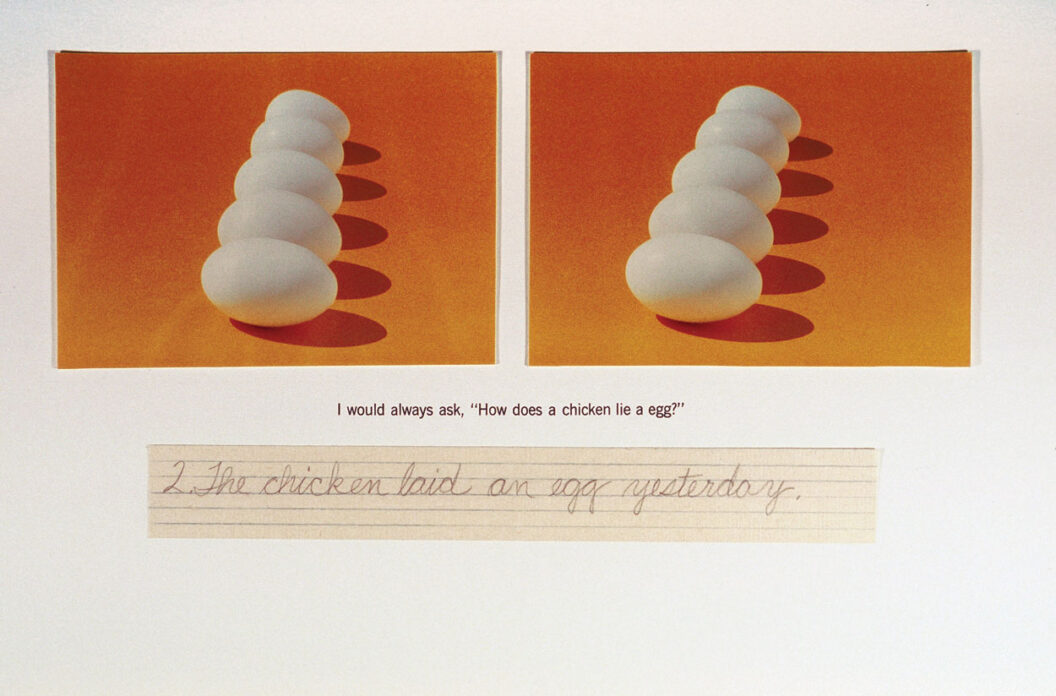
Image result for celia alvarez munozCelia Alvarez Muñoz is known for including her innuendo skills in many of her great artworks. Specifically, in her Enlightenment series artist’s books created in the 1980s, consists of themes that include: childhood memory, socio-cultural issues, linguistic clashes, and moral views. For instance, Enlightenment #4: Which Came First? (1982) showcases the socio-cultural challenges of learning English as a Chicanx student, a child’s curiosity of reproduction, and how the truth can be revealed through its distortions. The art piece is composed of five 12x20 color photographs depicting five eggs in a single row with a yolk color backdrop. The perspective of each photograph steadily changes and consist of a text below of an anonymous narrative and a child’s handwriting. This art work is significant because it shows how language can be a form of misrecognition and conflict and it explores the mind of a child who is growing up in a school system that was never created for them. Additionally, the artwork may reflect how the dominant culture enforces false ideologies and white-wash history during a child’s development. The artwork insinuates how the oppressors try to confine the existence of the child’s cultural identity through language. Tejada further explains that Alvarez Muñoz alludes and contests the way dominant society shames and punishes Mexican-American youth’s bi-cultural identity and linguistic skills. He discusses that the artist attempts to portray how language use reflects social history (Tejada, 46). In other words, the artist represents the way language is utilized to fabricate rules and restrictions. It is meant to marginalize individuals who do not fit the status quo. Thus, Alvarez Muñoz Enlightment #4 leaves the viewer to question their existence and use of language.

Sunday, April 22, 2018

CARA's Politics of Representation

347002In the article, Professor Gaspar de Alba discusses and critics the CARA exhibition's lack of inclusivity of Chicana artists. Gaspar de Alba explains the gender disparity and problematic female representation exhibited at CARA. For instance, she illustrates that many of the females portrayed by Chicanos are either depicted as mothers or as mistresses which objectify Chicana women to a constrain role or identity. This is interesting because I believe these expectations are still practiced in the Chicanx community. Unfortunately, women are seen as inferior due to the patriarchy and machismo embedded in society. Gaspar de Alba also discusses in lecture how CARA was created to preserve, represent, and maintain the Chicano/a experience. She specifically stated that it was "art for the people" which meant it was supposed to represent everyone in the most inclusive way possible. However, that was not the case since it represented only a few Chicana artists paintings and the rest were demeaning and hypersexualized Chicana women. This is upsetting since I believe that most male artist do depict women as objects and stereotype them either as mothers or whores. Chicana artists are historically underrepresented and their art work is always viewed lesser to the Chicano artists due to hegemony. However, many Chicana artists depict the reality of the Chicana experience and criticize and question the heterosexist Chicano narrative. Moreover, Professor Gaspar de Alba defines and distinguishes the difference between  politics of identity and identity of politics. She emphasizes how the politics of identity are the way an individual defines themselves. She then raised a very interesting question on who identifies as "Feminist" and unsurprisingly mostly women raised their hand and men did not. She then explains that many people misinterpret the meaning of feminism. It is stereotyped to be a "hating men" movement, when that is not the case.  Gaspar de Alba goes into depth explaining how a man can also identify as a feminist if he has shares the same beliefs as feminists. Similar, to being a queer ally any individual may be a feminist ally. It is not surprising to me that many people misinterpret the feminism movement because historically feminism was centered on the upper-middle class white women. Therefore, women of color and queer women did not relate to the initial movement and were in fact marginalized by the movement. Interestingly, many Chicana artists in CARA did not identify themselves as feminist because they believed it was not constructed for them. However, throughout the years feminism has taken account of the intersectionality of women of color and become more inclusive. Therefore, it is interesting to understand that many of these terms have been dismantled and reconstructed by people of color to fit into a more inclusive identity.

Sunday, April 15, 2018

Debra Blake's Chicana Sexuality and Gender


“By emphasizing that the consequence of ‘‘disloyalty’’ is eternal condemnation or isolation, the legends are used to socialize women into traditional roles, control their conduct, and define what constitutes Mexican femininity. The message conveyed is that independent women are dangerous and treacherous” (Blake, 49).
In Chapter 1, “The Power of Representation: History, Memory, and the Cultural Refiguring of La Malinche’s Lineage” explains the way the Malinche and La Llorona are negatively portrayed throughout history. Blake describes that the Malinche and La Llorona are illustrated to be malicious and bad archetypes for women due to having rebellious and independent characteristics. For instance, “By emphasizing that the consequence of ‘‘disloyalty’’ is eternal condemnation or isolation, the legends are used to socialize women into traditional roles, control their conduct, and define what constitutes Mexican femininity. The message conveyed is that independent women are dangerous and treacherous” (Blake, 49). In other words, the stories depict them as evil beings due to their resistive non-conforming behavior. These female figures challenge the traditional gender roles and go against hegemony and patriarchal ideals. This is significant since it implies that women are powerful when they are not confined by gender norms. Consequently, these stories are socially constructed to control and restrict women from challenging traditional norms. However, Chicanas refigure and reinterpret their legends to empower and take ownership of these stigmatize figures. For example, Gloria Anzaldua, a Chicana writer, depicts La Llorona as a caring and helpful role model to children instead of the traditional villainous character. Therefore, Chicanas taking control of their stories are able to represent, connect, and preserve many of these culturally significant figures that are historically marginalized. 

Thursday, April 5, 2018

Presentation: Sonia Romero

Image result for sonia romero macarthur park
MacArthur Park, Urban Oasis, 2010
After looking at the many influential inspiring Chicana/Latina artist list, Sonia Romero, a printmaking artist and muralist who work is all over Los Angeles, really caught my attention. The reason it did is because I never realized how much of her murals are all over Los Angeles and I past by them everyday.  I appreciate her art because in every work she captures the culture of Los Angeles, specifically, the Chicanx and Latinx culture of Los Angeles. Her work showcases the many experiences, symbols, and beauty of Chicanx culture. Therefore, I really connect with her artwork and would love to learn more about her Chicana artist experience.

Sonia Romero is a Chicana Artist based on Los Angeles. She is the granddaughter of the Founders of Craft and Folk Art Museum and daughter of artists, Frank and Nancy Romero. Therefore, she comes from a very artistic family background. She graduated form Los Angeles County High School for Arts and then pursued her Bachelor Degree in Fine Arts at Rhode Island School of Design where she learned printmaking. As a result, her art career sparked and she became highly regarded and known for her printmaking background and murals.

Sonia Romero's art reflects the life and diverse culture of Los Angeles. She emphasizes on the Latinx community  and she addresses contemporary issues through her art. She believes her printmaking art works can mass communicate the many issues that are present in Los Angeles. Her designs are inspiring and give a representation of the Latinx community in Los Angeles. Thus, I am really excited to discover more of her art and how it impacts the community.

Tuesday, April 3, 2018

Torres, Cristal

Hey Folks! My name is Cristal Torres and my preferred pronouns are she/her/hers. I am a second generation Chicana from South Los Angeles. I am currently a senior studying Psychobiology with a minor in Chicano/a Studies. My interest in Chicano/a studies began sophomore year when I took Chicano/a 10A where I finally learned the actual history of my community that I was never taught before since LAUSD continues to only teach white-wash history. Therefore, I quickly enrolled to multiple Chicano/a courses and pursued my minor. Through these courses, I gained knowledge of the way many marginalized Latinx communities are systematically oppressed on the daily. Nevertheless, these courses continue to remind me that our existence is a form of resilience. 
I enrolled in this course because I enjoyed Professor Lopez previous course Chicanx M136, Censored! Art on Trial, where I learned the various forms of censorship that occurs in the art industry. I also learned that many marginalized artists are able to communicate their experience and challenge hegemonic ideologies through their art, but are highly vulnerable of being censored. Therefore, I learned the significance of representation. Through this course, I hope to practice my creative and artistic skills. Furthermore, I hope to learn about the history and the upbringing of Chicana Art and become more knowledgeable about Chicana Artists. Likewise, I hope to connect with their art and understand how it relates to the Chicanx experience.
In the reading, "Why have there been no great women artists?" by Linda Nochlin describes the great discrepancy between male and female artists in the art industry. She goes into great detail explaining that the art industry is highly European male dominated which makes it harder for and/or prohibits women to pursue a career in art. She emphasizes how many women were restricted to a stagnant role and endured many limitations that included lack of education and resources due to males holding the power of what is considered art and who gets to produce it. Unfortunately, this European ideology is still normalized today through various institutions. For instance, many schools do not teach youth about the few successful women artists in the 1500s challenging their traditional role, but do teach youth the history of many highly regarded male artists. Likewise, in society, many artists of color are also not taught in schools, specifically artists who are women of color. This just shows that women of color have more obstacles to face and are constantly marginalized in the art world. Nevertheless, they continue to challenge and influence other artists through their art. Therefore, I believe it is important for women artists to become more visible and discussed in mainstream society. However, we must start by changing the narrative/system of who controls art and become more inclusive.