Showing posts with label 2021FAvilaAndrew. Show all posts

Tuesday, December 7, 2021

Avila Andrew

 For this week’s post I wanted to focus on fellow classmate Tadeo Spencer, and the artist he introduced to the class, Joanna Toruno. Joanna Toruno is a Salvadoran born, and community/self taught visual artist. She utilizes the ‘streets’ and other public spaces as a platform/gallery in which she displays and debuts her different artworks.Joanna has noted herself as being “inspired by the people that exist in public spaces. The  working class & immigrant Black & Brown communities are the beat of the heart of the streets”. She considers herself and her journey within art to be led by those who came before her, largely the ancestors, and elders from within her community. She believes, much like Nina Simone has stated, that the duty of an artist is to reflect the times. However, Toruno believes that its important to reflect the times and situations in which she finds herself in. 

Much of her art is influenced by being a product of displacement from Salvador at the age of ten. Growing up and witnessing the aftermath of the civil war in Salvador has not only influenced her sense and style of art, but also her identity as well. She has described her art as existing within the political public art sphere, but  also notes that she is not a voice for anyone, as no one is truly voiceless. Possibly hailing from her queer migrant lens, Toruno also believes in the possibility of reimagining new possibilities outside of the patriarchy (specifically, white cishetero) in which we can all collectively exist within our own set of truths and privileges. Joanna’s work seeks to inspire these notions for her viewers, by not only holding them in public spaces with readily available access, but also within the content of her work. 


Wednesday, December 1, 2021

Avila, Andrew

During my time within this course I have come to understand a number of different perspectives regarding ChicanX and LatinX art. As a young Chicano, Latino male I was seemingly unaware of the plight regarding Chicana art. More specifically, I was completely unaware of the many obstacles, challenges, and discrimination many Chicana artists face. To begin with, I was unaware that many Chicana artists face the amount of discrimination and endless amounts of unvalidation that they do. I was shocked to uncover the ways in which Chicana artists are made invisible. Perhaps the most eye opening work we discussed that centered on this topic, was the piece titled, “Why There Are No Chicana Artists”.  


On the other hand, it's genuinely hard to understand and relate to the plight of some of these artists. I think that is probably the most important thing I've learned and encountered in this course. As a Chicano/Latino artist I cant say I’ve ever really faced many types of discrimination in regards to my art, so it was chalenging to relate with issues regarding these forms of dicrimination. Additionally, I felt extremely removed from these types of scenarios because of the fact that I’ve never really encountered them on a personal level. That being said, it was almost shocking, surprising even to find out just how much discimintaion still exists today regarding Chicana art, and Chicana artists specifically. 


I think the best take away I’ve taken from this course is learning how to be an active listener and ally for those who experience these forms of oppression within our world of art. I find it to be an extreme honor to be able to conduct the activist work that will help elevate some of the Chicana/Latina artists who still face these forms of oppression. I just hope that my activist work does not end here within this course and within this quarter. I truly believe in the impact of the work that we are conducting, and I hope to incorporate that type of activist work throughout the rest of my career as an aspiring artist.


Tuesday, November 16, 2021

Avila, Andrew

 While there were many artists that stood out during last week's presentations, the artist that stood out to me the most was Armando Perez’s presentation of Brenda Barrios. A California native of Pasadena, Barrios’s work seeks to address specific social issues within her larger community. Her work has been known to center on topics such as: vaccination, voting rights, disability awareness, community support, and much more. 


During the CoVid 19 pandemic Barrios switched to a more general focus from her various other mediums, like painting and sewing, to a more general focus on digital art. Personally, I feel this was an important and influential move, as this not only seeks to address issues of safety, but also addresses issues of access for those within her larger community. Yet, this new digital era for Barrios has also allowed for access to her work over a wider range of communities. Her work has been shown in places such as New York, and even as far as the United Kingdom (specifically London). Within recent years, her work has been noticed by organizations like Amplifier which has helped provide Barrios a larger platform. 


One of her specific works I particularly like is a portrait of Alexandria Ocasio-Cortez, a New York Congress-woman for section 14; the Bronx and Queens. This particular work features Cortez seated on a chair gazing directly at the viewer. Cortez's hands rest gracefully in her lap, while they hold two calla-lilies. Overall the general work is very reminiscent of Frida Khalo, and the many of her self portraits in which she depicts herself seated, gazing directly at the viewer with her hands resting in the same position. Additionally Barrios’ use of color within this particular work is also reminiscent of Kahlo. Her use of bright colors in the back, and foreground contrasted by neutral colors that comprise the image of Cortez, not only attribute a sense of regalism to Cortez, but also evokes a sense of calm to the figure.  


Sunday, November 7, 2021

Avila, Andrew (Claudia Zapata, & Salam)

 In reading Claudia Zapata’s ChicanX Graphics in the Digital Age, a few assertions are made. First, Zapata asserts that ChicanX artists have “actively participated in each technological paradigm shift”, which in turn “lay the foundation for a new lens of ChicanX study”. What Zapata means by this, is that ChicanX artists have been at the forefront of each of the revolutions of artistic production; chief among these the digital revolution which began in the 1980’s. However, where some find fault with Zapata’s claim in that they exists as notions of erasure, she further asserts that ChicanX participation in the revolutions of artistic production largely exist as modes of offering “new visualizations of political resistance”. Zapata asserts that these new visualizations are based on the model that new ChicanX art forms are incorporated into new forms of art and representation and that “each new medium is never an addition to an old one, and instead never ceases to oppress the older medium until new shapes and positions are established for them”. In this way, Zapata asserts that ChicanX artists have existed at the forefront of each technological paradigm shift, and goes on to explain the means by which ChicanX artists in the digital age “define new visual practices to reveal injustice, [work to] create a more inclusive history of digital art, and expand the definition of graphic arts” for generations to come. 


While I found Zapata’s article informative, and relevant within the context of the digital age of graphic arts, there was one particular work that stood out to me. Xico Gonzalez’s collection of augmented reality portraits titled the Revoltosxs Series, specifically the individual portrait titled Salam, really stood out to me. The Revoltosxs Series, is a culmination of augmented reality portraits supported by HP’s Reveal app, which allows users to interact with these portraits on a multi-media interface. The app works by first allowing users to set up ‘trigger points’ or destinations in the physical world where the portraits are set up. From here, HP Reveal users are able to scan the portraits where they are met with a video narrative explaining the work, and its underlying contexts. Users are also able to view and interact with the artist’s individual profile. This is important because each artist's profile “spans the geographical” and includes a range of different activists and video narratives for users to interact with. Salam’s video narrative activist is Saeeda Islam (Mexican, Pakistani, Muslim activist), who discusses “how her multiple identities are under attack; the beauty of the Islamic faith, and her efforts to connect those around her by emphasizing Islam as a religion of love” in relation to Gonzalez’s portrait Salam. Other video narrative activists that can be found on the interface include Lakota leader Tatanka Iyotake (Sitting Bull), Marsha P. Johnson (transgender activist), and Filipino American labor activist Larry Itliong. 

Monday, November 1, 2021

Avila, Andrew (Xandra Ibarra/ La Chica Boom)

         Xandra Ibarra, perhaps better known as La Chica Boom, is an Oakland based ‘interdisciplinary’ artist, born and raised near the U.S./Mexico border between El Paso and Juarez. Ibarra’s work crosses a multitude of media including: performance, video, sculpture, etc., and seeks to address abjection and joy while contemplating, and challenging the borders between proper and improper racialized, gendered, and queer subjects. The specific work I chose to address by Ibarra/la Chica Boom, is her She’s On the Rag series, which features Ibarra’s own menstrual emissions. A collection of emissions from between 2013 and 2020, the series consists of Ibarra’s menstrual emissions, which she has cast into abstract shapes that are left for the viewer to interpret. What’s perhaps even more interesting regarding this series is that Ibarra sold these prints online from 2015 to 2020, and even went as far as to offer a psychodynamic analysis video of what these images evoke in their respective viewers. 


While Ibarra is a champion among many categories of art, she is well known for creating contreversial feminist art; pushing the boundaries of what contemporary art could and should be. That being said, I found her She's On the Rag series pretty uncomfortable, and very controversial. The thought of using bodily fluids to produce art is very surprising to me, though I understand Ibarra is not the first female artist to do so. That being said, I knew that I wanted to discuss this series of hers specifically because it made me uncomfortable. I find that this is a primary goal of Ibarra’s Shes On the Rag series, not to make viewers wildy uncomfortable by providing them something grotesque to view, but rather to provide them with something that challenges their perception of what contemporary art is. I think Ibarra’s work definitely achieves this goal, even if few people agree with, or support it. While I still don't quite understand how I feel about this specific series of hers, I do know that it's important that art is made that challenges our perceptions of what is acceptable, and who deems it acceptable. I think artists like Ibarra are crucial for the survival and future of art, and for that I can appreciate her series She's On the Rag.


Monday, October 25, 2021

Avila, Andrew (Wiki Draft: Vanessa Ayala)

 VANESSA AYALA 


Early Life and Education

Vanessa Ayala is a Colombian American Artist based out of New York. Ayala received her education in the arts from the California College of the Art in San Francisco, where she was classically trained in fine art and motion graphics. She went on to graduate with a BFA from the California College of Art in San Francisco, and later began to amass a following on social media ranging over 25 thousand followers. Today she is a full time visual artist, entrepreneur, and singer/songwriter signed with the label 2 Strong Music.


Notable Art, Career, and Influence

Much of Ayala’s art is influenced by the world of pop culture, and her art is largely a reflection of her generation. She believes pop art has the ability to capture the attention of the masses and further connect people regardless of age, ethnicity, and socioeconomic status. She describes her style as an observation of pop culture inspired by celebrities, primarily female entrepreneurs & influencers. Some of her biggest inspirations include: Andy Warhol, Kat Von D, Selena, and La India to name a few. Ayala frequently enjoys painting large portraits of glamorous female celebrities and Latina pop culture icons. Ayala has painted portraits of figures like Selena, Jennifer Lopez, Frida Khalo, in addition to  many others.


Philosophy

Ayala believes that each of her ‘Ayala sisters’, as she affectionately calls the female followers who support her art, are artists in their own right. Her brand, ‘By Ayala’, is a larger collective of indigenous, and non-indigenous identifying artists that create across a variety of media. Her work seeks to inspire those born into, and identifying with, Latino culture to decolonize and reclaim Native, Racial identities. ‘By Ayala’ is about pushing the boundaries of representation for first generation Latin Americans who are proud to be ‘Indigenous owned’.  


Reference Links


Vanessa Ayala Q&A: http://www.lamezcla.com/home/vanessa-ayala/


Vanessa Ayala Career Q&A: http://www.lamezcla.com/home/qa-with-artist-vanessa-ayala/


Artist Website


ByAyala: https://byayala.com


Avila, Andrew

    This particular image of Carmen Lomas Garza is called Breakdancers, San Francisco circa 1988. I chose to speak about this particular image because Garza depicts life in the mission district during the 80’s. In the image Garza depicts four young men whom she refers to as “Cholos” breakdancing in front of a store. According to Garza the young men had taped a large sheet of corrugated cardboard to the ground in front of the store, and placed their boombox several feet away. Perhaps what is most interesting regarding this particular image is the fact that all four dancers are simultaneously dancing to the same music coming from the boombox, yet Garza recounts each of them having their own distinct styles. 


    What I love most about this image is that even though each of the dancers are dancing to the same music they each feel something different, and express those feelings to the world. I feel close to this image mainly because I’ve never really been just an artist. In community college I was an art student/student athlete, and I felt like I was never taken seriously by most of the other art students in my department. It seemed to me that my professors and my classmates didn’t really understand why I was not solely dedicated to my art, and because of that it seemed like they didn't really take my art seriously. What I like about this image is that Gaarza refers to the young men specifically as “
Cholos”, a term with negative connotations, but despite this everyone is mesmerized by their dancing. I like the fact that even though Garza and the other people who stopped to watch, who would have normally just written these kids off, were instead mesmerized at the fact that these kids were capable of creating such passionate forms of art (breakdancing). It just goes to show that art can come from even the most unlikely places, and that it is worth celebrating.


Tuesday, October 19, 2021

Avila, Andrew

    According to Frausto, rasquachismo is neither defined as a style or idea, but that of taste. It’s interesting to note that Frausto elaborates as to the stance of rasquachismo not pertaining to Chicano communities, but being alive within them. He explains its a visceral response, an intellectual cognition that exists within each of us. It's also interesting to note that Frausto iterates that rasquachismo is largely a view from los de abajo, or those from beneath, the ‘underdogs’. While this is true, it’s quite contrasting that one never considered themselves as rasquache but always someone of lower status, as if there is always someone else of lower status. 

    The funny thing is I can recall instances in my life where my Mom did things I didn’t really think were rasquachismo, or rasquache simply because they made sense to me. For instance when we were young and we went grocery shopping, my Mom always had us save the bags from groceries, and she would repurpose them in all these different ways. Even when we got older and shopped on our own, each of us would always give the plastic bags we received at checkout to our mother. If they were plastic, they often found their way into one of the small trash cans my Mother had in each restroom. Other times they were reused to tote objects from place to place, usually when we needed to bring something to a family gathering. If they were paper, which they seldom were when I was growing up, they were often used to cover our books for school. My father also had his share of rasquachismo

practices as well. If we ever finished a jar of jam, salsa, pickles, or olives the jar was always washed and reused to store miscellaneous items in the garage. I can recall old jars filled with nails, and old coffee tins that housed ‘extra parts’ among the tools and practical things that we stored in the garage. Yet, as a kid these things didn't seem
rasquache, they simply seemed normal, they seemed practical, even if some of my friends didn't do the same things at home. I think that's why Frausto was accurate when he said rasquachismo is a taste. It's an evolving state determined by the individual in the moment, meaning something can be rasquachismo once or multiple times. Now that I’m older and I’m on my own away at college, I find myself following the examples of rasquachismo my parents modeled. Even though I have reusable bags to take to the grocery store, I often find myself buying an extra bag or two so I can reuse them in the small trash cans we have in my apartment. As an artist I also reuse old jars, and old shoe boxes to store items like pencils, charcoals, and pastels. 


Tuesday, October 12, 2021

Avila, Andrew

Abstracts: Vanessa Ayala


Vasquez, Jose, and Mitchelle Cobb. “Vanessa Ayala.” LaMezcla.com | Latin Music & Entertainment, 16 Jan. 2018, <http://www.lamezcla.com/home/vanessa-ayala/.>

In this article Jose Vasquez writes a short biography of Colombian artist Vanessa Ayala. Vasquez’s article discusses Ayala’s background in art and arts education, her current exploits in the world of art, and her future plans within her career. Vasquez touches on Ayala’s passion for art, at the same time bringing light to her passions for fashion, design, and music. 


Vasquez, Jose, and Mitchelle Cobb. “Q&A With Artist Vanessa Ayala.” LaMezcla.com | Latin Music & Entertainment, 17 Feb. 2018, <http://www.lamezcla.com/home/qa-with-artist-vanessa-ayala/.>


In this article Josue Vassquez has the opportunity to sit down with artist Vanessa Ayala and delve into a range of topics to gain insight into Ayala’s creative process. In the article Vasquez uncovers some of Ayala’s biggest inspirations within the world of art, music and design. Additionally, Vasquez provides insight into Ayalaa’s creative process by inquiring as to the creative space Vanessa enters when getting ready to create new paintings, or when in the studio writing new songs. Vanessa opens up to Vasquez in this article about the trajectory of her career and where she wants to take it, but more importantly the reasons regarding why she became an artist in the first place.


Saturday, October 9, 2021

Avila, Andrew (Week 3)

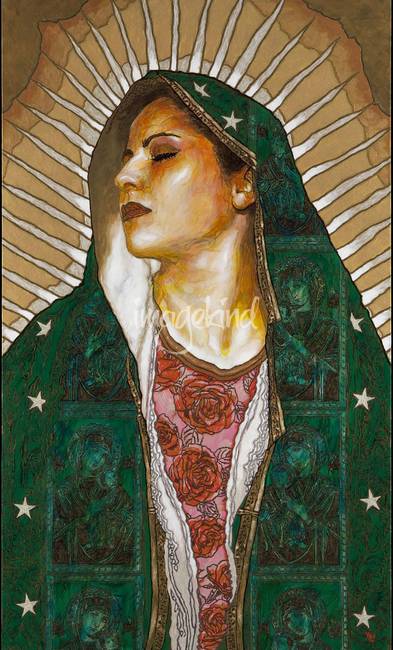
When it comes to the image of the Virgen De Guadalupe, I must confess that throughout my whole life her image was never common-place. For many Latinos, Chicanos, and those belonging to both Latinx and Chicanx communities, it seems this image is relatively commonplace, especially among those who are religious. You’re most likely to find this image relatively popular among Catholics, specifically Chicanx and Latinx Catholics. And while I do identify as Latino/Chicano and belong to these communities, it wasn’t until I was about nineteen years old that I actually saw her image for the first time. Now I definitely was raised amongst religion; both my Grandparents (Paternal & Maternal) are very devout Christians, and the same goes for my parents. Yet, being raised Christian while also belonging to a Chicanx/Latinx community can be somewhat odd at times. Most of the people I grew up with shared most of my beliefs, even though we went to different churches every Sunday morning. I realized sort of quickly that growing up in a Christian church rather than Catholic could sometimes make me the ‘odd man out’. Looking back I realize that while fundamentally there was nothing that really separated me from the other kids in my community in terms of identity, there were definitely customs and practices that I simply wasn’t used to. It wasn’t until I enrolled in community college that I began to understand the nuances that came with being raised Christian in a predominantly Catholic community. Like I said, I was about nineteen years old the first time I saw an image of the Virgen de Guadalupe. It was one of my best friends, Joanna, that explained to me for the first time the importance of the Virgen, not just as an image but as a person. As we sat on her couch admiring the ofrenda she, her father, and her brother had to put together for her late mother who had passed only a few years before I met her, she explained to me, often times translating interjections from her father, the significance and importance of Guadalupe. As a symbol she is overwhelmingly tied to a sense of identity and faith, not just for my friend Joanna, her family, and most Catholics, but also for many Mexican Americans, Chicanx, and Latinx peoples. She also explained that the Virgen’s symbol reaches far beyond spheres of faith and religion, and that some people regard the Virgen’s symbol to represent power, feminism, and justice. While the image I included isn’t the first image I laid eyes on of the Virgen herself, I wanted to include it specifically because I find this particular image of her particularly captivating. 


Sunday, October 3, 2021

Avila, Andrew

1. Linda Tanahirí

2. Ayala (Couldn't find a last name)

3. Elizabeth Cantero 


Saturday, September 25, 2021

Avila, Andrew

Hello everyone, my name is Andrew Avila, my preferred name is Andrew, and my pronouns are he/him. I'm taking this course (WAC128), with a few others I’m sure, from within the department of World Arts and Cultures. Being in the WAC department is kind of interesting because although it belongs to the School of Arts and Architecture, you meet a lot of people in this department with wildly different interests, which is something I really like. As for my particular interests, I’d consider myself as somewhat of a mixture of things. Chief among these, would probably be a hybrid between designer and artist. I’m heavily interested in the fashion apparel industry, specifically the worlds of high fashion and sneakers, though not necessarily in that order. Additionally, I'm also very interested in ‘creating’, and I think that sometimes labeling yourself  as being a ‘designer’ or an ‘artist’ is a bit too limiting.  In terms of research I’m very interested in how up and coming designers and artists can combat issues of un-sustainability and modes of unethical production that have existed for years within the fashion apparel industry. My interest in this course however, is primarily aimed at becoming familiar with LatinX and ChicanX artists. I’ve sort of come to a realization as of late, that as a young, aspiring, Latino multi-media artist/designer most of my “heroes” and “biggest inspirations” within the world of art and design don’t share this demographic with me. And while there is nothing wrong with looking different from your heroes or inspirations, I find it a little disconcerting that I do not know of many LAtinX or ChicanX artists/designers. While I’m sure there is no lack of artists and designers belonging to this demographic, I want to familiarize myself with those who do exist, as well as those who have come before me.