Showing posts with label 2021FDiazHector. Show all posts

Sunday, November 28, 2021

Diaz, Hector (Week 10)

  This quarter, I was introduced to so many Chicana artists! As someone who was not familiar with many artists in general, I was excited to learn more about the artists. An artist I am glad to have learned about was Yolanda M. Lopez. I found her work interesting after reading the assigned book and reflecting on it. What I appreciated the most from her art was the activism aspect. I enjoyed learning about how she uses her art to advocate for justice. During the Chicano Movement, her work contributed to uniting the community and spreading awareness about many injustices that Chicanxs face. It was great being able to write a paper about her because I was able to analyze her work more in depth. Her pieces, Free Los Siete (1969) and Your Vote Has Power (1997), speak to her dedication to support her community. I am passionate about social change because many injustices still remain. Artists and activists like Yolanda are pivotal to fighting for change because art can travel across the world and unite people. 

A concept that I learned from this course was rasquachismo. I am very surprised and in awe after viewing all the rasquache art. I am all for sustainability and creativity. I honestly found a lot of the rasquache art more appealing and interesting compared to art that is at museums. I am fascinated with the idea about using something for another purpose to make it art. I also appreciate that you don’t have to be considered an artist because I realized that our culture is very resourceful so it is not always intentionally art. Rasquachismo seems to exist in many places and I think more credit should be given to this art.

Overall, I am grateful to have taken this course because I learned so much more about art.


Saturday, November 20, 2021

Diaz, Hector (Week 9)

 This week, I found the presentation on Carmen Linares Kalo very interesting. Carmen is known for her mural paintings and her work is mostly based in San Diego, California. She is both an artist and spiritualist which can be seen in her art. Something I found interesting about the artist was that she is typically guarded about her art out of respect and the strong connection she has with the people it’s about. I was also astounded to hear that preparations for a mural in Chicano park took 26 years for her. It’s amazing to learn how much time and planning goes into big art like this because it makes you appreciate the work even more. I have always been interested in the process of art because there may have been some great ideas that did not make it on the mural. The first image depicted a blue heart that represented the creator and animals which represented humans. I liked this mural because the animals are beautifully painted and the colors are vibrant. This was a mural to detail a Creation story, and I enjoy learning more about the origin of humans and how different groups view the creation. The next two murals were dedicated to people. The second image was dedicated to Laura Rodriguez and Florencio, who were large contributors in founding Chicano Park. I liked this because it’s great to recognize the people that have advocated for representation. The third image was dedicated to the people who have died due to the policy, Operation Gatekeeper. I appreciate that the mural helps remember those that have tried to seek better opportunities for themselves and their families, but unfortunately passed away. A lot of the Chicanx community in California came due to immigration and it's an important part of many of our families history. Overall, I enjoyed learning more about a new artist and her work!


Saturday, November 13, 2021

Diaz, Hector (Week 8)


Armando’s presentation on the artist, Brenda Barrios, resonated with me a lot. First, I enjoyed the vibrant colors of the art because they stand out and feel more approachable. Also, Armando mentioned that Brenda intentionally uses these colors since they remind her of Mexico and to represent Mexican heritage. When I visit Mexico, the streets are always filled with vibrant color and there is always a great sense of community which I can see represented in her art as well. Also, I am someone who wants to go into the medical field, so her images resonated with me the most. I appreciate how Brenda is using her art to promote healthcare for all. Her first image mentioned “Medicare for all” and I am a firm believer of that because everyone deserves access to quality healthcare. Most importantly, this was a message that has traveled far and centers a community that is often neglected in medicine. Brenda includes her mother to represent the Latinx community and common workers. I appreciate the combination of art to promote a health issue I am passionate about. Similarly, the second image referred to the COVID-19 vaccine. I appreciated its effort to promote the vaccine in the community of San Bernardino because there is a lot of misinformation. Rightfully, the community has a right to be hesitant, but the image helps ramp up the community to consider getting it. It’s great seeing how art can be used in medicine to advocate for causes and the better of the community. The last image also resonated with me because again, Brenda centers the farm working community which I come from. It’s great seeing representation and creating awareness to the risks that an exploited group faces. The art serves as a reminder to the reality of their working conditions in order to bring change. Overall, I truly appreciated the presentation of the artist because they promote messages I am passionate about and resonate with.

Tuesday, November 9, 2021

Diaz, Hector (Extra Credit - Armed Manifesto)

        I was able to attend the virtual performance and chat about “Armed Manifesto” which was created by “La Revuelta”. At first, I had no idea what to expect, and when the performance began, I was intrigued to see women holding knives with their faces covered. My initial thoughts were that women were expressing how they are confined to the space at home and were challenging gender roles with their multifaceted use of the knife. Also, they were at times cutting “nothing” or air, which I thought was symbolizing them cutting away all their personal grievances they have personally experienced or anything that came to mind. However, I realized it was much more than that. They were representing the “armed women” which is part of revolutionary feminism. They were cutting many things and interestingly, they started cutting negative adjectives used on women, such as “silenced”. I sensed a feeling of empowerment and reclaiming space. They had a powerful presence and could feel their message. 

After the performance, they provided a brief presentation and I learned how their goal is to create art and stop centering art on men because that’s the current standard. “La Revuelta” is composed of 5 Central American women and they are aiming to uplift women's spaces in art. The knife was representative of a weapon and a weapon has been historically considered as a man’s tool that gives him dominance. Thus, they are actively challenging this narrative by arming themselves with a weapon. They mentioned how the art world is homophobic and machismo exists so resistance is not always easy. In art, it matters who writes the history, so this is another way of reclaiming their stories and telling them from their perspective. I really enjoyed the performance and how well-adapted it was to zoom. They mentioned they plan to perform it live in the near future which will be interesting!

Sunday, November 7, 2021

Diaz, Hector Claudia Essay (Week 7)

     Claudia Zapatas’ essay, titled “The Rise and Impact of Chicano Graphics, 1965 to Now”, details the history of art and technology coming together. I found this essay interesting because it relates to the art I was exposed to growing up. Technology is a crucial aspect of our society now and art has evolved and adapted to our technology-dependent society. Interestingly, Claudia mentions how printmaking was pivotal to the mass distribution of the art. This was especially important during the Chicano Movement. This helped art become more accessible and created a collective consciousness for the people to go against injustice. As Claudia mentioned, it’s important to acknowledge how graphics and technology were not replacing older art mediums, but instead adding to the creative outlets for art and activism. I also found it interesting how art was adapting to the technological advancements since traditionally, you would think of art as a painting, sculptures, or a mural that can’t be easily reproduced like pictures or printmaking. In addition, the images that stood out to me were the portraits of individuals victim to police brutality. This was created for the Black Lives Matter movement and it’s relevant to many of us today. I recall seeing all the graphics being created since the early 2010s and even now. These graphics have traveled far distances around the world, and many showed support. The graphic art was accessible and captions on posts accompany many of the graphics, like Claudia mentioned. In a way, the captions are individualized and connected with the art, creating a collective consciousness and dialogue. Technology and social media are a double-edged sword, but I think art and activism will continue to evolve with it to use the advantages of it. Overall, I enjoyed learning more about the evolution of graphic art and how technology, such as augmented and virtual reality, can be used to our advantage to communicate the story behind the art more effectively.


Sunday, October 31, 2021

Xandra Ibarra (Week 6)


When I was reviewing Xandra Ibarra’s work, I found her photographs on Views and Cast of/from My Mail Slot on the 30th day of Quarantine (2020) series. I found the view photographs to be the most interesting, especially because they were during quarantine. Early in quarantine, there was a lot of panic, misinformation, and a sense of uncertainty for many of us. I love the limited view because it symbolizes how narrowed everyone’s view was. All of our focus was on securing our homes and families in order to stay safe. This caused many to purchase too much of the basic needs which is why there was a limit at stores. Additionally, when I see the image, I also get a feeling of isolation. The mailbox is looking towards the house, and during quarantine, we had to isolate ourselves within the home. We were so near and could see each other, yet so far. The feeling of isolation and darkness summarizes how many of us felt during the pandemic. Also, the creation of the cast can eventually block the entire view. Once the cast is in, there will only be darkness. The cast reminds me of a lot of things we don’t need, yet keep. During quarantine, it was essential to focus on energy on safety. We learned what was essential to us and what wasn’t. If you keep the people, ideas, things, etc that were not essential, then it further harms you and distracts you from the focus. I am curious to know what her inspiration was for these photographs or the person who commissioned them. I am also curious to know why the mailbox view was used and what the cast images represent. In addition, these photographs seem to be different from her other art, so I am curious to know how they may tie to her beliefs and feminism.

Monday, October 25, 2021

Wiki Project Draft

Martha Ramirez-Oropeza (1900–2021) is a muralist known for her focus on the pre-Hispanic Nahuatl culture. Her early experience began during the Chicano Civil Rights Movement. Later, she learned more about developing her art under the guidance of muralist David A. Siquieros. Martha helped co-found the Nahuatl University located in Ocotepec, Morelos, Mexico. Upon her return to the USA, she became an instructor at UCLA and Social and Public Art Resource Center (SPARC) which is located in Venice, California. At SPARC, she teaches theater to elementary aged students. 


Biography (or Early Life and Education)

Martha Ramirez-Oropeza was born in Delicias, Chihuahua and her parents were migrant farmworkers. She worked with her family in the fields picking prunes at the young age of 4. Thus, she continuously traveled from Delicias to Colusa, California. Her family eventually settled down in Pacoima with is a neighborhood in Los Angeles. She experienced discrimination by a teacher that washed her mouth with soap after speaking Spanish when she was in second grade. Her experiences then lead her to partake in the Chicano movement, a hunger strike for the United Farmworkers Union, creating anti-war posters, and designing and paintings murals.


After high school, she attended California State University, Northridge.


From 1988 to 2011, she has painted about 20 murals in the USA and Mexico combined. 


Further reading

·       “The Toltec I Ching” – Written by Martha Ramirez-Oropeza & William Douglas Horden

·       “Huehuepohualli: Counting the Ancestors’ Heartbeat” by Martha Ramirez-Oropeza

·       Important article to know about


External links

·       Artist’s Website

·       Useful website link and name

Sunday, October 24, 2021

Diaz, Hector (Week 5)


Carmen Lomas Garza, La Feria en Reynosa The Fair at Reynosa, 1987 | Art  Docent Program

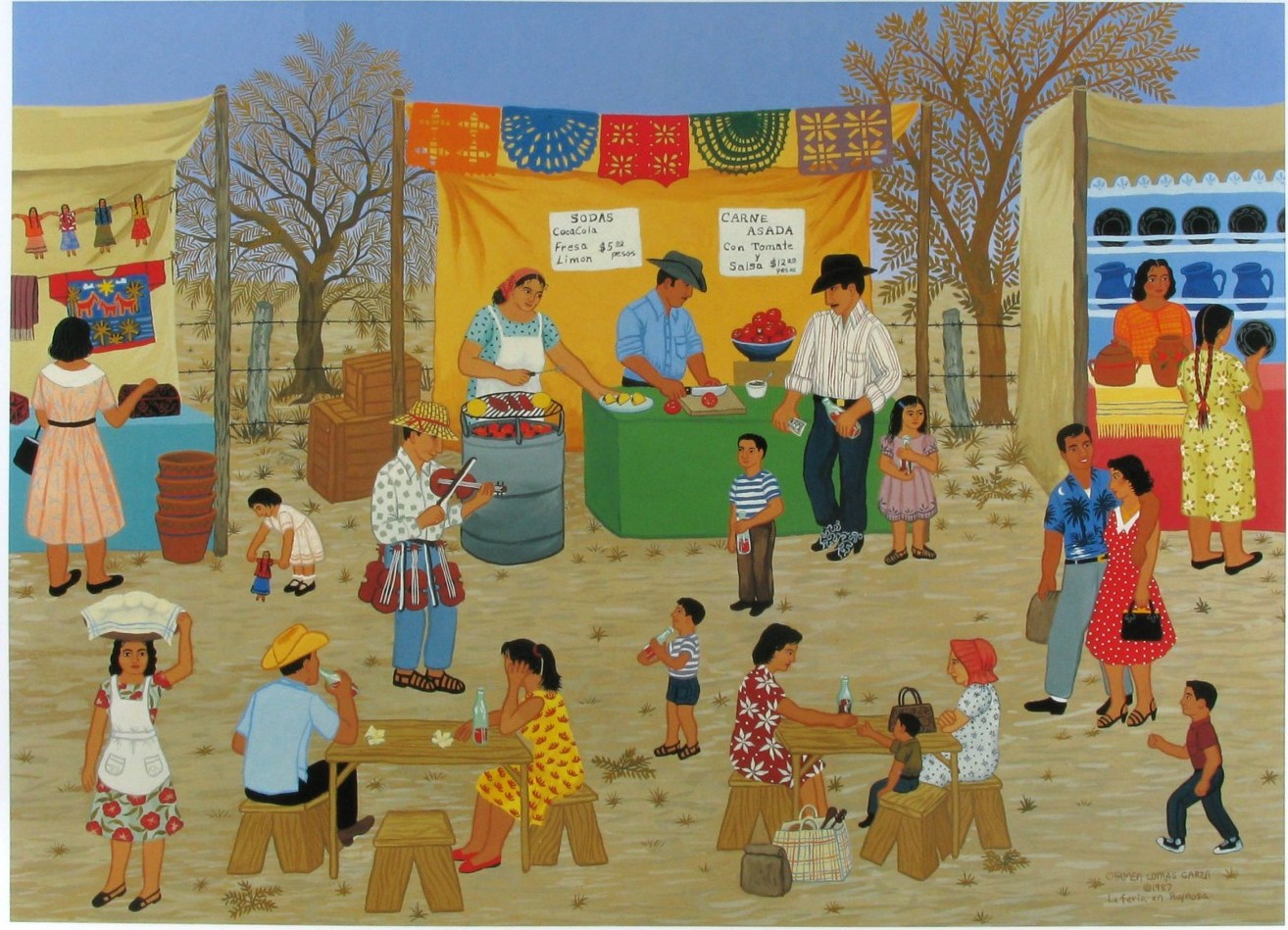
While reading the book Carmen Lomas Garza, written by Constance Cortez, an image that resonated with me was La Feria en Reynosa (1987) (pg 4). This image depicts a memory of Carmen when she attended a fair in Reynosa which is a border town. Interestingly, there is cultural hybridity because the fair is in Texas, but the products and celebration are influenced by Mexico too. The image reflects code switching and really resonates with my experience. 

As a Chicano, I have been balancing my Mexican and American identities. The blend of both cultures at the fair is similar to how I have blended them within me. I know how to speak both languages and I enjoy celebrating Mexico’s culture (food, music, shows, etc.) in the US. 

Also, this image reminded me of my trips to Mexico and crossing the border. At the border, it is clear how much influence Mexico’s culture has had and continues to have. I saw people coming to the USA to work and then going back to Mexico afterwards. At border towns, I recall how US currency and pesos were both accepted which appears similar to Carmen’s image. Similarly, I recall observing how LA has major Latinx influence compared to Northern California which is where I live. Thus, this image reminds me how “the border crossed us”, and also how the USA wants the labor and “Latinx” culture but not the people. The fence in the image reminds me of my feelings towards the border because I recall seeing how one side of a border is drastically different than the other. 

I appreciate how Carmen’s perspective highlights a celebration of Mexican culture because historically, it has not always been acknowledged. I appreciate the message and memory depicted in the image because it overall displays how I have grown to see myself and the balance with my identities.


Sunday, October 17, 2021

Diaz, Hector (Week 4)

 After reading “Chicano and Chicana Art: A Critical Anthology”, I learned about rasquachismo. First, rasquachismo can be a term applied in different ways, and it ultimately refers to something that is below. It can be referred to as “an underground perspective” and is often in reference to something that is the “standard” in society. For example, being a part of the working class or even Chicano has been considered rasquachismo. This is interesting because I come from a low-income family and identify as Chicano, yet I never learned or used the term. Also, I find it interesting how rasquachismo implies surviving with the limited resources. I recall how being resourceful was very important for our survival. To sharpen my pencils, we would use a knife. In Mexico, being resourceful is even greater because I’ve seen art and crafts be made from recycled materials. I also found it interesting how the reading mentioned that middle-class chicanos are the first to deny any association with rasquache. This reminds me of people that begin earning more money and immediately forget about their upbringing. Thus, rasquache receives a negative connotation and some are trying to get far away from it. However, it also becomes a term that is being reclaimed because many poor Chicanxs are still surviving despite being marginalized. Domesticana is similar to rasquache, but it refers to Chicanas. 

Rasquache art was also emerging and this was art that was being created with what the artist had available. In my community, we had a similar “shrine” to the Virgen de Guadalupe as the image I attached below. It was placed near a tree and a lot of the material was donated by the community. There were buckets with flowers and a little house made of wood housing her. It was maintained primarily by the community and always had decorations. The image attached is rasquache art because the Virgen de Guadalupe is painted on a bathtub, thus making the most with what they had. 


Wednesday, October 13, 2021

Diaz, Hector (Abstract for Martha Ramirez-Oropeza)

 Link to source: https://www.international.ucla.edu/lai/person/1393


Martha Ramirez-Oropeza is a lecturer at the University of California Los Angeles. She is a muralist and most of her work revolves around pre-Hispanic Nahuatl culture. She co-founded the Nahuatl University in Ocotepec, Morelos, Mexico and she’s had vast experience teaching elementary students at Social and Public Art Resource Center (SPARC). Notably, she has been able to work under the guidance of muralists David A. Siquieros and Guillermo Monroy. Lastly, from 1988-2011, she has painted 20 murals. 


Link: https://www.proquest.com/docview/2310857119?pq-origsite=primo&accountid=14512


At UCLA’s Chicanx Studies department, Martha Ramirez-Oropeza teaches a course on the Day of the Dead Ritual. She supports her students in creating ofrendas. Limited Information


Link: https://books.google.com/books?hl=en&lr=&id=ikLJLdhpYKoC&oi=fnd&pg=PR7&dq=Martha+Ramirez+oropeza&ots=ZxBlpUnqPe&sig=CGio1UPZCY9KxbY18dNFqZgx_CY#v=onepage&q=Martha%20Ramirez%20oropeza&f=false

Book title: Red Medicine: Traditional Indigenous Rites of Birthing and Healing


The book mentioned Martha Ramirez-Oropeza was a cofounder of Nahuatl University. The book also called her a “day keeper” and a muralist. One of her art pieces is mentioned in the book. The image depicts a curadera performing a limpia. Limited Information


Link: http://martharamirezoropeza.com/nahuatl-philosophy/

Artist’s Personal Website


Martha Ramirez-Oropeza is an artist, philosopher, and teacher. She was a cofounder of Nahuatl University in Ocotepec, Morelos, Mexico. She’s an instructor at UCLA and Social and Public Art Resource Center (SPARC) located in Venice, California. Her inspiration for her art and murals comes from the pre-Hispanic Nahuatl ancient culture. Her early experience began during the Chicano Civil Rights Movement and afterwards, she worked under the guidance of David A. Siquieros in Mexico. Upon her return to the USA, she became involved with SPARC by instructing students and painting murals. 


Friday, October 8, 2021

Diaz, Hector (Week 3)


     I grew up in a Cathloic household so the Virgen de Guadalupe was introduced to me early on. My earliest memory of her image is her birthday on December 12th. In my town, the Catholic community gets together to celebrate her birthday by participating in a “peregrinación” (pilgrimage). We begin in a neighborhood early at 9 am and everyone prepares their floats about the Virgen honoring her image. Then the cars with the floats, horses, and people start moving slowly while singing various songs to the Virgen de Guadalupe. Here, I recall seeing women dress up as the Virgen de Guadalupe on each float, and each float depicted a different appearance of her. I always saw this celebration as something that united the community. I would see friends and other community members that I would not typically see elsewhere. I even participated in one of the floats for one year. Similarly, going to Church in the morning for her birthday (around 5 am) was something we used to do as a family, and they would offer hot chocolate and bread. As I grew older, I learned that the Virgen de Guadalupe was a mother that we can pray to in order to help us get closer to God. Thus, her image always reminds me of purity, motherhood, and safety.

    Also, it’s interesting to hear about experiences from others. I’ve heard that people see her in their dreams, or that she appears in some shape or form in a location after a natural disaster or event. Thus, I also associate her with hope and faith. I am not the best practicing Catholic, but from my experience, Virgen de Guadalupe is a very admired person. In addition, I have seen how prominent her image is and how well-known it is because she appears in many places and many religious people carry around a bracelet or necklace with her image. 

    Interestingly, I haven’t really seen other depictions of the Virgen de Guadalupe, until lecture on Thursday. I am interested in reading more about the image on the cover of “Yolanda M. Lopez” because I have never seen this image and I’d like to learn what it represents for others.


Tuesday, September 21, 2021

Diaz, Hector


Hello everyone! My name is Hector Diaz, Hector is my preferred name, and my pronouns are he/his/him. I am a senior majoring in Neuroscience and minoring in Chicanx and Central American Studies! I am from a small town in Northern California called Yuba City which is about 45 minutes North of Sacramento! Moving to LA for school has been a great experience because I’ve been able to explore the city and try new foods!


I decided to major in Neuroscience because I am fascinated with how our brain functions and processes information. As a result, I am volunteering in a clinical research addiction lab where we are discovering the sex differences in cigaratte smokers since women have a harder time stopping! Ultimately, I hope to become a physician working with medically underserved communities. I decided to minor in Chicanx and Central American Studies because I appreciate learning more about the often untold history and contributions of my community. In the future, I wish to work with the Latinx community which is why this minor is also important to me.


I enrolled in this course because I am looking forward to learning more about art and how it’s used for activism since art can be powerful. I am very interested in art being used as activism because advocacy and activism are essential to fight for change. I wish to be a physician advocate and plan to always have the best interest of my future patients. I do not know much about the topics covered in this course, but I am excited to expand my knowledge. Thus, I am also interested in learning about Latinx artists because my education has not exposed me to their work. Lastly, related to how we process information, I find it interesting how some art and symbols remain with us and we begin forming associations and interpretations based on our unique experiences!