
Showing posts with label 2021LopezJessica. Show all posts
Showing posts with label 2021LopezJessica. Show all posts
Monday, March 8, 2021
Week 10 Reflection
Since the beginning of the Winter Quarter I had been looking forward to take this course not only as a fellow creative but as a Chicana as well. One of the main things that I thought would make me a little uncomfortable was learning about the conceptual art surrounding the Virgin de Guadalupe because I am Catholic and even though I am not overwhelmingly religious I do have a certain degree in which I deem certain things uncomfortable involving that topic. But after learning a little more behind the meaning of each work and artist who created them it was clear to me that there was no intent to malicious deface the religious figure as many claimed there was. The pieces of art stood to represent much more than a religious figure. Aside from that, I also took into account that there are many other people who don't share the same Catholic religion but still in fact see this figure in places everywhere that create connections between them and the image. I am glad and grateful I was able to acknowledge this and learn about the origins of the images and different ways they can empower and bring awareness to issues surrounding the community. 

Monday, March 1, 2021
Week 9 Blog Post Chicanafuturist
This weeks reading titled Deus Ex Machina: Tradition, Technology, and the Chicanafuturist by Catherine S. Ramirez explained how Chicana art has advanced through time with the development of new technologies that contribute to the production of art. Traditional forms of art such as using iconic religious figures such as La Virgin de Guadalupe are given new life and conceptualized different using digital print making and computer softwares. Artist like Yolanda Lopez, Ester Hernandez, and Alma Lopez are great examples of the many artist who have used technology literally and artist like Marion C. Martinez have used it figuratively. The reading illustrates Martinez's work with the piece titled Orotario a la Virginsita (2000) which is cyber arte that is constructed from discarded circuit boards, discs, wires, and chips. This methods transform the piece from traditional to a fused concept of futuristic yet it encompasses art forms of the past. She challenges the nostalgia and romanticism vision of the "Land of Enchantment" by interrogating the lines of Chicana and Hispanic identity (Ramierez pg.147). Not only did her work encompassed transformative art methods but also it acknowledges how her home town of New Mexico has historically been a landfill for technological trash. Chicanafuturism is not at all the end all be all for old art methods and conceptualism, but rather a twist of both worlds for the generations of today who carry on Chicana/o/x art.

Monday, February 22, 2021
Week 8: Looking Backward/ Chicano Art
This week's reading titled Chicano Art: Looking Backward by Shifra M. Goldman was a direct critique of the both the Chicano Art Movements exhibitions being Caifas and Murals of Aztlan. Goldman states in her critique a very narrowly tailored comment aimed at chicano artist's merit involved in the exhibits. She states, “should Chicano artists, at the cost of economic security and possible artistic recognition, continue to express themselves artistically around the same matrix of social change and community service that brought their movement to existence”. (p. 436) Goldman was implying that since some artist that were seen in these exhibits expressing themselves in art forms outside of the deem able realm of what is considered Chicano Art and were doing so at the cost of being recognized and acknowledged. Goldman's critique lead us to understand that her beliefs are that the entire construction and embodiment of Chicano art has always been and should continue to be surrounding social change and community service.
Chicana artist, Judith Hernandez rebuttals back in her own response that if that were to be the case, why isn't Chicano art displayed across Los Angeles Museums? On top of the fact that present artists have done enough work and can continue to achieve greatness based on their own merit and their own ways of expression that do not necessarily have to be along the lines of community service and social change. Doing so does not make an artist less of a Chicana/o, and their work does not define their identity. Hernandez, along with other artist, believes that this form of gate-keeping is impedes the advancement of Chicano art and not what they claim. Chicano art takes many shapes and forms and artist work does not lessen their identity any less if they choose to not center or channel mediums of social change in their work. Chicano Art is evolving and will continue to in many forms that should not be dictated or gate kept in order to be deemed "Chicano enough".

Monday, February 15, 2021
Week 7: Graffiti is Art
Week & reading, “Graffiti is Art” by Chaz Borquez, entailed information on the historical standpoints in which Graffiti came to begin and also how it was demonized. As a Los Angeles Latino, he talks about his experience with the "cholo" Latino gang style of graffiti and how placas were considered to be territorial street boundaries (p.118). Along with street styles of writing he explains symbols that are used such as the skull, and how these symbols are interpreted in our communities. The skull symbolize rebirth not death in the latino community unlike in others, and with that comes along respect or such symbols that cannot be used by just anybody because they carry a whole lot of history and heritage. Gonzales spoke about now being a gang member himself but growing up around it and developing a sort of respect for the visual art representation that was displayed in his entire community.
I resonated with Gonzales a lot in the aspect of growing up in South Central, Los Angeles and graffiti being much a normal to us to a point were it is not demonized any more. Growing up we knew that if we saw someone blasting a wall while walking home from school we do not stop and stare and most of all we don't try to stop it. The next day we would see it all finished and we would try to decipher the font style and characters used in the piece. Now as a student who travels back and forth from Westwood to South Central on a daily seeing graffiti pieces and street art, like the iconic Cheech and Chong piece off the I-10 on Alameda, lets me know I am home.

(This mural is off the I-10 and alameda as you enter Vernon going towards South Central, Los Angeles)
Monday, February 8, 2021
Week 6 Rasquachismo
I Had never heard of both concepts of Rasquachismo or Domesticana. But I have heard the term Rasquache being used to describe something that they would be referring to as in out of the norm or bad in taste in some way or form. Rasquachismo is described to be an attitude or taste (p.g 85) while Domesticana features "techniques of subversion through play with traditional imagery and cultural material," (95). Rasquachismo isn't something that can be easily defined or labeled, it is something that gives off an attitude or feeling that conveys it's status. Domesticana art stems from Chicanas challenging tradition with modern and cultural twists.
This image entails the embodiment of Rashquaquismo. It is by Car Show, 2001 John Valedez, and it is labeled raschquache art because instead of depicting historical and well known places that convey Los Angeles, the artist decides to capture street culture. The image shows LA street culture in the way the people are dressed and the activity of low rider car shows was born in Los Angeles. This challenged the norm of Los Angeles art and depiction with Chicano culture and views of what LA is to us.

Sunday, January 31, 2021
Week 5 Blog Post

As a Catholic woman and as a Chicana/Latina born and raised in Los Angeles, my experience with the Virgin de Guadalupe has been a constant in my life. Growing up I was taught at a very young age that she was someone important and that was considered our true mother. On top of that, she is an exceptional figure to look up to and strive to be like in any way we can emulate her as women. El reso de la Ave Maria is something that I learned at home from my mother even before attending catholic church school on Sundays. Ever since I could remember I do not leave my parents house without hearing those sacred words come out my mother's mouth as I head out the door, "que dios te bendiga y la Virgencita de Guadalupe te proteja mija". The Virgin de Guadalupe surrounds my life everyday, especially now spending most the time at home because of the pandemic. In my parent's house there are about twenty-three Virgen de Guadalupe framed images or religious figures all around the house, and in each and every room. It is hard for me to think of when la Virgencita has not been part of my life.
There are also some pressure felt along with the sense of serenity she brings to my life as a Catholic Latina. There are the pressures of trying to emulate her as much as possible and shame that comes along with not falling in line with those expectations from the Catholic and Chicanx/Latinx community. Pressures such as purity, nurturing nature, motherhood, and modesty. As Chicanx/Latinx women, we are expected to attain a certain level of purity along with modesty at all times. Any expression otherwise considered to be revealing or sexual would fall under the ideology of "santa or puta" that we know exists heavily today. Something that resonate a lot with is the pressures of being nurturing and being inclined to motherhood. I am not sure I want to be a mother some day and as a Latina and only daughter amount 3 boys, I get a lot of crap from family when I mention the fact that I am not entirely sure of the concept of having children one day. Deep down I am aware that the instinct of motherhood isn't something that is the same for every woman, in some cultures and religions those instincts feel almost as if they are forced on you. I have a strong sense of belief in my catholic religion but I am aware of the projections that my religion can have on women and the shame it cane bring with it.
Monday, January 25, 2021
Printing the Revolution Exhibition Preview (Week 4)
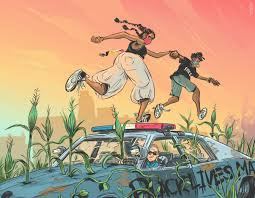
The Printing the Revolution panelist discussion featured artist like Ester Hernandez, Juan Fuentes, and Zeke Pena who offered first hand experience with the way the art world has evolved to better distribute Chicanx art. The discussions taking place among the artists were about how they believed the advancement of technology has propelled the way art is distributed and how quickly the messages being conveyed in digital prints can now reach audiences across the globe. Ester Hernandez spoke about the way prints were only able to reach a certain amount of people before without having the hard work of being able to go and post them in other places outside the communities from which it originated. Now, luckily, social media has being a network of roadways and paths that connect people and carryout messages of social injustice, police brutality, radicalization, and social discrimination to other people around the world. Those individuals repost and resend these digital art prints and get push from people supporting the initiative through donations, reposting, critiquing, and relating to the struggles depicted by them. Along with the propelling of digital art into society, technology has allowed artwork's like Zeke Pena's to come to life in ways never seen before. In exhibitions across the world, with the help of mobile devices, artworks are given effects of dynamic movement that allow the audience to experience art like no other way possible. With the continuation of advancements like this, it is clear that the art world has hit a new era in which it will allow further developments and techniques that will push Chicanx artists to blossom into their full potential for unlimited audiences to see.
Monday, January 18, 2021
Week 3: Ramirez-Oropeza, Martha (Installation)

Martha Ramierez-Oropeza is an artist and muralist, a bases her beautiful work on pre-colonial/pre-hispanic indigenous Nahuatl culture and philosophy. She is also a Nahuatl Culture professor in a university she co-founded named the Nahuatl University in Ocotepec, Morelos, Mexico. Apart from her artwork she is also a visual arts performer, and taught theater in the Mascarones theatre group for about 32 years as she progressed as a muralist and artist. Her first artistic experience came during the Chicano civil Rights Movement in 1969-71, and specifically used her amazing art skills to bring awareness of the issues being brought forth during the Chicano movement. She then traveled to Mexico in 1971 and became an apprentice to one of the greatest Maestros Artisticos, David A. Siqueiros, and that has been one of her greatest accomplishments as an artist. She is now a professor at the number one public university in the United States, UCLA, and is part of the Chicano/a and Central American Studies Department.
References:
“Nahuatl Philosophy.” Martha Ramirez Oropeza, martharamirezoropeza.com/nahuatl-philosophy/.
“Martha Ramirez-Oropeza.” Martha Ramirez-Oropeza, www.international.ucla.edu/lai/person/1393.
Monday, January 11, 2021
Lopez, Jessica Week 2 Discussion Q&A

Question: How has digital and visual art helped with the empowerment and the propagation dealing with awareness of social issues in society?
In “Chicanx Graphics in the Digital Age” by Claudia Zapata, they explain that in social justices issues such as we seen in the past years, for example the murder of Treyvon Martin and the acquittal of George Zimmerman cause outrage nationwide. Forms of digital media spread across multiple forms of social networks and media streamings to bring awareness of the fact that the community was definitely still mourning, ways in which to help, and protest to attend to show solidarity. The emergence of portraits, such as the ones created by Oree Originol, that were of significance to the community. It reminded people that the victims of police brutality had faces and were not just some name on an endless list of murders at the hands of law enforcement. Originol "produced artworks in solidarity with these efforts, focusing on singular portraits of individuals killed by police. Working with. the victims families." (Zapata, pg.142) The portraits were in black and white which made it easier for people to download and print to scatter across communities to bring further awareness of the fact that people were still seeking justice and that it is a systemic problem which we keep seeing reoccur with various of our community members lives being the cost. On social media the works were able to be reposted on various forms of media to make sure the movement covered ground online and off line at all times.
Sunday, January 3, 2021
Jessica Lopez

Hello! My name is Jessica Lopez, my pronouns are she/her/hers. You can call me Jess for short. I am a fourth year transfer student, expected to graduate this upcoming Spring 2021. I am majoring in Sociology and minoring in Chicanx and Central American Studies. I was born and raise in South Central, Los Angeles and transferred from Compton Community College to UCLA Fall 2019. I currently don't have a particular research interest but I have always been passionate about my community and the social impacts we face that causes us to be underfunded and underrepresented, so I am currently trying to pinpoint an area that most interests me to research.
I consider myself a creative, and this class was a must on my list. I enjoy anything that has to do with visual arts especially when it has to do with activist work created by people of color because they usually entail a piece of their lived experience, the over all struggle in communities of color, our perseverance, and our resiliency. This course encapsulates a lot of interests of mine, and I hope to learn about and find new interesting artist along the way.
Week one's reading, ¡Printing the Revolution! The Rise and Impact of Chicano Graphics, 1965 to Now, composed by E. Carmen Ramos corresponded to how art activism brings awareness to issues affecting communities of color. Particularly prints were easily able to circulate and not be censored across communities in order to galvanize people into joining movements across history. The reading reminded me of the social movements we have seen take place in Los Angeles and across the U.S this past year in 2020. Murals and digital artwork was seen across all platforms, and in the protests as well that depicted the brutality and the reality that people are facing and that propelled others to support and uplift their community members in any way they could at the time. Graphics as such were passed around through social media to bring awareness to where to donate and to inform people of events that took place or events that were going to take place. The fact that art can have an encouragement on communities to seek civil justice and inform them that they are seen and heard by others across the world, gives them the power they need to continue their fight on all fields.
Subscribe to:
Posts (Atom)