This is the blog for the UCLA Chicanx Latinx Art and Artists course offered by the Cesar E. Chavez Department of Chicanx Central American Studies (CCAS M175, also Art M184 and World Arts and Cultures M128). This course provides a historical and contemporary overview of Chicanx Latinx art production with an emphasis on painting, photography, prints, murals and activist art.
Thursday, March 4, 2021
Week 10 Blog Post : Quarter Reflection

Monday, March 1, 2021
Week 9: Chicanafuturism
Chicanafuturism is a term coined by the author of Deus ex Machina: Tradition, Technology, and the Chicanafuturist, Catherine S. Ramirez, which refers to the "Chicano cultural production that tends to cultural transformations resulting from new and everyday technologies (including their detritus); that excavates, creates, and alters narratives of identity, technology, and the future; that interrogates the promises of science and technology; and that redefines humanism and the human" (Ramirez, 157-158). As an example of what chicanafuturism is, Catherine S. Ramirez delves into artist Marion Martinez's works shown in the Cyber Arte exhibition held by Museum of International For Art (moifa) in Santa Fe, New Mexico.
Marion Martinez is a New Mexico native who has broken artistic, cultural, and social barriers through her artwork made with recycled computer hardware. Martinez categorizes her work as folk art as a result of her resourcefulness with available computer hardware that has been disposed of and/or is hoarded in acquaintances' garages. This feat not only allows for Martinez's work to be categorized as folk art, but also because of its religious and symbolic contents. Marion Martinez's art incorporates her spirituality, creativity, and activism.
I believe Marion Martinez's work is both innovative and powerful. I was very much drawn to her piece titled Blessings from the Little Flower (1998), even though it was not one of Martinez's four works displayed at the exhibition. This piece depicts Saint Thérèse (aka: "Little flower") with 700 pcb mother board that is placed where her stomach is, which places technology at the core of where life forms. Martinez's work as a santera -- a commonly male-dominated profession just like science and technology, breaks down borders within the profession, cultural traditions, and narratives. Marion Martinez contradicts the false narratives and stereotypes of New Mexico as a states, its population, and history. Her works explore issues of ethnic/racial racism, exploitation, and erasure of New Mexico's Chicano/Latino population. This false "Hispanic" narrative dominates tourist descriptions of what charming attractions are native to the state of New Mexico. These "in the past" descriptions of regions and the Chicano/Latino population as people who are stagnant and primitive, thus they are unable to contribute to the present's and future's technological advances.
I really admire her work because not only is it creative and detailed, but it also speaks on greater issues having to do with history, representation, racism, narratives, spirituality, culture, and much much more.
Sunday, February 21, 2021
Week 8 - Chicano Art: Looking Backward
Saturday, February 13, 2021
Week 7 - La Memoria de Nuestra Tierra (Memory)
Judith Baca honors the history of her family and that of many other Mexican-Americans from La Junta, Colorado. Baca portrays family, immigration/migration, hard work, and the overlooked and erased presence of many Mexican-Americans in the United States.
In observing this mural, I could not help but think about the story of Baca's grandfather's grave that she describes in her essay. Judith Baca's mother instilled and modeled activism in a specific instance pertaining to her father's unkept gravesite. Baca's mother advocated and succeeded in getting the governor of Colorado to maintain not only her grandfather's grave, but also those of other Mexicans that had been buried in the Mexican section of the La Junta cemetery. The stark memory of segregation, even in death, which Mexican-Americans faced just like many other communities of color served as factor in Baca's decision to create the mural.
The creation of this great mural and especially where it is displayed, has allowed Judith Baca to finally have found a place where she could honor Mexican-Americans who have experienced discrimination, erasure, among other things. Also, Judith Baca brings light to these pressing social issues as they are publicly displayed at the Denver International Airport. The visibility of the mural and the issues it depicts allows people traveling in and out of Colorado to examine and reflect on what they see; what they believe.
Something very interesting and unique about La Memoria de Nuestra Tierra is that Baca not only combined history and memory into the mural, but also computer technology and hand-painting. Judith Baca's choice in combining all of these elements reflects not only her creativity as an artist but also her dedication to justly and humanely portray the history of her family and that of many other Mexican-Americans.
I believe Judith Baca's work portrays the importance of memories quite well and reminds me of Carmen Lomas Garza's work. Both artists dedicate their work to incorporating and preserving memories. They are both activists in their own unique way.
Sunday, February 7, 2021
Week 6 Blog Post - Rasquachismo/Domesticana
![]() |
| bedroom decor using pine cones (domesticana) & using empty peanut butter or pasta sauce jars for decor, as a paintbrush holder, or water container for painting (rasquachismo) |
Rasquachismo is making do with what is at hand. As Tomas Ybarra Frausto puts it, "Rasquachismo is a sensibility [of the downtrodden] that is not elevated and serious but playful and elemental," which has become distinctly associated with the Chicanx community (p. 89). The way in which I have come to incorporate rasquachismo in my life has been through the utilization of empty peanut butter or pasta jars as containers to hold: decorations, paintbrushes, water for painting, and pencils/pens. Rather than purchasing over-priced jars or containers to hold things, I prefer to reuse jars I have. I LOVE peanut butter so I have come to collect many jars. This has become something fun and convenient for me to do. I also think is good for the environment and my wallet.
Thursday, January 28, 2021
Blog Post #5 - Virgen de Guadalupe
I have three distinct memories of la Virgen de Guadalupe. The most recent memory of la Virgencita is watching La Rosa de Guadalupe on TV with my family. This is as close as I have gotten to a recurring encounter with the image of la Virgen de Guadalupe in the past three or four years. It is a very odd thing though that la Virgen de Guadalupe has been at the center of the plot of a TV show. Why do people not protest this instead? The show uses religion to entertain, so why is that not viewed as sacriligeous?
The second house I moved to in Simi Valley was located in a predominantly brown community and on a corner diagonal from a mural of la Virgen de Guadalupe. I never really paid attention to it much because I have never been too much of a religious person, but I do remeber going to visit the mural twice. Once after my sister's quinceñera to leave flowers that were leftover from the party as well as once on the 12th of December.
The home I've been living in for the past three or four years does not have any murals of la Virgen de Guadalupe around. There are more white neighbors around where I live so that definitely has an impact on the neigborhood environment. Since moving, I never really realized that there was a mural or any onmipresent image of la Virgen de Guadalupe missing in the environment around me because I just never thought too much of it.
I have no memory of this, but I do have a photograph of myself wearing a blue veil dressed like la Virgen Maria (Virgin Mary). I now know that la Virgen Maria and la Virgen de Guadalupe are not the same thing. When I was a kid I thought they were the same woman just in different clothing and veils. Now that I've grown up, I know they are not the same, nor do I feel that they represent nor are tied to the same communities.
I feel like I fall closer to Yolanda M. Lopez's perspective of la Virgen de Guadalupe because I do not have an close or reigious relationship with la Virgen de Guadalupe. I hear of her from my mom when she says things like, "la virgencita nos quida" (the Virgen takes care of us). Also, perhaps because I did not grow up around dozens of murals and constant images of la Virgen de Guadalue that I do not feel as close to her as others may feel. Or that may not make a difference becasue I don't consider myself religious.
Friday, January 22, 2021
Week 4 Blog Post - !Printing the Revolution Exhibition Preview!

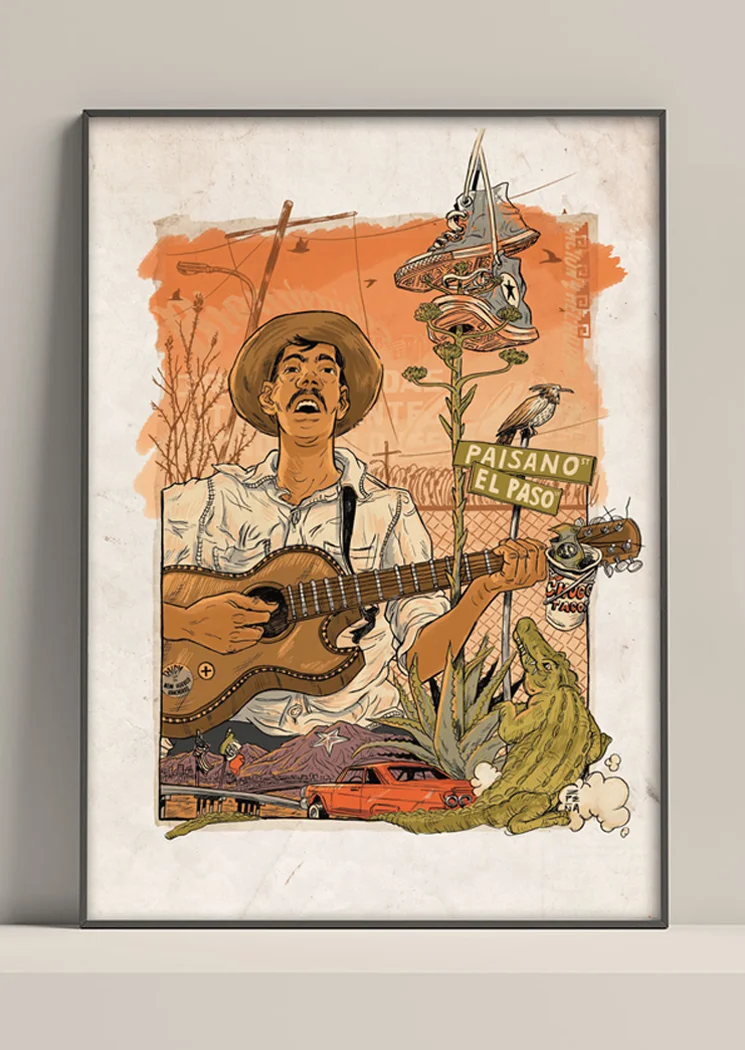
E. Carmen Ramos, acting chief curator of !Printing the Revolution!: The Rise and Impact of Chicano Graphics, 1965 to Now, and Claudia Zapata, a curatorial assistant, oversaw a panel consisting of three Chicano artists. The three artists -- Juan Fuentes, Ester Hernandez, and Zeke Peña, were asked questions about their work, their process, and the inspirations behind their works.
I was particularly interested in Zeke Peña's works as it is a perfect example of just how far Chicanx art has come. When curatorial assistant, Claudia Zapata asked Zeke Peña about how he implements technology to craft visual stories, he explained his process and journey in using technology and art together. I found it very unique and interesting how he began working on community graphics using old-school artistic techniques, then moved on to using technology to support his art.
Claudia also asked Zeke how user interactivity helps support his artistic and political objectives and he discussed how technology not only plays an essential role in the production of his works but also in publishing and distributing it. Zeke described how he uses augmented reality (AR) to continue the progress that has been made by Chicanx artists like Ester Hernandez and Juan Fuentes, who have placed community issues at the forefront of their work. Zeke focuses on creating work that young people can connect to and understand in the hopes that they may be inspired to become active in combatting such issues.
Also, one of the questions all three artists were asked, which pertained to describing what has stayed the same and what has changed in the past 50 years in Chicanx graphics, I especially appreciated Zeke Peña's response. He acknowledged how the methods used in Chicanx graphics have indeed changed, however, the activism that art can inspire has not changed. Zeke mentions being inspired by young folks who are so active in fighting oppression. He also makes note of how terms such as Chicanx, Latinx, and so many more ought to be critically thought about and used. Zeke also describes how, in the past, machismo, anti-blackness, and anti-queer sentiments plagued the Chicano Movement. Fortunately, that is not the case today as young folks call out oppression, racism, sexism, and all other social issues in society.
Sunday, January 17, 2021
Blog Post #3: Artist Wiki on Joana Toro


Sunday, January 10, 2021
Week 2: Q&A Discussion

Reading about how much technology has influenced art distribution, artists' message impact, and art itself made me question whether the use of social media to spread art and bring awareness to important social issues is beneficial for Chicanx artists who are also activists (artivists).
1. Since the internet and especially social media has become a way in which to spend leisure time, just how impactful is online artivism?
2. Also, how can Chicanx artists prevent themselves from being pushed out of people's timelines?
3. (my own psychological standpoint/input) Algorithms created by social media outlets such as Facebook, Instagram, YouTube, etc. have the ability to influence people's behaviors and beliefs. People have become addicted to social media as a result of curated content meant to keep people engaged for as long as possible. If such algorithms were not in place and big tech companies abided by ethical standards, I wonder if online artivism would be as popular as it is today? Is online artivism a trend?
Answer for Q#1. Scrolling through one's timeline is a passive action and so is liking a photo, commenting on a post, etc. Unfortunately, it appears that this is what activism has come to for some people. As was mentioned in the reading, Chicanx artists benefit from online social media platforms that "allow them to promote socially conscious art that creates a shareable database for the political zeitgeist, speaks to immiadiate and contemporary moments, and acts as a form of advocacy and pedagogy," however there can be some disadvantages. Chicanx artists could be said to have offset the downside to passive activism by allowing for their artwork to be downloadable and accessible for many such as Jesus Barraza's I am Alex Nieto and My Life Matters.
Answer for Q#2. In combatting algorithmic oppression (how research engines reinforce racism by filtering what information people have access to), Chicanx artists who have a following in social media such as Instagram can better their chances of popping up on people's timelines by utilizing hashtags to the best of their advantage. As was mentioned in the reading, the Black Lives Matter Movement, which began in 2013, made use of online platforms and hashtag #blacklivesmatter to spread awareness about police brutality and the wrongful deaths of black individuals. Similarly, I believe Chicanx artists can make use of various hashtags to make their artwork known. That way, artivists can also spread awareness to social issues pertinent to their artistic creations.
Answer for Q#3. Algorithms created by online social media platforms have created a trap for users by keeping them glued to their phones. With such influential power, big tech companies have failed to abide by ethical standards and creating addictions to social media. As a result, they have the power to set trends such that using social media more has become the norm for many. If big tech companies eliminated alogorithms, perhaps that could help lower social media usage and ultimately lead artists to not rely on the internet and social media platforms to share their art. Artivist would then be led to find different ways in which to spread awareness about both social issues and their art. This can be viewed as either an advantage or disadvantage for Chicanx artists.