In this class, I feel as if I learned so many concepts and artists that are substantially applicable in our society. Without joining this class, I truly don’t feel like I would be able to understand the hardships and barriers that the Chicano community faces on a day to day basis. With that being said, as cliche as it sounds, I think the term Chicana/x and Latina/x are terms that resonated with me since the day I learned about them. While some may say that these terms have become saturated and not as important, I strongly disagree with that. As a refresher, the terms Chicana/x and Latina/x are persons from Mexican descent; moreover, this terms is alongside used to identify as non/binary, agender, or genderqueer. These terms also play a huge role in history. As we learned in this class, and prior, Chicana and Chicano were implemented in the Chicano movement. Moreover, the term was used to express the inequality that women of Mexican descent faced. Inequalities such as no rights to work, the stereotypical “stay home” parent, and much more. Over the course of the years, women of Mexican descent have been able to truly express themselves; more so expressed through the lenses of art. With that being said, viewing the impeccable artwork made through this Chicana artist addresses a message; messages such as inequality, political movements, and much more. Jacalyn Lopez Garcia is one of the many artists that truly provided a strong message. With the amazing concept of incorporating her childhood story, through digital art, is one of the many ways that she, alongside with a lot of artists, expresses themselves. Garcia uses this technological masterpiece to express and address her cultural identity. I find this to be super powerful; moreover, I found it fascinating how artists, such as Garcia, express their ideas not just through a canvas, but through many tools such as technology.
This is the blog for the UCLA Chicanx Latinx Art and Artists course offered by the Cesar E. Chavez Department of Chicanx Central American Studies (CCAS M175, also Art M184 and World Arts and Cultures M128). This course provides a historical and contemporary overview of Chicanx Latinx art production with an emphasis on painting, photography, prints, murals and activist art.
Sunday, March 7, 2021
Sunday, February 28, 2021
Blog Post 9 - Chicana Futurism
Reading "Tradition, Technology and the Chicana futurist art of Marion C. Martinez "by Catherine Ramirez, I was baffled and intrigued to learn about the term, Chicanafuturism. Moreover, learning about the term, what it exemplified, and what it portrays is something that I think implemented a substantial stepping stone to the Chicana community. As Martinez defines the term, Chicanfuturism expresses "chicano cultural production that attends to cultural transformations resulting from new and everyday technologies... that excavate, create and alter narratives of identity, technology, and the future…”. Looking at these art pieces, it amazes me to see how 20th century technology is incorporated with the traditional styles of Chicana art. Something that also intrigued me is the fact that chicanafuturism has been around society for quite some time. Specifically, in an interview with Martinzed, she expressed that she incorporated the concept of chicanafuturism within her artwork for the past fifteen years of her life. Stepping away from the idea of incorporating technology into art, chicanafuturism plays more of a meaningful message than people think it does. As the article continues, something that I found super irrational was the fact that not only black individuals, but chicancos were prohibited from technology and science. This shocked me because as an individual who originates from Syria, we too were kept out from the modernism and evolution of technology and science. I can specifically recall a time when I visited Syria back in 2010. Comparing Syria to the country we all live in, the people of Syria don't have easy access to health and science. Moreover, RnD for the evolution of Science was severely limited. So, with that being said, I can empathize not only with Chicanos, but also with everyone who don’t have it easy.
Monday, February 22, 2021
Blog Post 8 - Panel

Unfortunately, due to WiFi issues in my building, I wasn’t able to attend “!Printing the Revolution! Virtual Conversation Series: From Black and Brown Solidarity to Afro-Latinidad”. Thankfully, I was able to watch a recording of the seminar as one of our amazing classmates recorded it. As an individual of color, predominantly Syrian, I felt as if I was really able to connect with Moses Ros-Suarez’ story. For some context, I was born and raised in the Bay Area, specifically Foster City, CA. My city consisted mostly of white individuals. Similar to Ros-Suarez’ ambiguity, I too felt marginalized at a young age. But, growing up, Ros-Suarez wanted to show his community his true identity. Moreover, in order to establish who he was, he used the power of graffiti to express his true colors. Similar to Ros-Suarez, I didn’t shy away from my identity. So, with the confidence of my roots, and my religion as a Muslim, I would maximize my values and pray during recess throughout my time in high school. While some individuals in my high school found it odd, I felt that my creative ways of following my roots to not only my culture, but my religion, empowered who I was, allowing me to educate my fellow peers and help them understand my true colors. Something that I personally want our society to address is that race and class are subjects that desperately need to be addressed. And to hear Ros-Suarez address this issue really relieved me because not a lot of people know the hardships and barriers that we the people of color face during our day to day lives. It would be amazing to see more classes that address these certain topics because then, individuals will truly understand our barriers and make an effort to push for change.
Friday, February 12, 2021
Blog Post 7 - Graffiti Is Art
Sunday, February 7, 2021
Blog 6 -- Rasquachismo
Created and theorized by Chicano scholar Tomás Ybarra-Frausto, Rasquachismo is “an underdog perspective, a view from los de abajo”. Moreover, this term heavily focuses towards the chicano work class, using ideas such as “hybridization, juxtaposition, and integration”. Being new to this term, I was mesmerized by the way it's used in many different shapes and forms. Particularly, the root of this term is said to be towards the idea of survival and maximizing a certain resource as much as possible. To the individuals who live under this lifestyle, we find this completely normal; however, to others, they find it as an “irrational” way of living. With this rooted definition, I feel as if it plays a substantial role in my life and my ethnic background. While I do not originate from hispanic descent, the term, rasquachismo, centers around my life, my characteristics, and my family's way of living. As some may know, I come from Syrian descent, and the way my relatives have lived, alongside with the rest of the people who live in Syria, use survival methods as their normal way of living. In summer of 2019, I got the opportunity to visit Syria; and as far as I can say, the way that my Syrian people did things, such as saving water and fuel, truly opened my eyes. Specifically, my grandfather is an individual that I learned a lot from. I can recall my grandfather using empty yogurt cups as cups to not only use for drinking water, but as templates to properly cut dough in perfect circles. I won’t shy away from my jido’s (grandpa) way of saving a few because that’s how my culture is and I’m truly proud of it.
Friday, January 29, 2021
Blog 5: La Virgen De Guadalupe
La Virgen De Guadalupe has surrounded my life throughout all of high school, and later continuing on to my community college time period. My first encounter with the image, Virgen De Guadalupe, was when I met my friend, Karen, in high school. Every time I saw Karen, I would always see her wearing a gold necklace with a gold piece image. The gold piece image was a lady looking down and her hands clamped together. Originally, I thought nothing of the image; however, as I started to meet new people in my high school, which is predominantly made up of Mexican-Americans, the image and meaning of Virgen De Guadalupe substantially grew on me. From what I was able to see in high school, the image of Virgen De Guadalupe brings purpose to represent the Mexican Culture. Not a lot of people may know this, but from what my highschool friends told me, Virgen De Guadalupe is a way for my friends to express their cultural identity. Similarly in my religion, Islam, a lot of people in my community wear a necklace with a piece that reads Allah, the name of God in arabic, in order to express their cultural and religious identification. What caught me by surprise, however, was that image of Virgen De Guadalupe also represents a sense of hope. When I played football, I would see my hispanic teammates firmly grab and hold onto the gold piece of Virgen De Guadalupe as a sense of hope and good luck. Lastly, what I personally didn’t know that substantially caught me by surprise was finding out that Virgen De Guadalupe and Virgin Mary are two completely different figures. In my hometown area, the Bay Area, there is a substantial statue of Virgin Mary located in Santa Clara; and it wasn’t until Week 4 when I learned that the statue located in my hometown wasn’t representing Virgen De Guadalupe, but someone completely different. As we continue on with this course, I really hope to learn more about Virgen De Guadalupe, and how she plays a different role compared to Virgin Mary.
Thursday, January 21, 2021
Blog Post 4 - Denver Art Museum
Friday, January 15, 2021
Blog 3: Barbara Rivera (Artist of Choice)
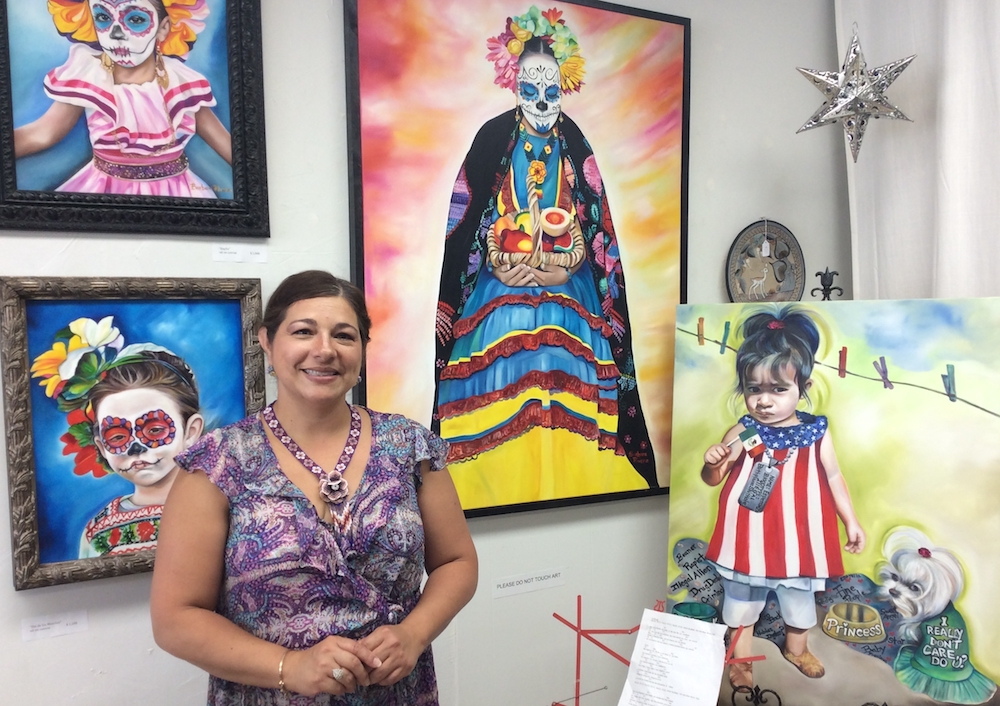
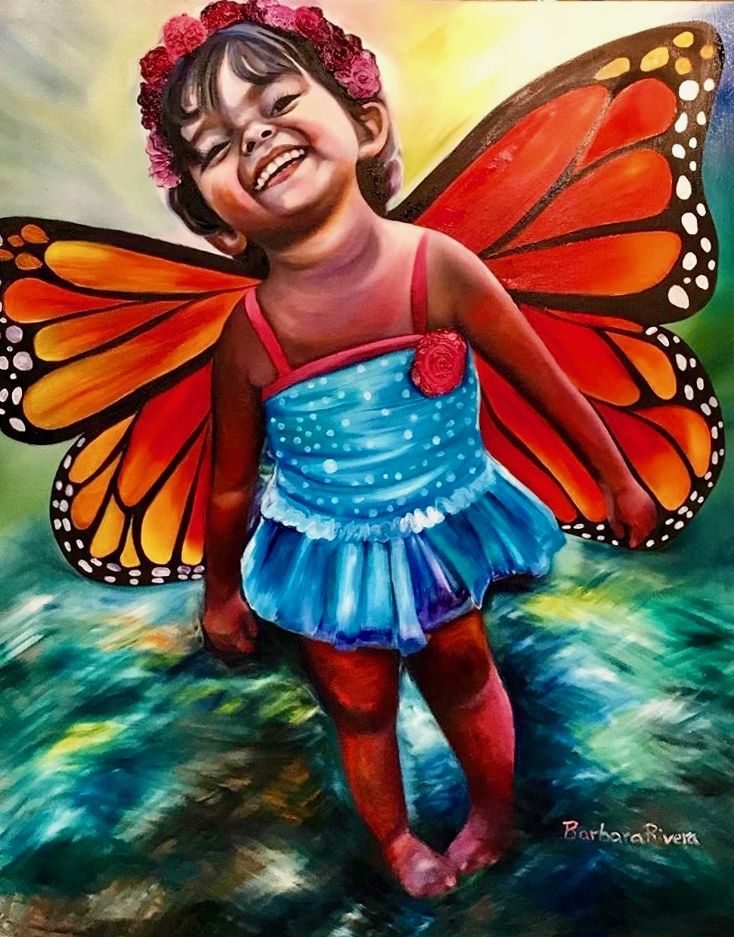
Barbara Rivera is a Cuban-Mexican-American who was born and raised in Southern California. Rivera is an artist who is famously well known for creating art through self-teaching methods. Moreover, Rivera is well known for her Fine Art skills, ranging from paintings of children to other political statements. Rivera’s life story is an inspirational one; with her busy schedule, in a sentence, Rivera not only taught herself to learn how to paint, but she also worked full-time, raised a family, and would come back home after long hours in the office and get to work with her paintings. Rivera's passion for art grew when she was in elementary school, and grew ever so substantially in high school when she took drawing and painting classes. Rivera’s name of her artwork came to life shortly after her kids left for college; then, her drive to teach herself on how to paint was established. When it came to self teaching herself, Rivera expressed that she made “a lot of mistakes. It’s very frustrating but when something comes out to your desire if you like it, [one would say] ‘Oh, I know how to do this now.’” When it came to trying new methods, Rivera also expressed that she never shied away from adding new colors that she’s never used before. Moreover, Barbara would add more to a certain color to her artwork, allowing her paintings to be viewed “hyper-realistic”, bringing her artwork more to life and allowing it to pop more. Rivera finds new ideas to put a white piece of paper to life; nonetheless, Rivera, oftentimes, is found in events and fairs, where she scopes out parents and children, takes pictures of them, with permission, and creates paintings based off of the photos. Rivera also had the opportunity to be in multiple exhibitions, her latest taking place on Norse Way in Long Beach.
Sources:
Podcast, Palacio. “Barbara Rivera, as an Artist, Paints Colors That Explode with Joy.” Palacio Magazine, 4 Sept. 2018, palaciomagazine.com/barbara-rivera/.
Thursday, January 14, 2021
Week 2 Blog 2 Zapata Q&A
In 1997, Jacalyn Lopez Garcia, created and designed a website in order to provide a tour of her childhood home. Through the website, Garcia incorporated special tools, such as the chancla, which was designed to allow users to click from tab to tab. For instance, these “Chanclas” allowed users to click on sub-pages, such as the “Living Room”, representing Garcia's history. Secondly, I love the way she incorporated the famous saying in the latin world “mi casa es su casa”, representing a cultural difference to those who aren’t ethnically from the group. Most importantly, Garcia placed three images of herself. Starting with the first image, underneath, Garcia placed “Mexican”, for the second, she placed “Mexican- American”, and for the last, she placed “Chicana”. Lastly, Garcia asks her audience “How do we survive in a world driven by assimilation and maintain our cultural identity”. While one of her main purposes was to show her audience the childhood that she lived, I believe that Garcia’s main motive to create her website, Glass houses, was to implicitly express her cultural identity. Through the lenses of these three images of her, Garcia expresses to society her journey to accepting and validating herself. We first see her as a “Mexican”, and later fast forward to “Chicana”. With that being said, I believe that Garcia’s communal based website represents a sanctuary to those who have a hard time accepting not only their ethnic background, but their true identity. I would say that Garcia’s barriers are obstacles that many individuals throughout our community face, whether it may be about our gender or sexuality. Moreover, Garcia shows her audience that as she grew up, she was able to fully accept herself as a “Chicana”. While it is easier said than done, within her website, Garcia expresses to her audience that anyone can have the courage to accept themselves and their body, and with hope and acceptance, it is more than achievable to do so.
Anwar Dababo - Blog 1 - Week 1
Dababo, Anwar
My name is Anwar Dababo. I’m from San Mateo, CA and I am a 3rd year Junior transfer at UCLA, majoring in Business Economics. My preferred pronouns are he/him, I would like to be called Anwar. Ever since I was a child, I’ve always had a passion for sports cars and art. I remember my parents taking me to car shows and art museums since I can remember! My love for cars grew when I began to learn more about my father’s business, in which he runs an auto body shop, and my love for art grew substantially when my kindergarten teachers handed me paper and a palette. I love to diversify my passion for art and love to observe the evolution of the different types of arts/murals not just through the artists we grew up learning at young ages, but different, ethnic artists from around the world. My goals in life are to run my own auto body shop and also get into the real estate business. However, I want to incorporate my interest in art and hope to run a non-profit organization in order to allow all walks of life to place their beautiful artwork in a gallery, where anyone and everyone can observe them. Moreover, I sometimes fantasize about purchasing artwork and placing them in my future auto body shop office! My hopes for this class is to learn about the artwork of Chicanx artists and how they influenced the art world. It’s fascinating to me how a person or persons can evolve the world in a substantial footprint. In this case, with art, I think that the creative thinking of one artist influences others, evolving the way artists think about their next canvas project. I hope to learn how these Chicanx artists changed the world, alongside with any barriers that almost stopped them.
Reading the short essay, “Printing and Collecting The Revolution”, by E. Carmen Ramos, I was really fascinated by the way Chicanx artists evolved their way of diversifying their audience by incorporating terms that shy away from the ways we interpret art. For example, Carmen exemplifies that the Chicanx artists “directly engage audiences without relying on traditional art-world structures…”. It amazes me that these Chicanx artists changed their way of what we view as art, and using graphical visuals to state a message to society rather than using “posters”, a traditional way of how artists spread a message during a revolution. Secondly, the way Carmen expresses how Chicanx artists “use graphic arts a synonym for printmaking”, indicates how simple terms are used in the art world and diversify one’s interpretation of what art really is. Terms like those, as Carmen would say it, opens opportunities on the definition of art, opening new ways for an individual to express themselves; nonetheless, I agree with Carmen on the idea that “visual culture [is not] usually the focus of art museum exhibitions or museum collections”.