This is my first time taking a class that merges discussion, history, art, and art making. This class served as a wonderful transition into UCLA for me for two reasons: 1. I began to connect with aspects of my life that I had often been to afraid or naive to embrace and that in turn began influencing work that I made this quarter in my studio art classes 2. the structure of the class allowed me to take steps towards joining more readily the conversation(s) of art, politics, and identity, which I feel are (at least for me) cornerstones of the university experience.
In all honesty I took this class because History of Korean Painting filled up during my first pass, but there was room here for me. It wasn't my first choice but it definitely was the best choice! I enjoyed listening and engaging with my classmates and teaching each other and being taught about Chicana artists (and art in general), while addressing the question of what is a Chican@. This multi-purposeful approach enriched my experience throughout the quarter. My classmates were all wonderful. Everyone was energetic about many of the topics that we discussed and we were all supportive of each other and coming from a community college in the desert, this was a startling revelation--this is why I feel this class was very transitory. In community college a sense of community was lacking. Most of the classes were set up so that we had to worry about the assignments more than the subject matter, so this class was a wonderful entree because it gave me a sense of what both my studio art classes and academic courses would offer in terms of nourishment.
Overall I had a great time and I'd like to thank my classmates and the profesora for all you have done.
#lookingforwardtothespringclass
Showing posts with label F2014ArzetaEdwin. Show all posts
Showing posts with label F2014ArzetaEdwin. Show all posts
Saturday, December 13, 2014

Saturday, December 6, 2014
Chicana Printmakers
The article discussed the displaced value of the Chicana printmaker in terms of where such group belongs among fine arts, while also celebrating those who have been instrumental in affecting change and energy in the movement since the 1960s. I greatly admire all of the printmakers discussed in the article for their ability to galvanize social progressive thought. They are compelling.
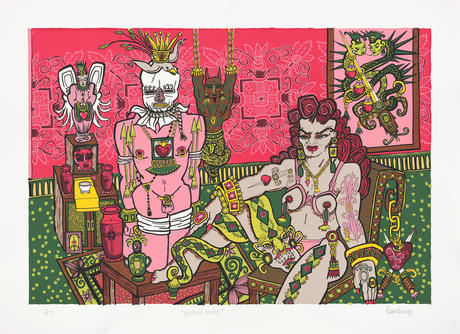
What I find most fascinating between the printmakers' work and white, traditional, institutional art, is the dialogue that the two practices share. Diane Gamboa's silk screen print, Altered State, questions "what is femininity?" It portrays the female gaze and says to the viewer "women can too objectify". In her prints, it seems to me, Diane employs techniques used by many of the impressionists during the late 1800s and early 1900s. For instance, like Matisse and Cezanne, she consciously avoids accurate linear perspective. This makes me wonder why does the art world have to be so sectional? Why is activist art treated differently from "high art" when all art is confrontational to some degree? Is Art racist?

What I find most fascinating between the printmakers' work and white, traditional, institutional art, is the dialogue that the two practices share. Diane Gamboa's silk screen print, Altered State, questions "what is femininity?" It portrays the female gaze and says to the viewer "women can too objectify". In her prints, it seems to me, Diane employs techniques used by many of the impressionists during the late 1800s and early 1900s. For instance, like Matisse and Cezanne, she consciously avoids accurate linear perspective. This makes me wonder why does the art world have to be so sectional? Why is activist art treated differently from "high art" when all art is confrontational to some degree? Is Art racist?
Saturday, November 29, 2014
Week 8: Carmen Lomas Garza
At first glance I quickly derided Carmen Lomas Garza's work due to its demure outward appearance. What I had not noticed was Garza's subversion ability. Most activist work is confrontational--it tends to make exclamations so as to draw attention to its intended subject. Rather than reminding the world of the plight of the Chicana/o experience, Garza's work celebrates the jubilation of her life. By doing so she is able to talk about the Chicana/o experience through a positive lens, capturing serendipity in her images.
My favorite piece by Garza is Tito's Gig on the Moon. The image is one of her more self-less pieces in that it's not about her experience, but more about Tito's wishes. This piece illustrates many facets of Garza's artistic practice: not one character (for the most part in any of her pieces) is more important than the rest, in particular her group scenes make it difficult to discern the most important characters if there are even any; if you zoom in on any subject in her images, there is an independent story going on that branches off of the main idea (for instance, each pair of dancers is doing their own dance while as a whole the dance floor is animated); everyone is significant--it's as if Garza acknowledges that lives are not lived alone, instead everyone and everything with whom and which we come in contact are the sources of our joys. It's as if life is a song and everyone in her life (or in this case, Tito's afterlife) is an instrument that helps build the melody.
 In terms of "capturing serendipity" I'm referring to Garza's isolation of events and furthermore isolating the smaller events within the big event that made the big event a great event. That said, not all of the events would typically be considered "big" events (like an afternoon on the porch eating watermelon). Some events that she depicts may seem trivial or banal, but then those pieces become less about the event itself and more about the beauty that she remembers about similar events, and she illustrates this by capturing the spirits of all those involved, and her memory of joy becomes the subject of all of her pieces--this is Garza's confrontation against belittlement of the Latina/o experience in America.
My favorite piece by Garza is Tito's Gig on the Moon. The image is one of her more self-less pieces in that it's not about her experience, but more about Tito's wishes. This piece illustrates many facets of Garza's artistic practice: not one character (for the most part in any of her pieces) is more important than the rest, in particular her group scenes make it difficult to discern the most important characters if there are even any; if you zoom in on any subject in her images, there is an independent story going on that branches off of the main idea (for instance, each pair of dancers is doing their own dance while as a whole the dance floor is animated); everyone is significant--it's as if Garza acknowledges that lives are not lived alone, instead everyone and everything with whom and which we come in contact are the sources of our joys. It's as if life is a song and everyone in her life (or in this case, Tito's afterlife) is an instrument that helps build the melody.

Saturday, November 22, 2014
7: Letter to Delilah Montoya
Dear Delilah,
I hope all is well. My classmate, Zora, recently presented your work to our class. I was not only awestruck by the subjects that filled your photographs and collages, but also I was moved by the narrative within each piece. As a new photographer, I have been finding it difficult to take great photos. I have always loved photography even in the context of family albums, but knowing now the nuances of film photography, I admire those who can capture life's serendipity even in its tragedy as you do with such skill.
I enjoy learning about different artists' creative processes and which artists they look up to. I would like to know: Which photographers, alive or not, do you most admire? In terms of your work, I can't help to liken some of your photographs to paintings by George Bellows and Thomas Eakins (two very masculine painters). Do you find their aesthetic has influenced your work?
I was moved by La Guadalupana. The Virgen will always be venerated despite her location, even on a criminal, even on someone who is a societal outlier. To me, this talks about society’s outlook on crime: when passing judgment we hold high standards, but we forget that behind the paradigm of what should be goodness and acting accordingly, there is a human that makes mistakes. This might not be what your intention of the piece is, but this this is how it speaks to me and that is why I admire your art.

I hope all is well. My classmate, Zora, recently presented your work to our class. I was not only awestruck by the subjects that filled your photographs and collages, but also I was moved by the narrative within each piece. As a new photographer, I have been finding it difficult to take great photos. I have always loved photography even in the context of family albums, but knowing now the nuances of film photography, I admire those who can capture life's serendipity even in its tragedy as you do with such skill.
I enjoy learning about different artists' creative processes and which artists they look up to. I would like to know: Which photographers, alive or not, do you most admire? In terms of your work, I can't help to liken some of your photographs to paintings by George Bellows and Thomas Eakins (two very masculine painters). Do you find their aesthetic has influenced your work?
I was moved by La Guadalupana. The Virgen will always be venerated despite her location, even on a criminal, even on someone who is a societal outlier. To me, this talks about society’s outlook on crime: when passing judgment we hold high standards, but we forget that behind the paradigm of what should be goodness and acting accordingly, there is a human that makes mistakes. This might not be what your intention of the piece is, but this this is how it speaks to me and that is why I admire your art.

Sincerely,
Edwin Arzeta
Saturday, November 15, 2014
Response to post by Lucero Duran: The Human Body: Isis Rodriguez and Laura Aguilar
I love that you reflected on both Isis and Laura’s use of the female body in making punctuated statements about
femininity, female empowerment, and societal perception. Isis’s artwork is
informed by her past as a sex-worker; Aguilar’s ongoing experience as a
socially unacceptable beauty informs hers.
It is
as if both women were pushed by society into two opposite corners of how it
tends to categorize women’s looks: object of desire and object of repulsion—sexy
or ugly. Yet neither woman succumbed to the gesture of sexual categorization. As
you mentioned, seeing the corrosive force of sexualization, Isis made it a
point to dispel myths about the power of sex by essentially illustrating the
sex industry’s fallout which is often derided as simply minutiae or worse—unimportant
as long as the workers feel good. She illustrates the ephemeral nature of using
the body for money. Her work makes it a point to move girls’ self-perception
and worth, in a sense, closer to Laura Aguilar’s position.
Laura,
on the other end of the spectrum, found that society had expectations of her:
she should be unhappy with her body because it is not what society deems
beautiful. However, Laura took her image into her own palm and found ways to
make herself beautiful and alluring to viewers, if only for moments at a time.
In a way the state of feeling that Laura can achieve through her self-portraits
in the desert moves her closer to the feeling that sex workers might feel while
under the spell of the job.
It was
interesting reading your connections between the two artists despite the
radical differences in both the work and the women. Thank you.
Saturday, November 8, 2014
Week 5: Laura Aguilar / Carlee Fernandez
Laura Aguilar is my favorite artist right now (and I'm not just saying that because I presented her). When I initially saw her photos I was stricken by the sight of her large body in nature--not because I found it unappealing, but because I saw so much beauty in the forms that her body created. Her search for the credibility of identity has got me thinking about my own art practice and how I want to utilize my abilities and aesthetic sense to affect change or provoke thought.
Carlee Fernandez also had me thinking about my own art practice. For much of my time spent studying and creating art, I've always sort-of shied away from being labeled as a gay or Chicano artist, but not because I was ever ashamed of those labels. Rather, I felt there was a responsibility of using those labels... like I was too naive to be able to claim them, so instead I created art that was/is devoid of the identity of any one kind of person.
My favorite piece is Center #73 by Laura Aguilar. The way her body becomes a boulder smoothed by the flowing water is so exhilarating. It's as if she relates herself more to nature and the beauty of rocks than she does with other humans. Also, there is a lifelessness about the form her body creates--like she creates a still life although she is still alive. In her desert images, the narrative that I create in my head is that as she was walking her body found the perfect place to rest and all of her energy leaves her enabling her body to remain there until it returns to the earth. It's so beautiful.

Carlee Fernandez also had me thinking about my own art practice. For much of my time spent studying and creating art, I've always sort-of shied away from being labeled as a gay or Chicano artist, but not because I was ever ashamed of those labels. Rather, I felt there was a responsibility of using those labels... like I was too naive to be able to claim them, so instead I created art that was/is devoid of the identity of any one kind of person.
My favorite piece is Center #73 by Laura Aguilar. The way her body becomes a boulder smoothed by the flowing water is so exhilarating. It's as if she relates herself more to nature and the beauty of rocks than she does with other humans. Also, there is a lifelessness about the form her body creates--like she creates a still life although she is still alive. In her desert images, the narrative that I create in my head is that as she was walking her body found the perfect place to rest and all of her energy leaves her enabling her body to remain there until it returns to the earth. It's so beautiful.
Saturday, November 1, 2014
Week 4: I choose Patssi Valdez and Margarita Cabrera
I was stricken by the realism of Margarita Cabrera’s hummer
sculpture (realism in the sense that it conveys real topics, not its production
value). I did not expect that it would be so shocking to look at at first
glance, but when I really examined it and learned the context of the piece I
grew fascinated. I think that’s the point of art though—to make objects or
artworks that resound within the viewer and invite him or her back to keep examining
the object. I think what was shocking was the attention to detail versus the
amount of effort to keep the sculpture erect. I mean, it is erect but it has
more of a melted appearance akin to a Dali painting. Overall the sculpture
seems surreal and I like that!
Another artist that grabbed my attention was Pattsi Valdez
with her current paintings. They remind me of scientific illustrations but also
the surrealism of dreams. I feel like the mixture speaks about the ability of
Chicana artists to enter the realm of both surrealism and science. Not in a
literal sense, but in a yeah-if-I-wanted-to I could kind of way. Anyways, as a
painter I really loved the attention to detail in her painting and the meticulous
nature of the color choices in the sense that they’re all so precise to the
piece and are purposeful to illustrating her point.
Friday, October 24, 2014
Stencil: Landscape/Seascape
.jpg) When I walked into class on Wednesday I had a different idea for my stencil that was stemmed from my roots as a conceptual artist, but when I saw how fun it could be to make a legit stencil and create a graphic image that implied a three dimensional plane, I decided to freehand a stencil. I wanted it to look more like an ocean with clouds, but instead it reads more like a field with clouds. Either way, I like it.
When I walked into class on Wednesday I had a different idea for my stencil that was stemmed from my roots as a conceptual artist, but when I saw how fun it could be to make a legit stencil and create a graphic image that implied a three dimensional plane, I decided to freehand a stencil. I wanted it to look more like an ocean with clouds, but instead it reads more like a field with clouds. Either way, I like it. I decided upon the idea of an ocean because in the art I had been creating during the summer, I was examining the idea of what is power and when is it important to assert power and dominance, if at all necessary? To me the ocean is a symbol of power and I thought that it would be evocative of the power of the works of art that we have looked at thus far in the course. I like that it also reads as a field, though, because it somewhat speaks of the campesinos.
Although I'm satisfied with the work, I'm considering adding text to the cover, but I haven't decided yet what it might say.
Saturday, October 18, 2014
Week 2: La Virgen de Guadalupe/CARA
When Professor Gaspar de Alba mentioned “art for art’s sake”
during her presentation of CARA, I was reminded of the Armory Show in 1913, New
York, which at the time was the first celebration of modern art in America. It
draws parallels to CARA in that both shows were meant to expose Americans to
the realities of contemporary art—the Armory Show the significance of aesthetic
as the advent of the camera released artists from the idea of “realistic”
representation, and CARA as a voice of a movement and a representation of the
reality of a people. CARA also reminds me of Daumier and the French Realists,
who like the Chicano artists, seek to bring attention to injustices done unto
them. The Chicano/a art movement is a fresher idea in that the subject matters
are more pertinent to the times, however I cannot help but ask if racism had
anything to do with the veneration of European modern art and European realism,
since there has only been ONE CARA exhibition. Was it too real for Americans?
Did it instill too much empathy for a “minority?”
When my copy of Yolanda Lopez’s book arrived in the mail, I
thumbed through all of the pictures and instantly started reminiscing in the
Virgenes de Guadalupe that pervaded my childhood. The most important VDG in my
life has been a print on a wood panel that my mom has had longer than my memory
can stretch. My earliest memory of that piece in particular was surviving an
earthquake in the early 90s—I remember my mother gathering up her five children
during the rumbling and hugging la Virgen with one arm and us with the other.
When the earth stopped rumbling, she hugged us one by one and finally la Virgen.
I am the type to sit and stare at an image for hours and absorb its minutiae until
my brain feels sore, and that miraculous, natural phenomenon-protector, print
of la Virgen was one such image. My perception of la Virgen de Guadalupe has
always been that of a young white woman covered from head to toe in cloth, with
her head turned down, but never did I think, what if she wasn’t white; what if
her neck got sore; what if she was burning up under all of that fabric? So when
I saw Lopez’s images, I immediately started asking all of these questions from
a feminist perspective. I was glad that we were able to look closer at some of
Lopez’s work because I think it asks questions that deserve answers. Although I
am not a religious person, la Virgen, to me, is an idea of a woman generated by
men, who is an exemplary role model for their daughters and wives. She can be
miraculous while keeping her head down and her body covered up.
Saturday, October 11, 2014
Arzeta, Edwin
I Edwin Arzeta am a new third-year transfer pursuing a BA in
Fine Art. I’m down with all kinds of art, but right now I work with sculpture,
painting, drawing, ceramic art, and am new to photography.
In Out of the House Judith
Baca’s book Woman’s Manual: How to Assemble
Scaffolding was mentioned; by the title alone, it sounds like Baca is making
a statement about women being just as capable of performing “men’s work”. It
seems that in that era male muralists were keen to neglect Hispanic female
artists so much so that this statement-book had to be written. When Baca’s book
was published was there some sort of backlash from the male muralist community?
I ask because to me, it appears that traditional gender roles in Mexico were
transmitted to the Chicana/o community in the United States where not even “white”
art circles were spared. Was the power struggle fostered more by the already
ongoing tradition in art that men were more prolific artists than women as
evidenced by the unbalanced celebration of male art, or was it influenced more
by the tradition of Mexican family tropes, or was it a blend?
What I took away from No
Place like Aztlan is that a sense of personal identity comes from the
internal mechanisms (memory and emotion) that we associate with locations; that
home is not the physical, but a psychological reaction to stimuli. Is that the
main difference between the terms ‘house’ and ‘home’—that we don’t feel “at
home” in a house (or a country) until we fill it with familiar and comforting
relics and stimuli that reminds us of belonging somewhere? Is this why the
kinds of artists you described create the things they do—to activate his or her
memory and emotions whether it’s conscious or subconscious in its activity?
Wednesday, October 8, 2014

Subscribe to:
Posts (Atom)