Upon enrolling in the course, I was excited to learn more about Chicana artists and their artwork, since they are an underrepresented group. I was looking forward to having a professor that is an artist herself, which elevates the importance and understanding of Chicana art. As we entered in the first weeks of Fall, I did not realize how much influence La Virgen de Guadalupe had in their lives. Not to mention, the numerous variations and meanings. Moreover, the influence of Pre-Colombian goddesses assists Chicana artists in embracing inner strength. The use of Coyoxauhqui and Coatlicue is a way for them to demonstrate feminism, drawing them as their ancestors. I have never considered them in this way.
The presentation in class was also a very helpful way in which I learned about a spectrum of "not your typical" Chicana artist. Each individual has their own style, influence, and experiences, which creates artworks that are unique. For this reason, I am able to list Chicana artists off the top of my head. Furthermore, I am familiarized with their work and have gained an interest in artists like Melanie Cervantes, Judy Baca, and Pola Lopez. Enrolling in this course has definitely broadened my spectrum of artists, Western or Non-Western.
Showing posts with label F2015RiveraArianna. Show all posts
Showing posts with label F2015RiveraArianna. Show all posts
Saturday, December 5, 2015

Saturday, November 28, 2015
Week 10- Thanksgiving
 Every Thanksgiving, my family and I prepare and eat dinner at our house. Thanksgiving dinners are usually spent with my immediate family. Following dinner, we cross the street to my grandma's house to spend time with aunts, uncles and cousins while we eat pumpkin pie and drink coffee. However, this Thanksgiving, we spent it in Monterey Bay. My older brother attends at Cal State Monterey Bay and was not able to go to Southern California because of work. So on Wednesday night my parents picked me up and we prepared ourselves for the long 5-hour drive from UCLA to Northern California.
In the picture I sketched, I included a window with the view of the bay. Realistically, a window does not exist in the dining area but I wanted to note the view from my brother's apartment. While I could have depicted any scene, I wanted to present the moment after everyone has eaten and is sitting around talking. My father is the one that starts the conversation and talks about his adventures while living in Guatemala. Some are intriguing while others make us laugh.
Thursday, November 19, 2015
Melanie Cervantes

I would describe Melanie Cervantes' style at spunky and bold. As for her art, daring and honest.
As a practicing art historian, I look beyond the artwork and consider the artist. I perceive Cervantes as an individual who is not fearful of speaking up on the social and political issues she is most passionate about. She is willing to challenge the viewer in looking at art in a different way- not just for aesthetic appeal, but a way to share a message. In fact, art can vary in functions and can appear anywhere. Art is all around us but every day an individual is surrounded by social, political, and economic issues.
In her artwork titled, Solidarity with Tunisia, she is challenging the viewer to consider worldly issues, like those happening in North Africa. The figure in the picture appears to be Muslim, perhaps from that region, exclaiming, "Victory will be attained by the peoples who struggle for their liberation!" This one statement is powerful and speaks beyond words, but Cervantes does something special with this statement. Cervantes translates the statement from Arabic to English to French to Spanish. By doing this, she is implying that every country is searching for victory in hopes of liberation. Nonetheless, no matter what language one speaks or what country they come from, the meaning of the statement is the same.
Saturday, November 14, 2015
Cholas, White Fence, East L.A. by Graciela Iturbide
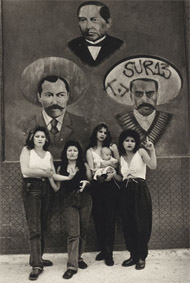 |
For that reason, I was drawn to this photo. She allowed them to pose and present themselves in any way they wanted. This method is rare, for the photographer is often looking to portray a scene through their own perspective, which might not be the best way. As a result, the scene would look staged. The viewer sees the photo as containing high aesthetic appeal, however, honesty is absent. Photographers have been doing this for years and continue to use it on various platforms.
Overall, it was refreshing to know that Iturbide permitted freedom of expression in this photograph. Her goal was to portray a day in the life of america, which she accomplished without tampering with perspective.
Saturday, November 7, 2015
Carmen Lomas Garza
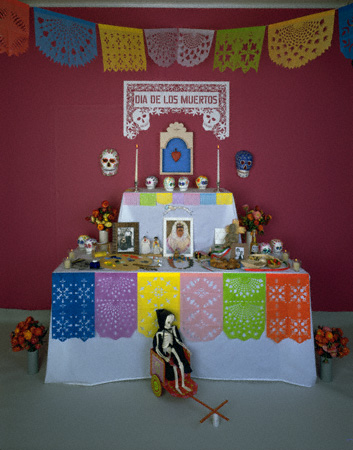
As I read this section of Garza's life, it also gave me an idea of what to expect as a curator. It is important to gain an understanding of cultures as the people are becoming more global in their relationships.
Friday, October 30, 2015
Polaroid/Photography Stencil
 The stenciled Polaroid is a representation of my love for photography, and my overall passion for art. Unfortunately, my talents do not lie in drawing or painting, so I use digital media to create my own art. Every now and then, I like to take my camera, explore LA, look through the lens, and create a snapshot of my perspective. For years I studied the art of photos, it was not until this year when I was encouraged to take them. With help from my photography friends, I went to Malibu Beach, Downtown LA, and the hilltops of cities to take landscape photos. Prior to these trips, I had no knowledge on how to operate a semi-professional camera. I have always left the exposure and aperture on auto so the camera can do all the work as I shoot photos. However, I now have knowledge and continue to gain knowledge on the ins-and-outs of taking the perfect photos. I seek out youtube channels to better my understanding and my friends for hands-on lessons. Aside from being an expensive hobby, it does require much patience. Especially when capturing a landscape photo with the right lighting, which can take hours or days. For photography, my preference is landscape but I do not want to limit myself. I am also interested in portraits and action photography of animals and athletes. Photography is more than just a representation of artistic expression, it is a representation of my love for new experiences.
Friday, October 23, 2015
Laura Alvarez

I selected Post Mestiza Handbook as a representation of Alvarez's ability to work with multiple medias and expand her imagination. I was impressed by the various medias she uses to create art. She does not limit herself, nor does she shy away from trying new techniques. On the other hand, I do not know of another artist that creates a story line out of her artwork, and creates musical pieces. I am not be a fan of her work, but I appreciate her ability to create a character that represents her Chicana-ness. She uses this character to defy stereotypes and represent her childhood.
Friday, October 16, 2015
Week 3 Blog: Self- Determination
 Shifra Goldman's essay features the hardships Chicanos/Latinos have gone through under each classification- race, ethnicity, and class. For example, under the section "Race," Goldman points out the stereotype that Mexicans are known for being lazy. Yolanda Lopez has proven this stereotype to be wrong by creating a mixed-media sculpture named Mexican Chair. On the back of the chair, there is an image of a "Sleeping Mexican", however, the seat contradicts this image. Resembling a cactus with its spikes, the seat is proving that Mexicans are hardworking individuals. In fact, no race should be considered lazy. Every person is hardworking in his or her own way regardless of race, ethnicity, or class.
Goldman also highlights the United Farm Workers protests. Every Chicano, Mexican, and Latin American fought for better working conditions. This meant marching in the heat and getting sprayed with pesticide for disobeying one's boss. No matter what hardship a Latino/ Chicano went through, they persisted to continue protesting. This relentlessness determination to fight for better living conditions is well-represented in Yolanda Lopez's Portrait of the Artist as Virgin of Guadalupe. Lopez is strong, confident, and determined in a stride that represents the individuality of Chicana/Latina. She is so focused on what's ahead that she is trampling over an angel. Lopez demonstrates the determination to fight against stereotypes, which can also represent the groups of Latinos/Chicanos that were determined to fight for better working conditions.
Saturday, October 10, 2015
Questions for Professor Alicia Gaspar de Alba
Article: Out of the House, the Halo, and the Whore's Mask: The Mirror of Malinchismo
Article: There's No Place Like Aztlan: Embodied Aesthetics in Chicana Art
Question: At the end of page 116 it states, "Generation by generation, Chicanos lose their connection to the Mexican past and become ever more melted into the American present." How can one avoid being further "melted into the American present?"
As a second generation Latina, I have become more American than Latina. I do not speak Spanish nor do I celebrate any of my culture's holidays. I feel as though I have been falling further from my cultural identity; which I want to avoid. I may not identify as Chicana but being mindful of one's cultural history is important to identity.
Question: Chicana artists, and Chicanas in general, have made many strides in being heard and noticed. As an individual who considers herself a feminist, how can other woman and I continue to strive for equality?
As I have stated, I consider myself a feminist. I have grown up in a predominately male household and have challenged the "womanly duties" my father gives me. I mean well when I challenge him, for I am learning about the traditional ways of my father and mother. I respect their traditional ways, but I do not agree on all aspects. I have noticed that women have moved away from domestic duties and have gotten a career. Every day, women are moving away from traditional ideas. As a woman growing up in this progressing society, I want to continue to see these strives. However, it doesn't only start with women, men must stand up for their mothers, daughters, and wives in progressing towards a gender equal society.
Article: There's No Place Like Aztlan: Embodied Aesthetics in Chicana Art
Question: At the end of page 116 it states, "Generation by generation, Chicanos lose their connection to the Mexican past and become ever more melted into the American present." How can one avoid being further "melted into the American present?"
As a second generation Latina, I have become more American than Latina. I do not speak Spanish nor do I celebrate any of my culture's holidays. I feel as though I have been falling further from my cultural identity; which I want to avoid. I may not identify as Chicana but being mindful of one's cultural history is important to identity.
Friday, October 2, 2015
Rivera, Arianna
 Hello! My name is Arianna Rivera. I am a third year transfer from Mt. San Antonio College in Walnut, CA. My love for indulging in history and culture has led me to major in Art History. I have yet to decide on a concentration within my major but a possible choice is Latin American/Chicano(a) art. I have taken a Pre-Colombian Art History course at my previous college that took me through the history of Latin American art, but my recent interest in Chicana art has drawn me to take this class. The exposure to Chicana artists and their stories will assist me in choosing a concentration. While I have studied several Asian, European and African cultures, I tend to overlook the Mexican culture. Taking this course would allow me to indulge in one of my cultures.
 I grew up around two religions: Christianity and Catholicism. One side of my extended family are Christians, so I grew up with the cross as an idolized symbol. I always saw a cross hanging in the homes of my grandma and aunts. Some of my cousins have gotten a tattoo of a cross with their favorite scripture. On the other hand, my Mother grew up in a family that practiced Catholicism. As a result, she observes Catholic holidays and encourages my family to do the same. Also, I have always lived in a Latino- dominant neighborhood that practiced Catholicism, so I would observe the celebrations of The Day of the Virgin of Guadalupe. I did not grow up with the image, but I have always seen it at various Latin restaurants and markets.
Wednesday, September 30, 2015
Judithe Hernandez
As I skimmed through her website, I came across her project at the Expo Metro Station in Santa Monica. The artworks look very powerful and I am drawn to know the story behind each one. Her palette is vibrant and eye-catching.
Subscribe to:
Posts (Atom)