Showing posts with label 2018GutierrezMejiaIrma. Show all posts

Friday, June 8, 2018

Extra Credit: The Black Experience Mural


It amazes me as we learned in class how art is everywhere. I had seen many murals prior to this class and while I was fascinated, I never truly knew the meanings. What I find so intriguing is the efforts of people to cover up and get rid of murals and pieces that are part of a political movement and historical references. This "Black Experience" mural in Ackerman Union is important piece of art like many others. This in specifically is a representation of Activism and key figures in the African American community. The detail and meaning is truly remarkable. It was created in 1970 and was tried to cover up with the excuse of needing more space for the restaurant. Like many other art piece the educators fail to acknowledge them and teach members of the community about it. I have been at UCLA four years and it took me taking this class to find out there is a piece of art so amazing like this. I am appreciative for being able to have learned that this piece was revitalized thanks to the African Student Union who worked to get it back. I think preserving murals is key to our community and I am grateful to have learned about this piece of art while still a student. I learned through this mural and the class that we need to take a moment to appreciate the context of art and learn more about our artistic histories.

Quarter Reflection Post

This quarter I have learned more about Chicana Artist and their than I imagined I would. After lecture on Tuesday I realized how many Chicana artist are in the field and I am currently are of. Prior to the class I had no art class background, nonetheless knowledge and women artist. Now I can not only name some but also talk about them and their work. My favorite thing about the course and leaning about Chicana Art and Artist is the meaning behind it. I realized each art work has so much meaning. Whether political, cultural or historical, women have a powerful way of portraying art. Their work often goes underrepresented when really it has so much significance. I think one of my favorite take aways from the class is the political movement the Chicana artist had that I was unaware of. So many artist talk about different struggles, are part of movements and portray women as strong. This to me is so important because we need women to be portrayed in the arts like many other fields.

My artist in particular is the one who most influenced me the most. Yreina Cervántez is in my opinion a dominant artist who highlights the power and strengths in women. She reflects how woman are deservingof being portrayed in art as powerful not simply abidingto gender roles. I appreciate the work of Chicana artist like Yreina because it empowers me to continue to excel in my future endeavors regardless of my many intersectional identities that would stop me from reaching my goals. All of these artist are inspirational and I have learned so much. I have been left with a great artistic inspiration to continue to learn more about Chicana Art and Artist.

Monday, May 28, 2018

Week 8 Presentation #2: Ester Hernandez

During this week's presentations, the work of Ester Hernandez stood out the most to me. Specifically, the "Sun Mad Raisins" screen print.  As we learned in class, Ester Hernandez's work contains political action with her interest to be involved in the community. This piece as the classmate discussed, is Hernandez's recreation of the famous Sun Maid raisins to the "Sun Mad" cover. This piece I find is especially important in reflecting her history as well as others with parents of farm workers. Hernandez was born and raised in the San Joaquin Valley by her parents who were both farm works. This area is associated with the struggle of farm workers, thus she was heavily influenced by her personal family ties that were active during the Farm Workers movement. This screen print was made back in 1982, as stated she grew up in San Joaquin and one of the biggest issues there was the polluted water. As this poster states, "Raisins grown with Insecticides, Miticides, Herbicides, Fungicides," which depicts the heavy usage of pesticides that farm workers are exposed to, as well as the consumers. Additionally, she changes the young attractive woman who used to be central to the brand, into a skeleton. Hernandez creates an illustration that voices the concern for the overuse of pesticides and the harm it has on the farmworkers, as well as the environtment. This poster was Hernandez's part of her support to the Farm Workers movement. Her efforts were to demonstrate the negative conflict the raisin industry like many other industries who are driven by economic profit, often have damaging effects for its workers and the residents who live in these areas.

Sunday, May 20, 2018

Week 7 Presentation Artist: Bjanes, Kim


One of the artist that caught my attention was Bjanes, Kim. When looking at her social media, and the actual presentation in class, I came across her empowering works. I say this because her artwork is a representation of empowering women. Often, different cultural and societal expectations degrade and bring down women and her art does the opposite. It allows women to find these items in which they can identify with and furthermore, be proud of who they are and what they represent. Additionally, it empowers women to understand their worth and strength. The presentation had three images, that all spoke to me. The first was the Brown, Badass, Bonita tee which I found a quote on her social media about that I have attached. This first piece is empowering, as it suggest women are rising, embracing, owning, and decolonizing. All powerful words that give agency and strength to many women who may often feel like they do not. Second, was the grenuda tee. This was also significant, as the spanish word means messy hair. Growing up I heard that term a lot as a form for my mother to nag me for how I looked. I thought this representation in my experience, of my language and culture is important to put on a shirt. We so often see people we don't relate to on clothing and this term I thought was unique, and important. Lastly, the third image was that of the artists, Bjanes in the popular undocu tee in which she shows support. I think for me this piece was important in showing the artist solidarity and support to the undocumented community. I say this because from my experience, while my older brother was undocumented during most of his undergraduate career we often were unsure of what the future held. When seeing this tee, it brought in my opinion awareness to a community and also support. Bjanes, Kim is a supporter of the Clean Dream Act and I believe she has work that have a positive impact  in our communities, of course depending on perspective and experience.

Sunday, May 13, 2018

Judith F. Baca


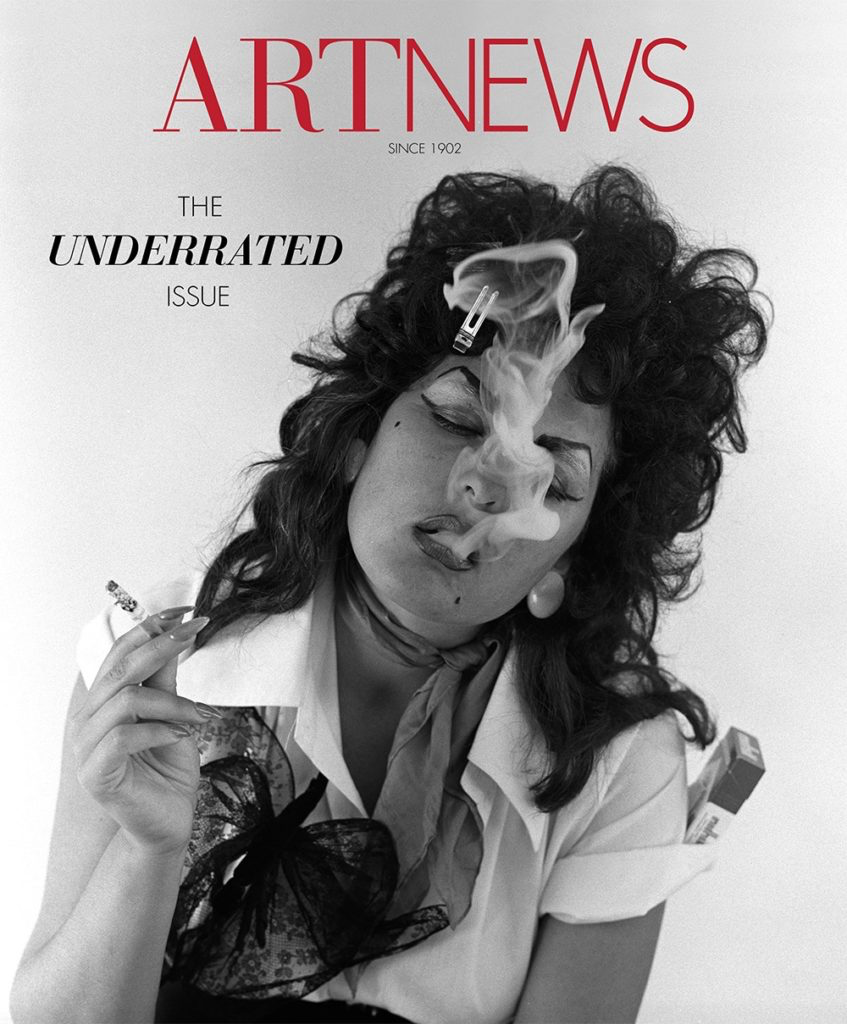
Figure 49, in the text is Judith F. Baca performing as a pachuca, 1976. I chose this illustration because of the power in gender roles I believe Baca exemplifies as she takes the role of the Pachuca. This depiction analyzes the gestures in which Baca appears dangerous and plays into sexuality. This image was taken of Baca from Las Tres Marias 1976 shot. The image identifies how Baca displays the defiance and with her smoking of the cigarette, while at the same holding the cigarette box in the sleeve of her shirt. Baca herself describes how her mother would have never let her take this role or identity, yet for her this character was a portrayal of how a woman can be exotic and fierce. Women are condemned for looking too masculine or overly feminine and there is a problematic gender role broken with this performance of Baca, which I find illustrates Baca’s inspiring breaking of gender norms and expectations.
Baca is an illustration of a key Chicana activist and artist. With her integration of public works to exemplify the lives of many underrepresented minorities and being inclusive to at risk youth her character demonstrates high importance in art history for Chicanas/Chicanos. Lastly, her performance of breaking gender norms that are especially influenced and reinforced by our parents is highly important in portraying how we do not have to be abide as women to be this perfect representation of a woman

Sunday, May 6, 2018

Astrid Hadad


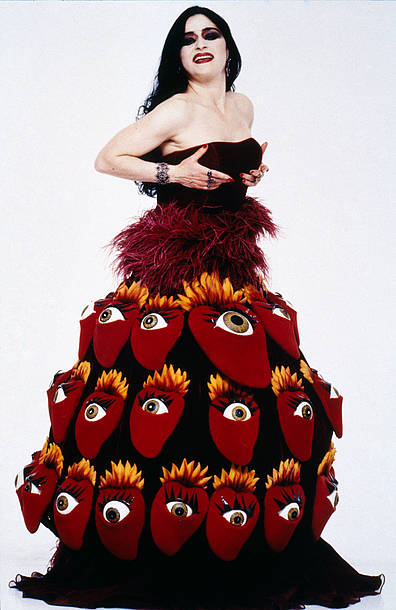
This week we discussed the work of Mexican artist Astrid Hadad. As professor Lopez Gaspar de Alba commented, Hadad is known for her performances from small local showings to large scale performances. Additionally, Hadad is famously known for her unique costumes. Astrid Hadad is a Mexican actress as well as performance artist who was born in Mexico and attended the National Autonomous University of Mexico. Hadad has performed in numbers of shows. One of the most popular shows Hadad took part of was the all female Mozart’s opera. Hadad has put a twist on performance, and has also added her own way of singing that does not follow the traditional expectation of women singing in very soft, low voices. This twist can be seen specifically in her famous “canto bravio.”


Hadad recently made a visit in 2017 to Westwood at the Hammer Museum for the Radical Women: Latin American Art, 1960-1985 exhibition. This exhibition is important with its purpose of making visible the artistic practices of various women artist with Latin American heritage, and different performance works. Hadad’s performance at the exhibition was the “(De)Constructing Mexicanidad.” Hadad is famously known for fusing both Mexican and Latin Music, as well as engaging in topics such as machismo, corruption and Mexican hypocrisy as seen in her performance. In doing this Hadad also adds a feminist perspective to her works. In the (De)Constructing Mexicanidad Hadad contextualizes some of the most prominent Mexican symbols which are the flag, cactus and the border amongst others.

Sunday, April 29, 2018

Yolanda M. Lopez


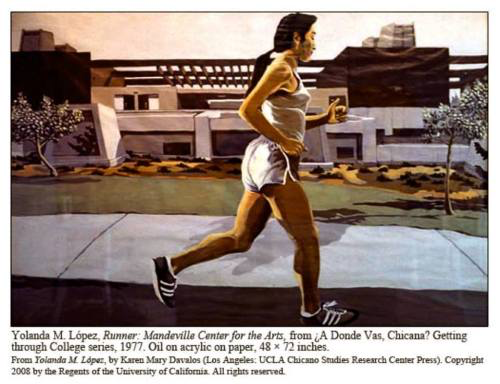
In Figure 44, Runner: Mandeville Center for the Arts, from ¿A donde vas Chichana? Getting through College series, Davalos engages in the autobiographical sequenced work in which Lopez portrays herself running through the University of California, San Diego. This portrayal was a reflection of Lopez achieving better physical health and endurance after having gained weight from being inactive during her graduate program at UCSD. The importance of this piece as Davalos highlights, is how Lopez as a woman can also engage in vigorous sports that are perceived to be in the male domain. In this figure the campus background Lopez is running through is described as both an informal and formal simplified landscape. The landscape reinforces the image of this institution as bland and in shadows to reflect the artistic failure of the Mandeville Center for arts department at UCSD. This figure illustrates Lopez intent in portraying the school of conceptual art as a symbol of uncovering the failure of encouraging creativity. Furthermore, the landscape serves to display the social oppression these students feel on campus.
I believe these art pieces by Lopez are uniquely important in breaking boundaries. As a Mexican, American born my parents both working class have tried to instill all religious, gender and cultural beliefs. These expectations have been imposed on me regardless of the different lifestyle I live as an undergraduate student pursuing higher education. I am empowered by Lopez's pieces because I feel like the illustration of Our Lady of Guadalupe, and Lopez running in a prestigious university are similar reflection to my experience as a working class daughter. My course of life does not abide to cultural expectations, but her work reinforces my achievements thus far as a woman of color and the potentials I have that are not limited to cultural boundaries.


Sunday, April 22, 2018

CARA’s Politics of Representation- Alicia Gaspar de Alba

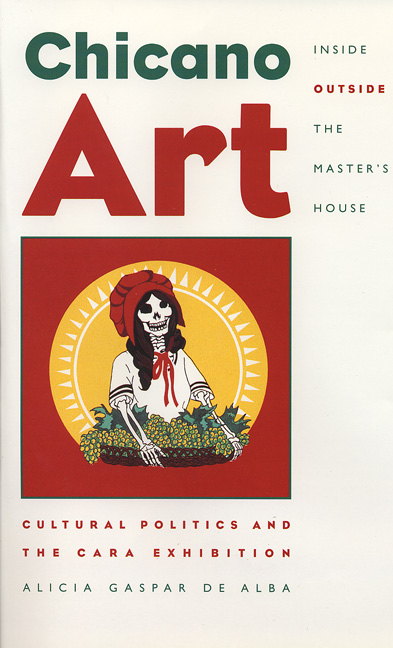
Professor Alicia Gaspar de Alba identified both in Chapter 3 and in her class lecture her critique of the representation of women in the CARA exhibit. I find her critique important and essential in understanding feminism and reclaiming the past in order to redefine the future. I believe her work and lecture not only do that but it challenges people to do so as well as she critiques an important historical exhibit. Her critique of CARA served to highlight the need to change the “ranking oppression” in which women who are illustrated in are are focused and identified as having roles of the wife, mother, and but not limited to “la fulana.” I believe her work is important in highlighting the need to have Chicana artist in order to move away from these ongoing prevalent gender issues that we have seen throughout history, but nonetheless continue to see and reproduce. Gaspar de Alba highlights how there are 100 more Chicano artist in this exhibition that Chicana artist. These numbers already prove to be complicated because as she states, “of fifty-four mural images projected, only seven were done exclusively by women or women’s collective.” Here Gaspar de Alba continues to describe the discrepancies with gender issues in the CARA Exhibition.Professor Gaspar de Alba discussion about politics of identity and identity politics really sparked my interest and ideas. When professor Gaspar de Alba asked how many of us were Feminist. I thought this occurrence in class was as her work strong and reflective. When thinking about my own politics of identity, which professor Gaspar de Alba explained is your own personal identities that include identity politics, race and that of myself I thinking of all this in understanding my own politics of identity I placed myself in an awkward situation. I say this because I have always thought of myself as a feminist in one way or another. Yet, I was uncomfortable because as a Mexican woman I reflected how much I have done for my community of women and how much I have shared my education with the machista male figures in my life. Overall, I enjoyed both the reading and her lecture because I was able to reflect on my politics of identity and encouraged me to work on how I want to identify and share the knowledge I gain about gendered issues not always talked about.

Sunday, April 15, 2018

Debra Blake's Chicana Sexuality and Gender

Chapter 2, page 73-74 “ Castellanos’s poetry, essays, and plays reveal an acute awareness and pointed disclosure of the systems of domination that enclose women, the and the indigenous in Mexico. Moreover in a book of essays published in 1973 exploring the condition of women, Castellanos describes the very issues that Chicana writers engage. ‘The boldness of exploring one’s self’ the need to become conscious of one’s bodily existence or the unheard-of pretension to confer a meaning on one's spiritual existence are severly repressed and punished by the social apparatus.”
 
In Chapter 2, Blake continues to portray the ongoing issues between these Chicana artists who are submerged into operational social boundaries.  Blake adds on the idea that these feminists, specifically Chicana feminists alongside feminists of color are challenging the traditional spaces and gender roles (71). Blake demonstrates how this challenge to traditional forms by feminist, go against the white, middle-class dominated as depicted by Castellanos. Blake says, “Castellanos’s poetry, essays, and plays reveal an acute awareness and pointed disclosure of the systems of domination that enclose women, the and the indigenous in Mexico... Castellanos describes the ...‘The boldness of exploring one’s self’ the need to become conscious of one’s bodily existence or the unheard-of pretension to confer a meaning on one's spiritual existence are severely repressed and punished by the social apparatus” (Blake 73). Furthermore, Blake is portraying the idea that there is this evident form of oppression that ultimately affects Chicana writers, and artist from engaging into creative works. These forms of oppressions and described by Blake demonstrate the perpetuated repression of these women, specifically of color who attempt to pursue creative, artist, writing etc. works.

Wednesday, April 11, 2018

Introduction: Irma Gutierrez-Mejia

Hello everyone,
My name is Irma Gutierrez-Mejia. I am a fourth year majoring in Sociology. I have lived most of my life prior to college in Sylmar California, which is near the San Fernando Valley. I identify as Mexican, American born. Both my parents were born in Mexico and I was their second child, but first to be born in the United States. Things I like to do on my free time are outdoor activities such as hiking, running, and swimming. I like to do more hands on activities. While I do not consider myself creative or artistic, I find art fascinating and love the different stories and meanings behind different art works. I became more culturally and politically engaged while at UCLA and this class sparked that interest with its inclusion of art. Courses at UCLA have allowed me to see the histories between my community and other communities and I felt like this course will take an interesting perspective on those issues.

I recently enrolled to the class because I had not the oppourtunity to study an art all of my undergrad, and ow that I can as a senior I want to see how this class engages in a focus of Chicana artist. I am excited on the dynamic of Chicana artist because I have yet to take a course that focuses on non-male dominant figures. As Venegas discusses in the article, "conditions of producing Chicana Art," it has been hard for Chicana artist to be recognized, and this is a reflection of sexual political constructs in society. I find this aspect important in identifying gender dynamic and the power dynamics in different fields we may not often think about. Furthermore, I am enthusiastic about learning and experimenting with what we will be practicing. I want to take the opportunity to engage in this creative, yet work committing class.

Monday, April 9, 2018

Presentation: Yreina Cervántez


The artist I am choosing to present on is Yreina Cervántez. Cervántez received her Bachelor's in Fine Arts at the University of Santa Cruz and her Masters at UCLA, and is currently a professor teaching Chicano/a studies at California State University Northridge. I chose to present on Cervántez because her art reflects women in movements, particularly the Chicano Art movement. Additionally, her work is created in the lens of a Xicana feminist. 


One aspect of Cervantez that particularly caught my attention was her public works. The murals she works on that serve to educate and engage the community. I have a new appreciation for art like hers that builds bridges between different communities. For example, in the mural pictured Cervantez helped  the restoration of a mural, called “La Ofrenda.” This piece of art was a bridge between the 
Chicano/Chicana community with the Central American Latin American community. I learned how this provided a bridge for these immigrant communities to work together and form a stronger community. I felt like this work is significant in portraying these relationships and histories. I want to further look into her works, and engage in the cultural impact Cervantez has made.

Being Latina I appreciate this art form that provides a sense of homage for individuals who may relate to the art. The art I have been taught throughout K-12 education is no reflexive of my community and struggles. I am really excited to learn more about Cervantez and her social and cultural impact.