As I reflect on this quarter, I recall the highs and the lows. More often than not, I am asked why I decided to take an art history course. The answer is that my biggest step towards coming closer to my artistic side was through a formal course about art. As an applied mathematics major, I rarely get to express that side of myself, which I abandoned prior to transferring to UCLA this academic year.
This course has taken my outside of my comfort zone on multiple levels, and has simultaneously brought me closer to my interests outside of my major. I enjoyed learning about Chicana artists, and their role in cultural and female empowerment. The topics at hand are so relevant in the current political climate, and I was interested in the artists, and also my classmates insight. It was also interesting to learn about, and actually experience, the level of intricacy that art requires.
The sketchbook was probably my favorite part of the course. Initially, I was afraid of my ability, as I have never participated in drawing/painting to this degree. I was afraid of drawing something "incorrectly", but the exercise in which we drew hands without looking at the paper quickly made me realize how cool I think the imperfect hands look. Admittedly, I am still afraid of drawing, and procrastinated doing my self-portrait until the night before the sketchbook was due. Upon completion, my self-portrait is one of my favorite drawings, and I am surprised at the how my drawing skills have developed.
I came into this class with the expectation of dipping my toes into the art world, something I have put to the side for a long time. After learning about so many different Chicana artists, I am inspired in many ways. I am inspired to engage in conversations and pursue feminism. I enjoyed this course and am excited to continue to expand my knowledge about art.
Showing posts with label 2018KalluPriya. Show all posts
Showing posts with label 2018KalluPriya. Show all posts
Friday, June 8, 2018

Monday, May 28, 2018
Week 8 Presentations: Xandra Ibarra
The artist that most caught my attention from the presentations during week eight was Xandra Ibarra, also known as La Chica Boom. Ibarra is a performance artist who pushing her viewers out of their comfort zone. The introduction to the presentation in class was a compilation of clips from Ibarra's short film. As a young college student, I welcome different arts because I love to experience and interpret new things in my own way. Upon seeing the short scene with the tapatio, I went through a range of emotions; I went from feeling shocked to laughing to seriously contemplating the message Ibarra was attempting to convey. I think it was interesting that my classmate took the time to leave us with a question after her presentation, that is, were we (college students) uncomfortable watching Ibarra's performance art, or for the most part open and interested? I take for granted my own ability to view art without judgement or discomfort, and assume that most students are similar to myself. I never realized that some students may not like Ibarra's work as it is provocative.
In regard to Xandra Ibarra's artwork, I was most interested in her performance at the Broad,"Nude Laughing". Initially, without any description or reference of the performance, I was attracted to the expression of Ibarra's face in the image provided in the class presentation. Her laugh seemed genuine but also painful, creating a mixed range of emotions. After hearing about what the performance entailed, I gained more interest, as I learned that this performance was a sort of reaction to John Currin's painting, Laughing Nude. It was interesting to understand the intentions of Ibarra's performance, as she tries to portray the inability of women to fit into the archetype John Currin created. Overall, Xandra Ibarra's work is very intriguing and I definitely hope to see her performance art in the future.
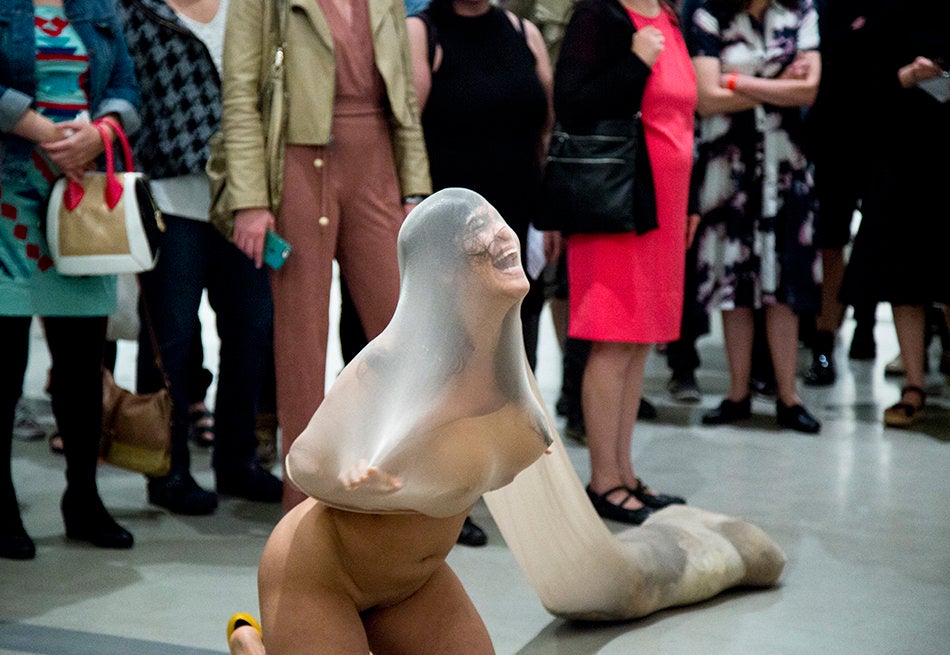
In regard to Xandra Ibarra's artwork, I was most interested in her performance at the Broad,"Nude Laughing". Initially, without any description or reference of the performance, I was attracted to the expression of Ibarra's face in the image provided in the class presentation. Her laugh seemed genuine but also painful, creating a mixed range of emotions. After hearing about what the performance entailed, I gained more interest, as I learned that this performance was a sort of reaction to John Currin's painting, Laughing Nude. It was interesting to understand the intentions of Ibarra's performance, as she tries to portray the inability of women to fit into the archetype John Currin created. Overall, Xandra Ibarra's work is very intriguing and I definitely hope to see her performance art in the future.
Monday, May 14, 2018
Las Tres Marias - Judith F. Baca
Judith Baca is particularly fundamental in addressing white middle-class feminism and proposing new ideologies of identity. Las Tres Marías (1976) was a part of an installation featuring Baca performing. Physically, the piece is three panels, one mirror in the center, a figure to the left of an indifferent chola looking down at the spectator and a figure to the right, a 1940s/1950s pachuca. In combination with the title, the three panels portray Baca’s adaptation of the three marys of the crucifixion story. Indych-Lopez draws specific attention to inclusion of the pachuca as she directly attacks gender roles, and encourages a feminism that breaks social constructs and supports sexuality. The mirror similarly plays a significant role in encouraging true identity, as it forces spectators to confront their existence and being. Las Tres Marías uniquely addresses a multitude of topics as it promotes diversity among Mexican-American identities and fights the ideologies of white feminism.
Anna Indych-Lopez describes the Chicana artist Judith Baca as a driving force behind public arts and a feminist visionary. In essence, Baca made significant advances in the world of art, introducing murals as a tool to expand the audience of Chicana artwork, and consequently, expose the masses to ideas of diverse identities and feminism/equality.
Anna Indych-Lopez describes the Chicana artist Judith Baca as a driving force behind public arts and a feminist visionary. In essence, Baca made significant advances in the world of art, introducing murals as a tool to expand the audience of Chicana artwork, and consequently, expose the masses to ideas of diverse identities and feminism/equality.
Monday, May 7, 2018
Carmen Lomas Garza
Carmen Lomas Garza is a Chicana artist who grew up in South Texas.
Her artwork ranges from paintings, to installations, to children's books and
much more. Ultimately, Garza aims to provoke thought and create art that
resonates culturally with Mexican-Americans. Carmen
Lomas Garza by Constance Cortez explores Garza's life and work, and
the meaning behind it all. I think Garza's work is particularly appealing
because a lot of it deals with the normalcy of Mexican-American culture. She
depicts daily life in a Mexican-American household. This is important, as it
exposes the culture to the media and society, promoting the coexistence of
multiple different cultures.
The image that particularly stood out to me was Peace (1967), a linoleum block print.
Depicted in the print are three figures, two of which are similarly reaching
for a dove and one is on the ground, portraying sorrow or tiredness. Cortez
comments on the piece and notes the recognition of a struggle for peace, which
is expressed through the character on the ground. Nevertheless, there is a relentlessness
present through the two figures reaching for the dove, to achieve peace.
Stylistically, the artwork is also significant in that it uses a lot of
negative space and boldness. As a fan of art surrounding negative space, I was
immediately interested in this print. The design Garza exhibits is enticing and
unique to the majority of her colorful and realistic works. I was attracted to Peace because of the flow
of all of the figures; the curvature of everything presented, and lack of
rigidness, in the image creates a sense of calmness. I believe the cohesiveness
of the print is crucial as it parallels the necessity for unity in order to
achieve peace.
Monday, April 30, 2018
Free Los Siete by Yolanda Lopez
López’s official political involvement was kickstarted by Free Los Siete (1969).The poster intends to defend the seven young Latinos accused of killing police officer Joseph Brodnick. The artwork depicts the seven boys behind prison bars, which double as the stripes of the U.S. flag. Davalos establishes a correlation between López’s use of the flag and Latinos being trapped by the U.S. Justice system. In addition, there are selective words of the Pledge of Allegiance along the border of the poster. Lopez intentionally omits certain phrases, for example,“with liberty and justice for all” and ends her reconfiguration incomplete, with only the word “free” as opposed to “freedom”, which parallels the incompleteness of equality in the United States. Free Los Siete challenges the basis of the U.S. as a whole by discrediting the Pledge of Allegiance, making it one of Yolanda López’s most significant political statements.
Monday, April 23, 2018
Alicia Gaspar de alba and the CARA Exhibit
In “Out of the House, the Halo, and the Whore’s Mask: The Mirror of Malinchismo”, an essay by Alicia Gaspar de Alba, the author delves into many topics, but what most caught my attention was her focus on feminism and the CARA Exhibit. The CARA exhibition was a traveling exhibition which primarily attempted to showcase the first 20 years of the Chicano art movement, in an effort to end discrimination, racism, and poverty. I was fascinated at the lack of equality that existed, despite what the CARA exhibit claimed it stood for, as Gaspar de Alba points out. The underrepresentation of women was omnipresent, ranging from the manner in which Chicanas were portrayed in the art to the lack of Chicana artists. One example Gaspar de Alba notes is the portion of the exhibit dedicated to artists expressing the impact of Frida Kahlo. While it is a step forward to highlight the career of a female artist, it was counteractive that all of the artists who's opinions were valued enough to be featured in the exhibit, were Chicano. To suppress the Chicana voice from a matter such as feminism is not feminist at all. I think that the exhibit contradicted itself in this example and many others, as it claimed to be activism for equality. Gaspar de Alba generally claims that the CARA exhibition had a lack of focus on gender and sexuality, two very important subjects to pay attention to in the fight for equality.
During her in-class presentation, Alicia Gaspar de Alba, brought up interesting concepts and historical events in addition to her study of the CARA exhibition. More specifically, I was surprised when she began describing feminism in the 1970s. 1970 feminism was essentially white feminism, as the group of people who claimed themselves to be feminists were dominantly white, heterosexual females. They pursued blatant discrimination as they avoided, or mores rejected, being associated with lesbians, as they did not want the general public to view all of them as lesbians. The prejudice exhibited by the only group of people who set a reputation for feminists in the 1970s exemplifies how deep-rooted inequality is. Even women, who were supposedly fighting for equality, were practicing discrimination against other women. I was stunned as Gaspar de Alba introduced this and many other topics to our class in her presentation.
During her in-class presentation, Alicia Gaspar de Alba, brought up interesting concepts and historical events in addition to her study of the CARA exhibition. More specifically, I was surprised when she began describing feminism in the 1970s. 1970 feminism was essentially white feminism, as the group of people who claimed themselves to be feminists were dominantly white, heterosexual females. They pursued blatant discrimination as they avoided, or mores rejected, being associated with lesbians, as they did not want the general public to view all of them as lesbians. The prejudice exhibited by the only group of people who set a reputation for feminists in the 1970s exemplifies how deep-rooted inequality is. Even women, who were supposedly fighting for equality, were practicing discrimination against other women. I was stunned as Gaspar de Alba introduced this and many other topics to our class in her presentation.
Monday, April 16, 2018
"Chicana Sexuality and Gender" by Debra Blake
Blake most notably presents the concept of countermemory, which is commonly exercised by Chicanas in order to bring forward the parts of history that have been concealed and left in the shadows .“This phenomenon is most visibly articulated in Chicana art integrating feminist concerns and interweaving personal, familial, or community motifs with existing cultural representations” (Blake, 24). Chicana artists found ways to reinvent classic art like La Virgen de Guadalupe to become more personal to each artist. The artistic outlet used by Chicanas created a movement to unapologetically “expose” their true identities. Countermemory acts as a way for these artists to reconstitute the history of women and correctly portray them as what they always have been: equal to the male, with sexuality, emotion, and flaws.
Monday, April 9, 2018
Presentation: Crystal Galindo

Searching through social media, I stumbled upon Crystal Galindo, a Chicana artist from the San Francisco Bay area. This fact ended up being an extra reason to learn more about this artist because I was born and raised in the Bay area. Crystal Galindo was born in Tulare County, California, and recalls the first instances of art in her life through coloring books and drawing bed time stories for her three siblings. Her artistic inclination was inherited from her father, who originally was pursuing portraiture before he had to sacrifice his passion to join the workforce and support his family. Galindo was primarily self-taught until she began to take courses on drawing and painting at her local college, College of the Sequoias. I enjoy that Galindo came into more success and a larger audience through social media, after moving to the Bay area. Her art was gaining traction online while she was still an undergraduate student at Sonoma State University. It is important to note the role social media played in allowing Galindo, and many other women, access to an audience while still pursuing an education.
Galindo is most known for her portrait series Multifacetica. Upon first viewing her portraits, I could immediately sense Galindo's focus on female empowerment through the bold colors she chooses to use. There is a sense of pride and unwillingness to mute her subjects in Galindo's art. I was attracted to the way her subjects are portrayed as being unapologetic for who they are. Galindo continues to make strides as a Chicana artist who is putting a spotlight on women through her painted portraits of her family, friends, and other Chicana artists. Crystal Galindo's work has been showcased in galleries throughout California and I look forward to her getting the opportunity to expand her audience to other states and even countries.
Thursday, April 5, 2018
Kallu, Priya

Because of my interest in feminism and the ways in which women have been declined the same opportunities as men both historically and in present day, I found the article "Why Have There Been No Women Artists?" by Linda Nochlin to be very engaging. Nochlin makes the argument that the conditions in which men and women experience life are two very different situations and consequently result in different opportunities. More importantly, women were at a disadvantage. Women were never given the set of tools necessary to become "Great Artists". A specific example emphasized in the article is the inability of women artists to acquire nude models in the past. Nochlin establishes that an artists' ability to practice art using nude models was a crucial step in gaining the momentum to becoming a "Great Artist". This was just one instance in which female artists lacked the same opportunities as male artists. Nochlin "suggested that it was indeed institutionally impossible for women to achieve excellence or success on the same footing as men, no matter what their talent, or genius". The fight women face against systemic oppression continues in present day as women are not given the chance to become as successful or idolized to the same degree as men historically have.
Subscribe to:
Posts (Atom)