After the first class meeting, it became very clear to me that this class would be structured very differently from what I had experienced before. Sort of art history, sort or lecture, sort of studio, I wasn't sure if it would be for me. But I was so excited to get back into art-making, something I've been in a real slump over for about a year, that I decided to stay. I feel really happy to have been able to learn about all these women, especially from a professor who stands among them as an artist, and to do so while making art at the same time. Getting back to the basics of drawing has really helped me reboot.
Chicana artists built such distinct bodies of work from similar experiences and ideologies, it was interesting to learn about a variety of media and styles. But there is also such diversity within the community, people from different regions and different sexualities, that makes the work even richer. Researching some of these artists has been an exercise in frustration from the lack of literature on them, but it really just highlights the work that's out there for art historians to undertake. I feel like I've been missing out, especially as someone native to Los Angeles, since I haven't gone out of my way to see all the public art in the city. I am super excited to go out and look at some murals and to be able to recognize the artists that created them.
Showing posts with label 2020MorenoCindy. Show all posts
Showing posts with label 2020MorenoCindy. Show all posts
Thursday, March 12, 2020

Friday, March 6, 2020
Week 9
Since last Friday, I haven't been able to stop thinking about Yreina Cervantez. Particularly ingrained in my mind is her self-portrait as a jaguar, which is really striking. My brain keeps having a hard time seeing through the layers, finding the regular woman's face underneath the mask-like design. I had a really hard time seeing the red lips within the open mouth of the jaguar, I just couldn't see that her own mouth wasn't actually open. Though that might just be a me thing. She looks out boldly as if she were actually seeing beyond the viewer. The hand to her neck and the jaguar's open maw suggest something like pain or shock, but the eyes are impassive.
The textures of the mixed media used in the work, when zoomed in close, make me want to touch the surface. The color pencil outlines of the Mayan imagery, especially on her face, are my favorite effect. The floral pattern on her shirt (?) is unmodulated, creating a flat area almost like wallpaper. The pattern continues like ink or henna on her neck. The palette of deep shades is energized by the contrasts between red and green.
I felt an unexpected joy in seeing it, my attention was caught as soon as it came up on the screen. I love her blue-black hair and her round, brown face and brown eyes and the fact that the arches in her thin brows aren't perfectly symmetrical. I love the bloodred, almost black color on her nails. She is so beautiful.

The textures of the mixed media used in the work, when zoomed in close, make me want to touch the surface. The color pencil outlines of the Mayan imagery, especially on her face, are my favorite effect. The floral pattern on her shirt (?) is unmodulated, creating a flat area almost like wallpaper. The pattern continues like ink or henna on her neck. The palette of deep shades is energized by the contrasts between red and green.
I felt an unexpected joy in seeing it, my attention was caught as soon as it came up on the screen. I love her blue-black hair and her round, brown face and brown eyes and the fact that the arches in her thin brows aren't perfectly symmetrical. I love the bloodred, almost black color on her nails. She is so beautiful.
Thursday, February 27, 2020
8-Cristina Cardenas
During Jennifer Cardenas-Barajas's presentation, I was particularly enthralled by Cristina Cardenas' mural. It appears to be made in the medium of painted ceramic tile, which is just one of my favorites. Looking up this image, which is in Tucson, the details and imagery it incorporates are more visible. It's really an amalgam of STUFF, combining indigenous Mexican iconography with later folk traditions. One corner has the hummingbird associated with the Aztec god Huitzilopochtli, the god of the sun and of war. The sunstone peeks in from the background. A piñata is painted near it. A farmworker is bent down on the side, and a mountainous landscape seems to appear behind him. Everything is framed by a geometric pattern on the top and bottom, with a floral motif on the sides.
I found a video in which Cardenas talks about her work and this piece particularly, and she, of course, cites the influence of the three great Mexican muralists. She sees herself as a direct part of that tradition, especially because her teacher, when she studied art in Mexico, had actually been David Alfaro Siqueiros' assistant.
I'm really curious about her process for these murals, how she plans them, what technique she uses on the tiles (?), and what the size of her team is (because I assume this is a large undertaking). This style of mural is different from the ones we have generally seen in the Chicano movement. It was great to learn about her and the other artists discussed during the presentations, with many more to come.

I found a video in which Cardenas talks about her work and this piece particularly, and she, of course, cites the influence of the three great Mexican muralists. She sees herself as a direct part of that tradition, especially because her teacher, when she studied art in Mexico, had actually been David Alfaro Siqueiros' assistant.
I'm really curious about her process for these murals, how she plans them, what technique she uses on the tiles (?), and what the size of her team is (because I assume this is a large undertaking). This style of mural is different from the ones we have generally seen in the Chicano movement. It was great to learn about her and the other artists discussed during the presentations, with many more to come.
Thursday, February 20, 2020
7: Patricia Rodriguez
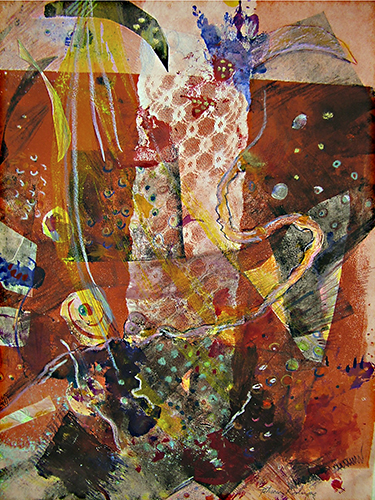
Patricia Rodriquez is mostly known as a public artist, and my presentation will emphasize her most recognized work- her collaboration with the Mujeres Muralistas. Still, I wanted to include an example of her artwork that is both individual and recent. She has a website with a portfolio of her more current work, which, though sparse, features an assortment of abstract, monotype prints. Lace was made using this technique, wherein the artist creates a painting on plexiglass and transfers it onto paper. The style and subject matter is very clearly distinct from those of the murals she collaborated on, but I thought it would be interesting to compare common threads.
Rodriguez's bio on her website states that her grandmother was her first artistic influence. Her grandmother always set time aside after work for her creativity, and this would often include sewing and embroidering. Rodriguez remembers sitting next to her grandmother as she did this. The image she chose to illustrate this bio with is the monotype Lace. It is clearly abstracted, but the central band of knit white is recognizable as the source for its title. This suggestion of fiber art references both her grandmother and women's work more generally. In this way, I think the bridge with her earlier work is a thematic one. She once described the Mujeres Muralistas' work saying, "We were painting women. Women in the marketplace, women breastfeeding, women doing art. People got really angry that we were doing that. ‘How could you do this when there’s so much going on?’ but we were saying that being a woman is a revolution in society."
Rodriguez's bio on her website states that her grandmother was her first artistic influence. Her grandmother always set time aside after work for her creativity, and this would often include sewing and embroidering. Rodriguez remembers sitting next to her grandmother as she did this. The image she chose to illustrate this bio with is the monotype Lace. It is clearly abstracted, but the central band of knit white is recognizable as the source for its title. This suggestion of fiber art references both her grandmother and women's work more generally. In this way, I think the bridge with her earlier work is a thematic one. She once described the Mujeres Muralistas' work saying, "We were painting women. Women in the marketplace, women breastfeeding, women doing art. People got really angry that we were doing that. ‘How could you do this when there’s so much going on?’ but we were saying that being a woman is a revolution in society."
Thursday, February 13, 2020
Alcatraces STENCIL
I had a lot of ideas for this, but the designs turned out to be a bit too complicated for this assignment. I immediately thought of using a picture of a Brown Beret from the early 70s, which I saw at an exhibition at the Autry last year about La Raza newspaper. Unfortunately, the bandoliers she was wearing were just too many to cut out. Instead, I decided on a design of calla lilies. My mom has grown these flowers in her garden for as long as I can remember, and knowing that alcatraces are her favorite makes me feel particularly connected to them. These flowers reoccur in images, most notably Diego Rivera's many paintings of women with calla lilies. Perhaps as a result of following this precedent, I see these flowers in so much of the art at the Mexican restaurants I grew up visiting with my family. They often accompanied brightly colored Aztec scenes or sprawling wildernesses or dancing couples. I particularly remember a painting in a restaurant in Paramount that shows a woman cooking tortillas on a comal, framed by calla lilies.
Although I am associating these flowers with art, my personal experience of them is much more communal and "low brow" than seeing a Rivera oil painting of a woman and bouquet that would hang in a museum. Also, I just went down a rabbit-hole trying to find the etymology of "alcatraces" in Spanish and why it's different from "alcatrazes," as in Alcatraz Island. The latter means albatross (or some other seabird?) and comes from Arabic (maybe??). I have no idea about the flower, though.
Although I am associating these flowers with art, my personal experience of them is much more communal and "low brow" than seeing a Rivera oil painting of a woman and bouquet that would hang in a museum. Also, I just went down a rabbit-hole trying to find the etymology of "alcatraces" in Spanish and why it's different from "alcatrazes," as in Alcatraz Island. The latter means albatross (or some other seabird?) and comes from Arabic (maybe??). I have no idea about the flower, though.

Monday, February 10, 2020
Ofelia Esparza
Listening to Ofelia Esparza discuss her life's work felt like listening to my own grandmother sharing some indisputable wisdom.
She was clearly nervous at first as she held her little notebook, but Ofelia assured us that once she got in the swing of what she was sharing her, jitters would go away. And the nerves did fade as she became more animated, telling us about her work and her family and how those two things are inseparable. She was full of vitality for someone of her age, but it was sweet nonetheless to see how her daughter was so ready to chime in if something was left out. And she was attentive to any of her needs, like when she had water when Ofelia seemed parched.
It's clear that the entire family (and it's definitely a large one) is involved in Ofelia's work, or have at least learned about the craft and done their part to keep traditions alive. Ofelia says she owes so much to her great grandmother, and she is passing this knowledge on to her own great-grandchildren. It goes beyond to so many others through her museum installations, community projects, and through the film that owes so much to her teachings and philosophy. I feel very grateful to have had the opportunity to listen to her speak and to learn about her work. I haven't been able to stop thinking about it, and I've told so many people about what she shared. I can't wait to rewatch Coco soon.
She was clearly nervous at first as she held her little notebook, but Ofelia assured us that once she got in the swing of what she was sharing her, jitters would go away. And the nerves did fade as she became more animated, telling us about her work and her family and how those two things are inseparable. She was full of vitality for someone of her age, but it was sweet nonetheless to see how her daughter was so ready to chime in if something was left out. And she was attentive to any of her needs, like when she had water when Ofelia seemed parched.
It's clear that the entire family (and it's definitely a large one) is involved in Ofelia's work, or have at least learned about the craft and done their part to keep traditions alive. Ofelia says she owes so much to her great grandmother, and she is passing this knowledge on to her own great-grandchildren. It goes beyond to so many others through her museum installations, community projects, and through the film that owes so much to her teachings and philosophy. I feel very grateful to have had the opportunity to listen to her speak and to learn about her work. I haven't been able to stop thinking about it, and I've told so many people about what she shared. I can't wait to rewatch Coco soon.
Wednesday, January 29, 2020
Rasquachismo and Domesticana
Loud and colorful aesthetics tend to be associated with bad taste, especially in the context of mainstream minimalism that was popular in the mid-1900s, the same time that Chicanx art (which is typically loud and colorful) began to flourish. In Domesticana, Amalia Mesa-Bains characterizes this "tastelessness" as a challenge to the dominant culture and the hierarchies imposed upon aesthetics. This is of course because the categorization of what is "good taste" is decided by those with power. Beyond just kitsch, rasquachismo is taste that reveals resourcefulness, being associated with Chicanx working-class repurposing of objects and reinventing them. It is an interesting aesthetic form, rooted in activism. As is usually the case, the breaking of Chicano hegemonic values is concurrent with Chicana breaking of Chicano patriarchal values. Here, this consciousness is revealed through an engagement with domestic spaces and its typical features.
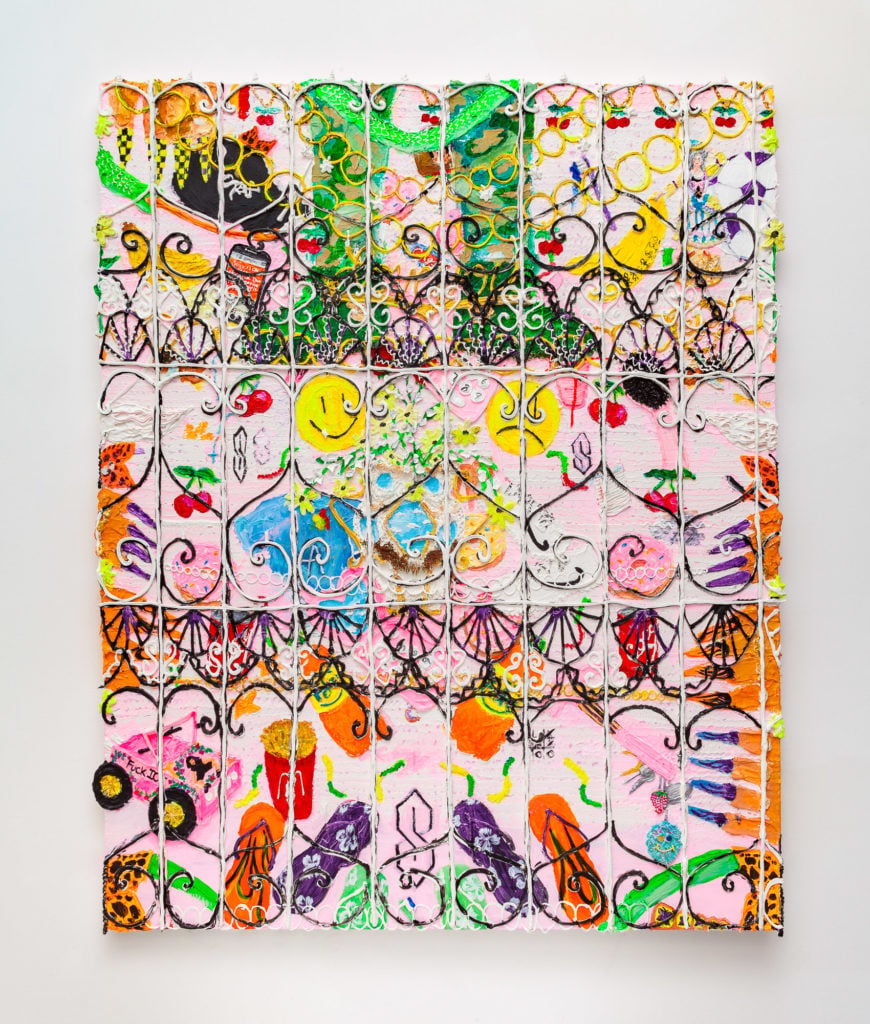
In looking up the etymology of the word rasquachismo, I came upon an article about the work of Mexican-American artist Yvette Mayorga (https://news.artnet.com/exhibitions/yvette-mayorga-geary-contemporary-1712022). Her artworks make use of recycled objects and references to mass commercial production, culminating in a lavish aesthetic that feels like very dream-like. Her work comments on the US/Mexico border, particularly the experiences of those crossing north and the hopeful fantasies sometimes carried with them. Some of her paintings make use of pieces of wrought-iron fences, creating a physical border between the viewer and the imagery in the painting. I think that the loud, colorful style that recalls rasquache aesthetics functions in reinforcing the idea of a "fantasy."
In looking up the etymology of the word rasquachismo, I came upon an article about the work of Mexican-American artist Yvette Mayorga (https://news.artnet.com/exhibitions/yvette-mayorga-geary-contemporary-1712022). Her artworks make use of recycled objects and references to mass commercial production, culminating in a lavish aesthetic that feels like very dream-like. Her work comments on the US/Mexico border, particularly the experiences of those crossing north and the hopeful fantasies sometimes carried with them. Some of her paintings make use of pieces of wrought-iron fences, creating a physical border between the viewer and the imagery in the painting. I think that the loud, colorful style that recalls rasquache aesthetics functions in reinforcing the idea of a "fantasy."
Thursday, January 23, 2020
Lopez, Margaret F. Stewart: Our Lady of Guadalupe, 1978
I wrote quite a bit about this work for the reading response, about Lopez's interest in the formation of cultural imagery and redefining iconic figures. Still, it has just struck me how the subject matter is itself a metaphor for the artist's process of remaking icons in her work. Margaret, Lopez's mother, is shown at her sewing machine working on Guadalupe's cloak at her. At the same time, Margaret is identifying with the figure of the Virgin through the light mandorla that surrounds her. An artist's role as creator is signaled by the subject's own act of creation, both as a textile worker and as a mother. It is interesting to consider the ways that images become icons over time through cultural use, and it goes to show Lopez's conceptual prowess in her work.
Visually, I appreciate the bold colors and the texture from the rag paper surface. The artist's mother is detached from a tangible physical space and instead appears to float in the sky. This image is much less painterly in style than the other two works in the triptych, perhaps suggesting something about the clear working-class image of the subject? I am still trying to discern the significance of the angel at her feet, who rests their chin on their hand and looks up at her. I wonder if this is just a remnant from the original Virgin de Guadalupe image or if it signifies something about the angel's role in holding up the bottom of the Virgin's clothing? Maybe it is just part of the identification.
Visually, I appreciate the bold colors and the texture from the rag paper surface. The artist's mother is detached from a tangible physical space and instead appears to float in the sky. This image is much less painterly in style than the other two works in the triptych, perhaps suggesting something about the clear working-class image of the subject? I am still trying to discern the significance of the angel at her feet, who rests their chin on their hand and looks up at her. I wonder if this is just a remnant from the original Virgin de Guadalupe image or if it signifies something about the angel's role in holding up the bottom of the Virgin's clothing? Maybe it is just part of the identification.
Wednesday, January 15, 2020
Patricia Rodriguez
Based on her projects with las Mujeres Muralistas and the continued vibrancy of her work, I would like to do my presentation on Patricia Rodriguez.
Sunday, January 12, 2020
2020 Moreno, Cindy
Heyy everyone, so this is a relatively late introduction, but my name is Cindy (she/her) and I'm a third-year transfer majoring in art history. I am still considering what my minor will be, but Chicano Studies is a top contender. My interests and career plans with art history relate to art conservation, especially within museums. I hope to someday help facilitate the repatriation of artworks that were acquired in, shall we say, less than equitable circumstances (i.e., imperialism). I am grateful for the opportunity to do a ten-week internship at the Straus Center for Conservation at the Harvard Art Museums this coming summer; hopefully it will all go well!
I am looking forward to taking this class for a variety of reasons, one aspect being the opportunity to learn about art while also making art. I feel that I have been so busy lately that I hardly have the time or energy to draw or paint even half as much as I used to. Also, it feels like a failing on my part to be a) a budding art historian and b) someone who identifies as Chicana and still somehow be mostly ignorant about the work of Chicana-identified artists. So I want to rectify this. I do, however, remember encountering Professor Lopez's work in a survey class on "post-Columbian Latino art" I took a couple years ago before transferring, and I think it's a privilege to be able to learn from her.
This is going to be an amazing quarter, I hope I get to know some of you over this next quarter!!
I am looking forward to taking this class for a variety of reasons, one aspect being the opportunity to learn about art while also making art. I feel that I have been so busy lately that I hardly have the time or energy to draw or paint even half as much as I used to. Also, it feels like a failing on my part to be a) a budding art historian and b) someone who identifies as Chicana and still somehow be mostly ignorant about the work of Chicana-identified artists. So I want to rectify this. I do, however, remember encountering Professor Lopez's work in a survey class on "post-Columbian Latino art" I took a couple years ago before transferring, and I think it's a privilege to be able to learn from her.
This is going to be an amazing quarter, I hope I get to know some of you over this next quarter!!
Subscribe to:
Posts (Atom)