Showing posts with label 2021DuarteAndres. Show all posts

Monday, February 15, 2021

Week 6 Blog Post

 Rasquachismo is a term I have never heard before this class, but it was very interesting to read about. As described by Tomas Ybarro-Frausto, Rasquachismo is an "underdog perspective" and is "An attitude rooted in resourcefulness and adaptability yet mindful of stance and style. The way that I interpreted Rasquachismo is that it is not something you can merely read about to fully understand it, but something that you have to experience in your own life. From the outside looking in, Rasquachismo can look intimidating and may be upsetting to those of higher classes, but this style is based on the difficult realities of many Chicanxs in these communities. Rasquachismo is a culmination of all the coping mechanisms that Chicanxs must use to survive in such a harsh environment, such as houses falling apart, bills being due, and working at a job that doesn't pay nearly enough. Rasquachismo is an essential tool to maintaining a little bit of sanity when the world around you is crumbling.

The term Rasquachismo derives from the term "rasquache" which was used to describe people of lower class and was meant as a term to both degrade and generalize people of lower class. However, the term was reclaimed during the Chicano movement, and though it still has vulgar connotations, it is no longer necessarily a derogatory term. To exemplify Rasquachismo you have to be able to make the best out of whatever situation life throws at you. 

One thing that reminds me of Rasquachismo was how resourceful my grandmother always was. My family did not always have the money to buy me the nicest clothes, but my grandmother was a seamstress when she was younger and she always made sure that the clothes that were handed down to me fit me correctly and sometimes she would embroider logos onto them so that I would be able to show off my cool branded clothes. Rasquachismo lives in the most resourceful Latinxs and it is something that you have to experience to truly understand.

Monday, February 1, 2021

Week 5 Blog Post

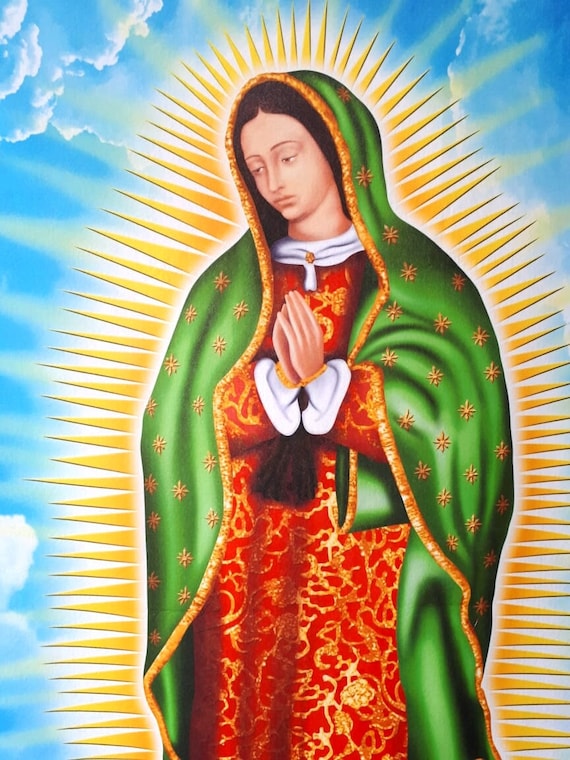
 Virgen de Guadalupe poster Our Lady Guadalupe Virgin of | Etsy

    Growing up in a household of first generation immigrant Latinxs, there was never a shortage of depictions of La Virgen in the house. My abuela and tia were both extremely religious women and they would always have candles and pictures of La Virgen whenever I would visit their houses. To them, she was a sign of hope. Life as an immigrant in America can be overwhelming and often times no one cares about your struggles. The only source of comfort for many Latinx women, my tia and grandmother included, is the church because there are so many people in the exact same situation as you. Being a spanish-only speaking individual in a predominantly English speaking country can create such isolation it is difficult to keep a positive outlook on life, but the Church welcomed these people with open arms.

    Now this may be the perspective of my tia and abuela, but it is definitely not my perspective. My immediate family was not as religious as the rest of my family; we weren't even Catholic, we identified as Lutherans. Though I respect that a woman could have such a high position in Christian iconography, in my eyes, it does not overshadow the obscene amount of atrocities perpetuated by the Church. La Virgen should serve as a shining beacon that women are sacred and they give life to the world, but it often feels like La Virgen is only there for convenience. The image itself panders to one of the Catholic Church's largest audience, Latin America. Foreign religions become much more palatable when you see representation of yourself in it, and La Virgen is the perfect example of giving representation to Latin Americans for the Church's benefit. Under the loving eyes of La Virgen, the Catholic Church has spread racist and oppressive ideals that value conservatism and piety over human life. Catholicism is a plague that has wreaked havoc through Latin America and as long as icons like this exist, it will continue.

Monday, January 25, 2021

Week 4: Printing the Revolution

     The exhibition, Printing the Revolution! The Rise and Impact of Chicano Graphics put into perspective how far Latinxs have come within both the art community and American communities. With the word once standing as a pejorative towards Mexicans in California, to it being reclaimed by these same people, the term "Chicanx" is now a badge of pride for many who live in these communities. The history of Chicanx art runs in tandem with the history of Chicanx's in California, because many of these pieces were in direct response to conditions or laws faced by Mexicans in these communities.

    What I liked most about this exhibit was that it gave perspective of history for Chicanxs from their own perspective. Often time when we learn about history it is from the perspectives of the wealthy and the white, but exhibitions like this show us that there is more than one perspective of history, and this history has value and deserves to be learned. One of the difficulties for Chicanx art is that it is not valued as highly as art from whiter individuals. In the same right that white people are able to create both good and bad art at their choosing, Chicanxs should have the freedom to create any type of art they desire, without having to justify and explain themselves when it is compared to white art. This justification and distinction permeates other aspects of society much like how Chicanx History classes are labelled specifically as such, when Chicanx history was already so important to Los Angeles history. The fact that this history needs to have its own category rather than fitting into a broader picture shows how whiteness has dominated more aspects of life than we consider.

    This piece by Ester Hernandez spoke to me because it brought a grim reality to such a seemingly harmless topic. Though raisins may seem like a regular snack, it is harvested by the work of countless underpaid immigrants. There is no cruelty free consumerism when the people harvesting these fruits can barely make ends meet.

Sun Raid by Ester Hernandez


Monday, January 18, 2021

Week 3 Artist: Manuela Guillen


Manuela Guillen is a Cuban / Salvadorian painter, muralist, and digital illustrator based in North Philadelphia. Manuela has made murals in various locations throughout the US and Mexico. Though she is an artist through all aspects of her life, her day to day job is that of a Spanish Art Teacher. I found the work of Manuela Guillen through my partner who had actually been following her on Instagram for quite some time. Her art immediately caught my eye because something about it just felt so spiritual almost. The topics of her art usually pertain to immigration, voting rights, social and political awareness, and anti-capitalism. The work of Manuela is appealing to me because she uses such soft, comforting drawings and colors to discuss such serious, and often sad, topics. The reason she focuses so much on posting her art on Instagram and public murals is because she believes art should be accessible to anyone, and the topics she discusses through her art, such as women empowerment and immigration rights, should be seen by the whole public, not just select few who have access to websites. For this reason, she just goes around Philadelphia posting up her designs throughout her community to raise awareness.

This image depicts a woman letting birds and flowers fly away while the sun shines down on them. This image spoke to me because it is just such a simple yet elegant way of demanding the rights of these children locked in cages.
This image depicts a woman sitting surrounded by plants that says "Take up Space". The reason this image caught my eye is because it was a reminder that it is okay to just exist. People are so often judged solely on what they can offer to society or how much they work, but it is okay to just take time for yourself and enjoy life. I also liked how the plants around her are so many shades of green. It feels as if she was trying to show that all plants do is breath and live their lives and that is okay, just like how people should.


Monday, January 11, 2021

Duarte, Andres (Week 2 Blog Post)

 How has the internet provided a platform for more socially aware forms of art?

The road to becoming a more socially aware person is a road that requires a lot of self-reflection and education on many topics, but the issue with achieving this level of social and class-consciousness is the fact that many of these ideologies and beliefs are very difficult to access for those who cannot afford higher forms of education. Though this does not necessarily mean that uneducated people cannot be socially aware and progressive, but lack of education is a large contributor to racial stigmas and practices. With the age of the internet upon us, or as referred to by Zapata in her article, "Web 2.0", access to this information and social movements have become more accessible than ever. With the world being more interconnected than ever before, a simple hashtag is enough to create a snowball effect of progressive movements. Movements such as the #MeToo and #BLM were only possible through world wide platforms that allowed for people with similar ideologies and life experiences to make their voices heard throughout the world. Prior to the 1990's social injustices, such as the unfair murders of black, brown, LGBTQ+, etc. people, would often go overlooked by most of society, with no progress to be made, but in todays day and age videos exposing corrupt officers, live testimonies, and informative infographics no longer get swept under the rug by the ruling class who would much rather maintain the status quo than potentially jeopardize their position of power. Victims such as Breonna Taylor, George Floyd, and Trayvon Martin, among many more, have been immortalized and now stand to challenge the oppressive systems that the government and wealthy class have sought to maintain for so many years. The internet allows for anyone to be able to access this information. Though this era has led to an age of misinformation and echo-chambers, it is an undeniable fact that progressive movements are now able to reach a larger audience than ever before. Though the world still has a long way to go for many social injustices, voices no longer have to become lost to time. 

Monday, January 4, 2021

Duarte, Andres (Andres)


My name is Andres Duarte. My preferred pronouns are he/him. I am currently a 5th Year Spanish, Community & Culture Major and I work in an after-school program in a predominantly Latinx community. I was born and raised here in Los Angeles. My mother's family is from Ecuador and my father's family is from Mexico. Though I have had many opportunities to visit Ecuador, I dream of being able to visit many different parts of Mexico. My goal after college is to become a teacher working with children in predominantly Latinx communities. My mother was a teacher, so school was an important part of every aspect of my life. The reason I am interested in this class is because I am tired of seeing artists that do not represent me. Growing up in America, we are taught about these famous European artists and from this point our idea of what can be considered art is immediately skewed. Only learning about the forms of art of one single race, in this case white Europeans, not only changes how we perceive other types of art, but actively colonizes our minds against them. I am excited for this course because I want to see "unconventional" forms of art that will truly make me wonder why I had never considered why this could be done. One of the readings that particularly interested me was the "Why Have There Been No Great Women Artists?". I found this article so interesting because I had never really considered this question. I've heard of artists such as Frida Kahlo, but my knowledge of female artists ends there. I had never considered the amount of privilege it takes to achieve the same level of fame that most of these male artists achieve. Even the idea of what can be considered art is exclusionary and at times directly hinders female artists.