Showing posts with label 2021GonzalezMelissa. Show all posts

Friday, March 5, 2021

Week 10 Blog Post: Reflections


Fresa Con Canela

I have been looking over Crystal Galindo’s work over the course of the class, as she was the artist that I presented, so it feels best that I reflect on her. There were new additions to her website as it came closer to my date to present her work to my classmates so seeing new art by her felt really cool. Especially when I researched that her portrait “29 Dolor” was one of the last self-portraits she did and when she uploaded the new work she had a new portrait of herself. When I was listening to my other classmates present their projects, a few of them had mentioned that they got into contact with their artists and had a conversation with them, and mentioned that they were doing a project about them. I had been thinking about doing that with Crystal Galindo but shyness kept holding me back from doing so. But after hearing everyone else’s pretty positive responses to talking to their artist, I may get a hold of Galindo and tell her what I have learned about her and her work, along with telling her about the project. 


Before I took this class, I was not very knowledgeable about artists, let alone Chicana/x and/or Latina/x artists. Now that I have seen everyone present their projects with their artists, along with the panels that I have found very interesting, I now see what I was missing in terms of art and artists. I had been limiting myself in the type of art that I consume. Not only that, I now see the passion that these artists have for their work with what they incorporate into their art, whether it’s from their personal lives or from social issues they are passionate about (such as Favianna Rodriguez being an environmentalist and wanting to have a conversation about abortions and sexual pleasure and womb trauma if I remember her speech correctly). I may go back and find some of the artists my classmates presented and view more of their work on social media or their websites. I really enjoyed seeing all of the different types of artwork by all of the Xicana/x’s, Chicana/x’s, and Latina/x’s. 


Thursday, February 25, 2021

Blog Post #9: Chicana Futurism

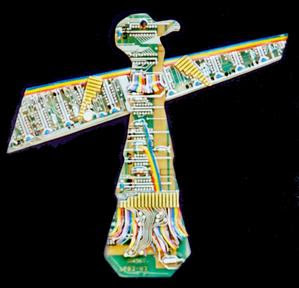
Marion C. Martinez - Techna-Bird

“Chicanafuturism” seems to be an art form that mixes “traditional” Hispanic art forms mixed with 20th-century technology. It can be best described in the chapter, “Deus ex Machina, Tradition, Technology, and the Chicanafuturist Art of Marion C. Martinez” written by Catherine S. Ramirez. An example of Chicanafuturism is in the exhibition Cyber Arte in the Museum of Internation Folk Art in Santa Fe, California. The exhibit is described as, “visual art fusing ‘“elements traditionally defined as ‘“folk”’ with state of the art computer technology”’” (146). Hence, Chicanafuturism. The article continues on to relay that, like African Americans, Chicanos have been excluded from and objectified by the discourses of science. An even detailed definition of Chicanafuturism is stated as a cultural transformation from technology that, “excavates, creates, and alters narratives of identity, technology, and the future; that interrogates the promises of science and technology; and that redefines humans and humanism” (158). 


The work of Marion C. Martinez is compromised of technology as well as wood and other materials - not just limited to parts of machinery. In an interview, Marion C. Martinez said she has made visual art with technology for 15 years and always had a curiosity about computer parts. In the Cyber Arte exhibition in Santa Fe, California nine of her works were featured and they were definitely, under the definition of Chicanafuturism, a mix of folk art and technology. Of her nine works, “Four of the pieces are inspired by the matachines, ‘“a ritual drama performed on certain saint’s days in Pueblo Indian and Mexicano/Hispano communities along the upper Río Grande valley and elsewhere in the greater southwest”’” (152). Her other works included headdresses worn by danzantes, or male dancers, that was comprised of circuit boards and wires. Marion C. Martinez’s work is a mix of folk art and technology, making up what is known as “Chicanafuturism”. 


Sunday, February 21, 2021

Post #8: From Black and Brown Solidarity to Afro-Latinidad panel discussion

Screenshot of "3 Pillars of Gender Justice"


Favianna Rodriguez is an Afro-Latina of Peruvian descent who lives in Oakland, California. She is a 1st generation woman of color who is also an environmentalist. Living in Oakland has led to her fighting against the fossil fuel industry because of the amount of pollution the city endures because of the freeways. She also incorporates messages about the body in her work. She openly talks about abortion and womb trauma and believes they should be openly discussed topics as opposed to being the “taboo” that the culture thinks they are. I found Favianna’s talk incredibly interesting because of how candid she was with topics that are usually seen as taboo within the culture and with her experiences of traveling due to her mother being a travel agent (pre-Internet, as she states). She lived in Mexico City and noticed that her people, such as her Afro-Latino father and grandmother, were not represented in the novelas. She also traveled to Peru and reconnected with her culture as well. 


I also remember that one of the readings, “Chicanx Graphics in the Digital Age” from pages 138 to 139 had mentioned Favianna and her website that has resources such as shareable graphics and art downloads. One of the questions that the moderator, Kaelyn Rodriguez, asked was about entrepreneurship in art and Favianna had mentioned sharing resources. I cannot remember exactly how she phrased her answer but “sharing resources” had reminded me of the reading and her website that does in fact do so. She also talked about gentrification in Oakland and the displacement that comes with it. She was discussing how, compared to her younger years living in Oakland, the community currently is not the same as it was when she was younger. Favianna also incorporated how her community, or those of the Black and Brown community, are suffering from high rates of COVID. All in all, I really enjoyed hearing her speak. She touched upon many different topics and I would enjoy listening to another of her talks in a panel.


Friday, February 12, 2021

Blog Post 7: Graffiti


Venice Beach graffiti - Pixabay

Graffiti is a way to manifest self-esteem and self-expression and it usually begins with wild and uncontrollable adolescence at the start of each new generation. The chapter by Charles “Chaz” Bojórquez states that, “Graffiti is a new type of imagery irreverent to any rules” (117). Of course, Los Angeles has a plethora of graffiti and the history behind it is just as plentiful with intricacies and styles. Something I did not know about graffiti is that each style has its own name and has its own way of being produced. One such style is called placas, or a pledge of allegiance to one’s neighborhood that is placed on a wall. Placas are commonly seen as the graffiti in uppercase letters. Tagging a wall with a placa is an artistic way of expressing a formal document that encourages gang strength and exclusivity. This art is written in a format with a headline, body copy, and a logo - similar to ancient Sumerian ancient clay tablets and the Constitution of the United States. 


I don’t have experience with tagging, or graffiti, other than seeing it on walls, freeway underpasses, and on the sides of small stores when I was living in LA County. Growing up, there was this idea that graffiti was “bad” or an indication of gang activity. Even the article says that graffiti is often associated with “vandalism, destructive behavior, and meaningless scribbles. We also hear about the enormous cost to property value caused by tagging” (117). I was also taught that graffiti is something to be scared of, the article states this too. I never understood this concept of associating graffiti with vandalism and fear because it just, to me, seemed like public artwork. Though I know now after reading the article that there is more symbolism, art styles, and form to graffiti, I never once thought it to be something I should be afraid of.


Friday, February 5, 2021

Post #6: Define Rasquachismo or Domesticana


Domesticana was stated to be the counterpart to rasquache. There were definitely distinctions within the art movement between Chicano art (rasquache) and Chicana art (domesticana). Amalia Mesa-Bains says it best, “Chicana rasquache (domesticana) . . . has grown not only out of resistance to majority culture and affirmation of cultural values but also from women’s restrictions with the culture” (94). Within domesticana, it seemed that the art typically was focused on the home, church, and the community - overall, a domestic space within working-class Chicanas. This domestic space includes home embellishments, altars, healing traditions, and a feminine style. Altars will include family history and/or cultural beliefs and are typically placed in the bedroom. They contain objects such as flowers, candles, mementos, family pictures, flags, and more


I have never thought about domesticana being a present artform in a household, now that I have learned about it, I always have had an altar in my home or have seen one when I go to my grandma’s house or even one of my aunt’s homes. They always have pictures, flowers, trinkets, candles, and so on - the ones I have seen are in the living room but I do not doubt there are some in the bedrooms as the article has stated. A personal example of an altar comes from mom and from myself. The image on the top left is first seen when entering my house, though it is simplistic, my mom often decorates it according to holiday or the season. No matter, some recurring items are a candle, a photograph of family (or mainly my baby brother), or a plant, along with some holiday decorations. The image in the middle

right and bottom left are in my own room, I would consider my examples as an altar because it follows the list of objects found in altars such as flags (from countries I’ve been to), pictures, plants, candles, or small trinkets that I find valuable. Both examples indeed create a feminine style that also has a timeline of family history of a sort. My mom will also typically have some sort of religious item on the constantly changing altars as she is a Christian.


Thursday, January 28, 2021

Blog Post #5: The Virgin of Guadalupe - Gonzalez, Melissa


Santa Rosa de Lima

For about the first 10-11 years of my life, I lived in Maywood, California, an extremely small city in LA County that is also a predominantly Latino community. My parents were Catholic during our time living in that city and we often went to a nearby Catholic church called Santa Rosa de Lima. In this church, I did catechism as well as my First Communion. I remember my dad doing something skin to adult catechism too. We were moderately involved with the church, although I really did not care to go to church at all, I sort of just accepted the fact that being Catholic was part of my “identity”. As I got older, around 14 years old and in my freshman year of high school, I began a phase of wearing a necklace of la Virgen de Guadalupe.


I cannot remember why I began to wear her so often but I did. One year, someone broke into the church and defaced the Virgin Mary with 666. I remember being so hurt by this that my phase of wearing her around my neck grew stronger. However, things began to change. I thought that since I was wearing her so often I would try and improve my religious studies. Reading the bible became a goal of mine but I read one story (that I cannot remember which but can remember a summary) and I became so disgusted with the contents that I read, I closed the bible, ceased wearing her around my neck, and never looked back. After dismissing the bible, I also realized that I hated going to church and sitting there for an hour listening to a priest telling me to be virtuous and doing certain acts is a one-way ticket to hell and that certain things are not “pure” in god’s eyes. I questioned many of the sermons of the church because I simply did not agree with what they saw as righteous or sinful. There was a point where my dad forced me to read psalms/stories to my younger brother and I realized that I hated doing that too. And THEN I began to assess my “relationship” with la Virgen de Guadalupe and I could not think of any other reason as to why I wanted to be close to her other than that’s what I was told to do. 


Since then, I detached myself from her because I realized it was an empty “relationship”. I don’t necessarily hate her, I just know now that the only reason I attempted to be close to her was that I was conditioned to. I know La Virgen is a huge symbol with Catholics and within the Chicanx community, but I simply do not feel the need to form a relationship with her, even as I further my studies of my community. I can admire who and what she represents (especially with the battles she was depicted in history, I found that quite interesting) but I cannot bring myself to admire her as I once did (or even in the mindset of the community) because it would simply be a lie. I don’t pay mind to her and I am no longer Catholic, as a matter of fact, I’m not religious at all, but I understand her importance to the community. 


Catholic Church Ransacked


Friday, January 22, 2021

Blog Post 4 - Smithsonian Art Museum

Sun-Raid Raisins by Ester Hernandez, screenshot, time 26:00

The panel for Printing the Revolution! The Rise and Impact of Chicano Graphics, 1965 to Now from the Smithsonian American Art Museum was very interesting. I thought it was engaging to see Claudia Zapata again as a Curatorial Assistant of Latinx Art. I found Ester Hernandez’s background enlightening. I enjoyed that she mentioned her familial backgrounds that led to inspiration within her artworks. Her background as being born into the Movimiento with her family as a “woman-centered farmworker family” and the women having a history of labor strike involvement in the early 1930s and the 1960s with the United Farmworker Movement, with her father being first in the barrio to join. I also thought it was cool that she has a history of seeing the Teatro Campesino. I had just taken a Chicano theater class the previous quarter so I enjoyed that I can apply what I have learned from a previous class to what she experienced with the Teatro Campesino. 


One thing that stuck with me was when Ester Hernandez spoke to Dolores Huerta. Huerta talked about the importance of making images of oneself because, in the media, Chicanas are portrayed as “people to fear or to pity”. Thinking back on the readings, I definitely agree with this. I can see how Huerta’s statement about making self-images that can go against the image that others impose upon Chicanas is connected to the readings. Ester Hernandez was gracious enough to give an example of how this applied to her when she was censored for the first time at UC Berkeley. If I got to ask her some questions they would be, did you fight the censorship of your artwork at Berkeley? If so, how did you go about it? Did you experience censorship again in the later parts of your artistic career and how was that handled?


Sunday, January 17, 2021

Artist: Crystal Galindo - Post #3

Image from Galindo's website

Image from Galindo's website
 
Crystal Galindo is a Yaqui-Xicana artist who was born and raised in Tulare County, Galindo now lives in the San Francisco Bay area. Her inspiration for her work is her father, who gave up his own artistic endeavors in order to support his family, her figure paintings ranged from close-ups to cholo style portraits, she was self-taught until 2004 before enrolling at the College of the Sequoias for drawing and painting classes, and her paintings are known for being bright, "confrontational", and celebrations of her culture. Galindo is also an undergrad at Sonoma State University. "Multifacetica" is her popular series that, "focuses on muxeres who inspire and encompass strength, power, and pride" (Galeria). A new series titled, "Xingonxs" is said to be one of her newer works to be debuted in the future.  

References 

crystalgalindo.com  : Information derived from "BIOGRAPHY" section on website
pbs.org : "Crystal Galindo Art Exhibit"
remezcla.com : "Meet Crystal Galindo, the Painter Celebrating Chicanas, Chingonas, and Cholas"


Monday, January 11, 2021

Week 2: Revolutions


I found this article by Claudia E. Zapata to be incredibly interesting as it touched upon the digital aspects of Chicanx artists and art. Other classes I have taken have mentioned the earlier forms of art such as posters, calendars, murals, paintings, drawings, etc but they never went into depth about how artists and artwork evolved as the world became more technologically advanced. The article made the point that digital platforms assisted Chicanx artists to protest injustice, to improve education, and cultural reflection, and solidarity. One section of the article that made me wonder about technological advancements and political activism was Rupert Garcia and how they, “viewed digital strategies as part of a commercial practice, that it would corrupt the purity of fine art” (132). The article continued to state that Garcia quickly renounced doing hand-printing art, as they found it time-consuming, and embraced the digital way of producing artwork. 


Garcia’s reluctance of digital artwork then embracing it while renouncing handmade work made me wonder about handmade artwork as a whole within the Chicanx community and its political activism. Within political activism, did the rise of digital platforms completely demolish handmade artwork or did handmade artwork become the lesser-used model? If I had to make my own observation, I would say that the answer to my question has some grey areas to consider. Although I am not an artist, I don’t believe digital platforms demolished artwork by hand or that handmade art had completely ceased because there are artworks that are both digital and handmade - two small examples I can think of are pins/buttons and bookmarks. I am not certain of the prevalence of them during the beginnings of transformative artwork but today, they are excellent forms of political artwork that can be digital or handmade. While some works can solely be done digitally or by hand, there is still a middle area of the artwork that relies on both platforms and are just as effective.  


(Top bookmark - Front: Campaign Party with Mariachis. 1954. From the Chicano Studies Research Center Edward R. Roybal Papers.

Bottom bookmark - Front: Various record scans from the Strachwitz Frontera Collection of Mexican and Mexican American Recordings.

Right and Left pins - pins from a Chicano club at Fullerton College in Fullerton, California.)

Thursday, January 7, 2021

Gonzalez, Melissa


Hi everybody! 

I'm Melissa Gonzalez and my pronouns are she/her/hers. I am a second-year transfer majoring in American Literature & Culture and minoring in Chicana/o & Central American Studies. I am a copyeditor intern for the newsmagazine La Gente and this is my last quarter at UCLA. After graduating, I hope to enter the book publishing field in New York City and eventually move to London, England. Aside from reading and writing, my other interests include running, watching scary movies, and playing dnd (a new hobby thanks to quarantine). 

I took this class because I do not know a lot about Chicanx art and artists. The topic has come up briefly in other classes that I have taken but I like the fact that this class is dedicated to learning just that. While I do enjoy seeing art at face value, I hope to gain a greater appreciation and understanding of Chicanx art and artists. In Holly Barnet-Sanchez's, Where are the Chicana Printmakers?, something I found interesting was the contrast in how Chicanx's were portrayed in artwork. On one hand, they were portrayed as icons from Mexican history, soldadera's, and political activists, while the Anglo image stereotypically portrayed Chicanx women as maids, long-suffering mothers, dancers, and performers. I was aware that women were confined in the way that they are portrayed within the community but I did not realize how Chicanx women are portrayed by Anglos. I hope this topic is something that the class can touch further upon.