I grew up knowing about the virgin of Guadalupe, but I didn't know the story of how she appeared. I would always confuse her with the virgin Mary. I never asked because I assumed that they were the same. In one Chicana(o) class I took, they were talking about the virgin, and then everything I was confused about fell into place. I asked my dad if he knew, and he said yes. I was very confused, and I wondered why I did not ask. Growing up knowing about her was always a positive experience. When I grew up in Mexico, parents tell their kids to pray to la Virgen de Guadalupe and that she will help us sleep and accomplish our dreams. For me, she was like a magical being. I also saw her with motherly like characteristics because, in my mind, she was always there to help me. When I decided to draw her on my sketchbook, I was thinking about how she looks; then, I imagined my mom. In reality, my mom was the person who was always there to help me. My mom used to draw flowers on a notebook still. I remember as a child when my mom would have her notes from work out and at the bottom of the page, she would have pretty little flowers doodled with pen ink. In this image, the virgin has characteristics that remind me of my mother. In this image, the virgin has a dress made out of flowers. Instead of an angel, there is a bouquet of roses. She has curly hair because my mom has curly hair and has the glowing light around her. This is because, to me, my mom is magical.
Showing posts with label 2020OcampoMaria. Show all posts
Showing posts with label 2020OcampoMaria. Show all posts
Sunday, March 15, 2020


Thursday, March 12, 2020
Blog 10:Course Reflection
When I first signed up for the Chicana Art and Artists course, I was not entirely sure about what we would be learning. I was excited that I would get the opportunity to learn more about women in art since I did not know many women who were well known by many people. The class was very interesting from day one. The activity of writing down on the board the names of women in art made me realize that there are so many artists that we still do not know and are like hidden gems. Lectures were always entertaining and knowledgeable. I enjoyed listening to all lectures about work related to the virgin of Guadalupe. I grew up going to church, and la Virgen the Guadalupe was a big part of my life. Looking at how artists changed the narrative to empower other women was inspiring to me. Unlike other people who got upset at the references to la Virgen de Guadalupe, I thought that it was powerful to challenge ideas of religion that have been part of our history for a long time. To me, it was not insulting. Instead, I was able to relate since the artwork created by Chicana or Latina artists was based on representations of real women in our lives. When I learned that I would be doing an art project with the sketchbook, I was very excited because It had been a long time since I stopped drawing and making art, which used to be one of my favorite hobbies. Going back and learning some of the basics of drawing was very helpful. Even though I thought I was not going to be able to do much, I enjoyed the process of creating and slowly learning different skills. Finally, listening to my classmates' present work from Chicana or Latina artists was also one of my favorite parts. Every artist has unique techniques and ideas. Getting exposed to all of the artists' works made me more curious to learn more about women in art and continue learning even after completing the course.
week 9: artist presentations_artwork response
An artwork that caught my attention in class from my classmate’s artist presentation is a print titled “migra” (2013) created by Natalia Anciso. This print shows an ICE agent walking past a dead body on the floor. The agent is looking down at the floor where the body is lying. His sight aligns with where the face of the person on the floor should be. The face of the person on the ground has flowers covering the face. The flowers seem to be bursting from the ground and blooming. These have vibrant colors and seem full of life. The person on the ground and the ICE agent are not colored; they are both gray. This reminds me of the way statues are usually displayed at different art museums. They do not have color and seem to be in moving motion, but they also seem to stay still as if they were in a photograph. This image captures the reality happening in the present. Immigrants die while attempting to cross the border. Some of the leading causes include heat stroke, dehydration, and hyperthermia, according to sources. Another cause of death is due to the abuse of force from the border patrol agents. The print speaks about this issue happening to Latino immigrants. The agent walks by the body on the ground as if it were nothing important, but the vibrant colors of the flowers speak for themselves. They place the most importance on the person who seems to have passed away. They reflect life even though the person has lived a short life. The image serves as a protest against the injustices happening at the border.

Friday, February 21, 2020
Guadalupe Rosales, 2020 Presentation artist
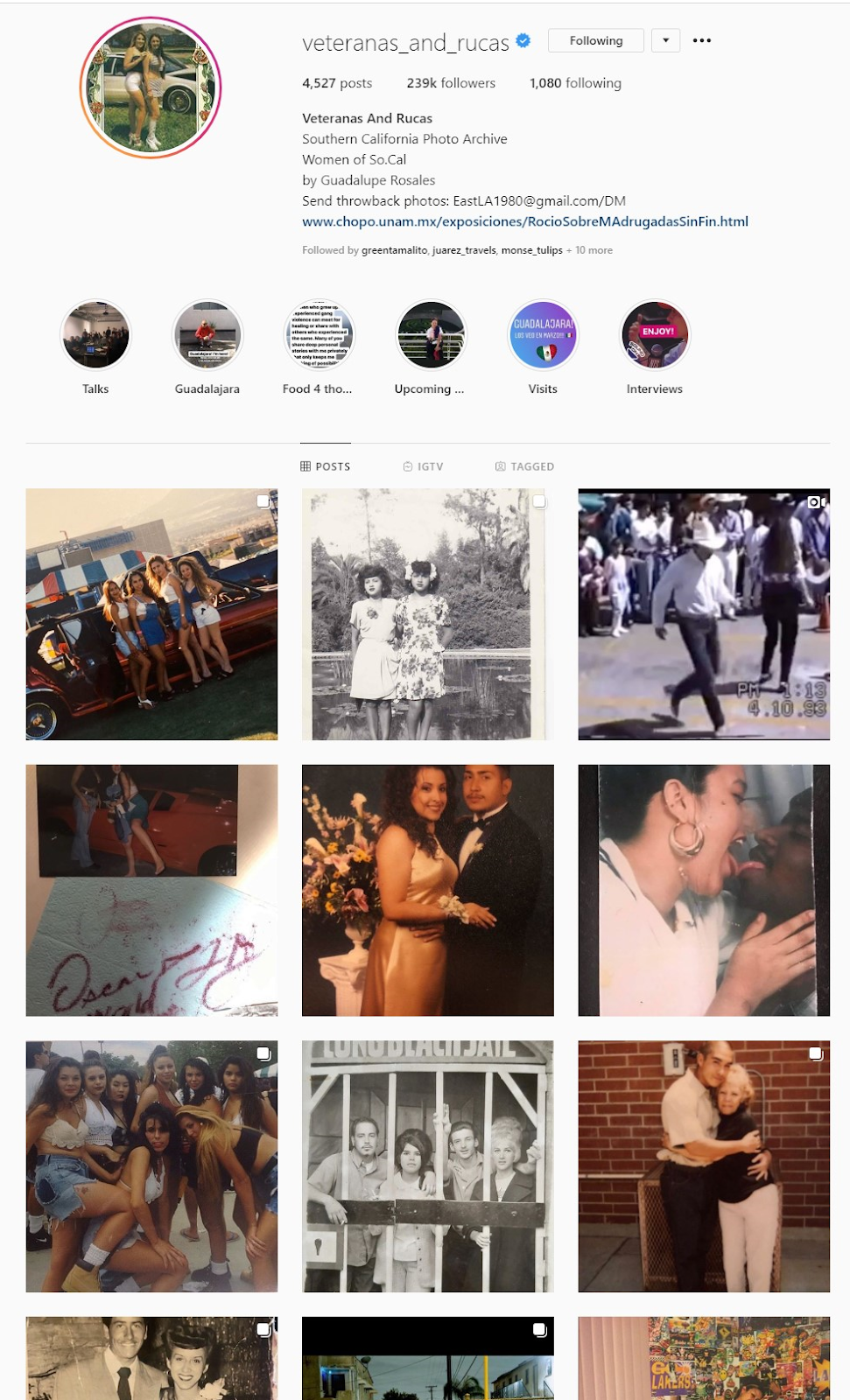
For my presentation, I chose to talk about Guadalupe Rosales. She created an Instagram account, where she shares images of photographs taken before social media began. She began the Instagram page with some of her photographs; then, she started to receive pictures from many people who came across her platform. She did this project that later became a gallery. People could submit their photos about people they missed, and that represented the life of women, especially in the community of Los Angeles. She became famous, and her work was published in magazines and got transferred into a real-life gallery. For Guadalupe Rosales, this project was important because when she was twenty years old, she moved to New York, where she disconnected from everyone in her life. She decided to make these decisions because many things in her life were changing. One of her close cousins was killed at a party due to gang violence. This experience led her to disconnect from her family and move out. She realized that she missed her family, but Rosales did not have communication with them, so she started to research things on the internet to keep up with news and reconnect with her community, but she would not find anything. All she saw were misrepresentations of her community. She had the idea of creating an Instagram account, and since then, it has become prevalent with over 200k followers. In the present, she continues her work, and she also organizes car shows at different events. She has also presented in different places, including UCLA, museums, and other public institutions.
Week 7
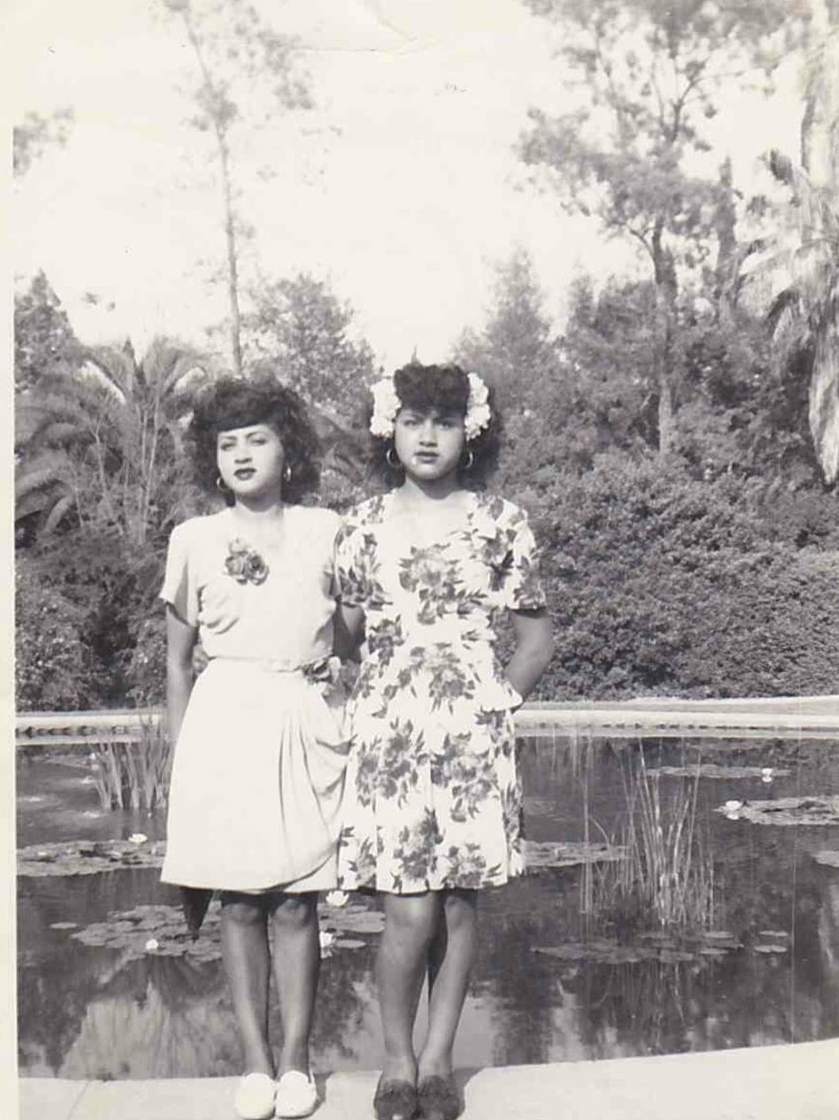
Guadalupe Rosales (1980) is an artist born and raised in Los Angeles, CA. She moved to New York when she was 20 years old. She mentions that she moved because many things were changing in her life when she was living in LA. One of her cousins died due to gang violence. When she was in New York, she missed her community and wanted to feel connected with then, but every time she would search for things that would connect her with her past life, she would not find it. She would only find misrepresentations of her community. She decided to create an Instagram account and post old pictures (pre-social media) that represented the life of Chicana women and anything related to their community in Los Angeles. She did not want male-dominated or fashion photos, she wanted to represent females and things that would feel more intimate to her stories. Her Instagram account then became an online gallery where anyone can submit their pictures of people or things that they love and or miss. I like this image because it shows how life was during the time it was taken. It reminds me of pictures I saw at home from my parents when they were young. Women used to have big hair and dresses that went down to the knees. The images stop time and save treasures for a long time. Even though I did not grow up when these pictures were taken, I can connect and imagine myself as if I was there too.
Friday, February 14, 2020
Week 6 stencil
I decided to use a combination of these images because I wanted something that represented the essence of a person. I think of each person as a unique universe on their own because we all have unique thoughts and ideas. Sometimes it is hard to understand a person entirely because of the individual experiences they have gone through, which are different from our own. Often people try to understand others, but it is okay to not identify with everyone. It is okay not to know what to say to others. In the images, the stars represent not only an infinite amount of thoughts but also an endless amount of people. All the generations lived in this world and maybe others. The trees represent being able to find the way to ourselves. Discover all the good and not so good things about us before judging or criticizing ourselves and others. We often see negative things everywhere—news on television from people arguing, crime, and other things. I feel like people forget that it is okay to be different, and it is okay to have different ideas. All this is what makes life interesting. Instead, they argue, fight, and even go as far as to harm others. I feel like we need to get to know ourselves first and love ourselves so that we can have better relationships with others. These images are a representation of the human essence. It means that everyone is unique and has enormous potential as big as the universe.


Monday, February 10, 2020
Carmen Lomas Garza
Week 5 - Blog Post:
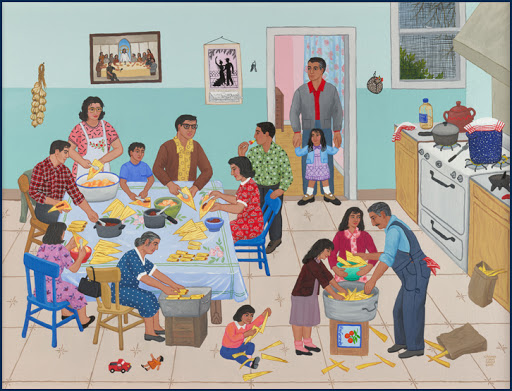
One of Carmen Lomas Garza’s images that I am interested in is “La Tamalada.” This image displays the culture of many Chicano families, but also other cultures where families come together and work as a team to create something great. In this image, Garza shows a family helping to make tamales. Everyone is helping- from the youngest to the oldest. This reminds me of when my family gets together to make tamales for Christmas. It is like a bonding time. Everyone is sharing their life experiences, kids are playing around the house, and by the end, everyone gets to try the first batch of tamales. We eat and drink something traditional such as champurrado, a warm chocolate drink, or a hot fruity drink, ponche. From talking to my friends from different backgrounds, they also have similar traditions where they get together to make big portions of food. A friend was telling me that in his house, they usually get together to prepare food in large quantities, but instead of tamales, they make dumplings. The image displays specific cultural symbols which can be considered to be part of “domesticana.” The image of “The Last Supper,” a religious painting, a chain of garlic hanging from the wall, and a wedding picture. All these are part of the Mexican culture. They are usually seen in traditional Mexican homes. Garza uses these symbols to bring the viewer to a closer understanding of the culture and make it for others to be able to identify with it.
Rasquachismo and Domesticana
Week 4 - Blog Post:
Before reading about Rasquachismo and Domesticana in Chicano and Chicana Art: A Critical Anthology, I believed that the term rasquachismo had a negative connotation. I listed people using this word while I was growing up and people would often use it as an insult or a negative adjective to describe someone or something. I used to think that this word described a lazy person or a person who does not care about their appearance and did not want to get a job. After reading about this term in the book, I realized that the meaning of the word is used differently throughout time and space. In the present, this word is used as a cultural continuity. For people who want to reconnect to their roots and their history. They use elements that are associated with being Mexican, for example. Rasquachismo can be seen in art, music, movies, poetry, etc. It describes the way how the “thing” came to be. People use whatever is available to them to create. They are resourceful and have a different attitude towards what they do.
On the other hand, the meaning of Domesticana adds on the experience of Chicanas in specific. They also display rasquachismo, but they display everyday experiences of the “domestic space.” In a way, it shows the gender roles there are in the Chicano Culture. The saying that women belong in the house cooking, cleaning and taking care of the family. I had never heard this word before, but now I understand it and I am able to distinguish it in the art of different female artists.
Saturday, January 25, 2020
CARA exhibition: blog 2
“Out of the House, the Halo, and the Whore’s Mask: The Mirror of Malinchismo” by Alicia Gaspar de Alba talks about the low representation of women in art in the exhibition CARA, the first major national exhibition of Chicano(a) art. But more specifically, it talks about sexism and stereotypes women faced withing the Chicano Movement. This writing gives a perspective of the movement through the eyes of women artists. For me, it was interesting to see how many people in my culture have a long history of a fixed mindset-Machismo. In this writing, we can see how women were criticized when they broke their expected roles. For example, women were not supposed to be artists because they needed to pay attention to their families. They were not supposed to create murals because they did not have the strength to do the hard work- they were not “mentally or physically capable” to be out doing this type of thing. In art, when created by men, women were depicted as “humble virgins, radiant mothers, or ferociously devoted revolutionaries.” Women were not seen as good Chicanas because they were presenting themes about the female body such as abortion or menstruation, sexuality, and others. It is interesting to see how the Chicano movement was working towards equality, but there were not being supportive of women in the movement. When women created art, they were seen as anti-Chicanas, as women who sold their bodies, wannabes, and others. Machismo is still present today. This happens because men might be afraid to let women take charge. All of these beliefs have been internalized that it is hard to change them. This causes so many stereotypes and hurts women in this case.
Thursday, January 23, 2020
Week 3: Yolanda's Margaret F. Stewart: Our Lady of Guadalupe, 1978: blog 3
Growing up in Mexico I got to experience the devotion Mexican people have on the Virgin of Guadalupe. She is referred to as the Queen and mother of Mexican people. As a kid, I had a great admiration for la Virgen de Guadalupe because everyone talked about how miraculous she is. She also is the definition of how a woman should be. It is interesting to see how Lopez uses many iconic features from the Virgen of Guadalupe and involves then in her artwork. In Margaret F. Stewart: Our Lady of Guadalupe, 1974, Lopez uses iconic features that represent the Virgen of Guadalupe such as her Blue Cloak filled with gold stars, an angel, red roses and rays of sunlight. Instead of using those features to represent the Virgin of Guadalupe, Lopez depicts her mother, Margaret and brings up a new way to see “womanhood” and a new proposal of beauty. Her mother, Margaret, is surrounded by bright gold sun rays as she sews a blue cloak with stars. There is an angel at the bottom looking at her and seems to be wondering and looking at Margaret. The roses do not take up a lot of space, instead, they are on the corner of the painting and lay on the floor. There is also a serpent that is tightly wrapped and pinned to the sewing machine. The serpent can have different meanings, one which is fertility. The image of Margaret shows a woman who has shed her imaginary skin like a serpent and has given a new meaning to who Chicana woman is. It does not mean being passive and displaying only purity, love, and devotion. It means leaving behind the stereotypes and owning her sexuality- her life. The image does not show women displaying “youth or glamour, whiteness, and leisure, thin and curvaceous bodies,” it shows a woman that represents beauty without the need to follow stereotypical and sexist ideals of beauty. I like this painting because it illustrates a real woman- a real representation of a Chicana woman who does not need to meet the requirements of society to be beautiful. She is the representation of beauty.

Yolanda M. Lopez, Margaret F. Stewart: Our Lady of Guadalupe, From the Guadalupe Series, 1978. Oil pastel on paper, 22 x 30 inches.
Wednesday, January 15, 2020
Ocampo, Maria blog 1
Hello!
My name is Maria Ocampo Brito. I was born and raised in Guerrero, Mexico. I migrated to the United States when I was fifteen years old. I attended Cypress College in Orange County and I transferred to UCLA in the Fall of 2018. I am a Psychology major and a Chicana(o) minor. My goal is to get into a Ph.D. program in Clinical Psychology. I would like to research about family interactions and mental health stigma in the Latinx community and how these affect help-seeking behaviors. I would like to be able to work with my community and bring mental resources closer to the people.
Before transfering from community college to UCLA, I did not know a lot about Chicana(o) Studies. I did not understand what a Chicana(o) was. Since I migrated from Mexico, I only knew about people like me. I did not know that there was a group of people who considered themselves as Chicana(o)s. When I finally learned about this, I only thought that this term applied to Mexican people who were born in the US. When I took Chicana(o)10A and 10B, I finally understood the history and the experiences of people that have been recorded over time.
I am excited about taking Chicana art and artists because I would like to learn more about how Chicana women portray art, how they are portrayed by others and the different interpretations and perspectives there are. Also, I would like to learn about more women in art since many of the artists I know are mostly male and seeing Chicana women in art is inspiring to me. Watching art through the lenses of Chicana women will give me a different point of view about history and the struggles they have gone through from the history of living in the US.

Subscribe to:
Posts (Atom)