 This
quarter I really learned about the power Chicana art has had and how art can be
used to take pride in one’s culture, make political statements, and start conversations
about the world around us. I learned about some interesting Chicana artists like
Yolanda Lopez, Carmen Lomas Garza, Judith Baca, Liliana Navarro, and Monica Kim
Garza. The two artist I have discussed earlier in my blog, Liliana Navarro and
Monica Kim Garza are two artist that really caught my attention. Since seeing
their work I have followed their social media sites and look forward to seeing
new works by them both. I think something that I really enjoyed in this class
was seeing the many different styles of Chicana art. Before this class I kind
of figured all Chicana/Latina art was the same but after learning about the
different artist I got to see so many different types of works. Something that
really caught my attention, because it made me uncomfortable and a little embarrassed
all at once, was the work by Xandra Ibarra. She is one of the performances
artists shown during presentations. At first, I was confused. I was kind of
just like “why?” I started to research into her performances and realized that
making viewers uncomfortable through her pieces is the point to get the deeper
messages across. She wants to create a hyperbole of racialization and sexualization
in her works to reflect society in an over exaggerated sense. I also have to
applaud her work because being a performance artist take a lot of guts,
especially with the work she creates.
Showing posts with label 2018LopezAudrey. Show all posts
Showing posts with label 2018LopezAudrey. Show all posts
Monday, June 4, 2018
class reflection
This
quarter I really learned about the power Chicana art has had and how art can be
used to take pride in one’s culture, make political statements, and start conversations
about the world around us. I learned about some interesting Chicana artists like
Yolanda Lopez, Carmen Lomas Garza, Judith Baca, Liliana Navarro, and Monica Kim
Garza. The two artist I have discussed earlier in my blog, Liliana Navarro and
Monica Kim Garza are two artist that really caught my attention. Since seeing
their work I have followed their social media sites and look forward to seeing
new works by them both. I think something that I really enjoyed in this class
was seeing the many different styles of Chicana art. Before this class I kind
of figured all Chicana/Latina art was the same but after learning about the
different artist I got to see so many different types of works. Something that
really caught my attention, because it made me uncomfortable and a little embarrassed
all at once, was the work by Xandra Ibarra. She is one of the performances
artists shown during presentations. At first, I was confused. I was kind of
just like “why?” I started to research into her performances and realized that
making viewers uncomfortable through her pieces is the point to get the deeper
messages across. She wants to create a hyperbole of racialization and sexualization
in her works to reflect society in an over exaggerated sense. I also have to
applaud her work because being a performance artist take a lot of guts,
especially with the work she creates. 
Monday, May 28, 2018
Week 8 Presentation: Liliana Navarro
Liliana Navarro’s work caught my attention because of
how modern the style looked to me. I also loved the empowerment of Chicanas and
browns skin. It was intriguing to look at all the details included in her work
that connect to indigenous roots or the Mexican culture. For me, the pride in
brown skin is important because society is constantly telling brown girls, or
other darker skinned girls that they are not beautiful. Media is always showing
lighter skinned girls. Even Spanish magazines will show Latinas that are
lighter skin. I have a niece named Yliana, who only 6, with the most beautiful
brown skin. We call her little beautiful little brown baby. I constantly remind
her how lucky she is to be brown, so she never thinks otherwise.

The image
presented in class, “Brown Warrior,” hit home with me for that reason. The
painting was just so dope to me when I first seen it. The contrasting bright
pink on her brown skin was something really attention grabbing. The inclusion
of the indigenous war paint and feathers made the message even more powerful.
It connects the brown woman of today back to her indigenous roots and shows her
strength. The work makes a statement to tell the world “I am a brown Chicana
and I am strong.” Especially with the inclusion of the Chicano Power pin on her
top with the balled fist. The simplicity of the image though also makes it
powerful. It is a self portrait that says so much more than, “this is me.” It
shows who she is and her pride in that, which I really love.
Sunday, May 20, 2018
Presentations: Monica Kim Garza
 One artist’s
work that caught my attention during this week’s presentation was this painting
by Monica Kim Garza. All the pieces shared by the presenter, Armando Berumen,
were pretty attention grabbing. The nudity at first made me uncomfortable in a
class but I really felt the style and images were unique. Her technique is pretty
interesting; It looks acrylic to me and I love the layered look she used for
the water. The contract between the blue water and the warmer skin tones of the
women makes the colors really stand out. I liked the imagery in this one most, though,
because I feel like it shows beauty in women that do not fit into today’s size standards
of beauty, which include being lighter skinned and a size zero. The women in the
painting are all curvaceous and proud. They are also confident enough to flaunt
their bodies at a public beach which I feel sends a very good message relating
to body positivity. The inclusion of darker skinned women also made me like
this picture. The presenter also described how the women are performing actions
most people would not be expecting thicker women to be doing. Here they are freely
stretching, maybe doing yoga, and surfing at the beach. More interesting is
that the surf boards are actually sharks. This eludes to the idea that these
women are fearless as well, which goes along with message about confidence and
body positivity. The painting, overall, tells women to love their bodies and
that you can do whatever you want, no matter your body size or society’s
expectations of you.
Sunday, May 13, 2018
Judith Baca: Nonviolent Resistance

Judith Baca’s Murals are
interesting to look at and note all the small details and images. The use of
color in her murals brings them to life. One mural I found particularly
interesting, besides The Great Wall
of course, is a panel from The World
Wall, titled Nonviolent Resistance.
The image includes five activists together arm in arm to resist the Gulf War
and the destruction of land caused by fossil fuels. Behind them are industrial
pipelines, gas masks, and debris. The background also is painted in a red hue
suggesting blood coming from the land. The activists seem to be of all ages and
are powerful looking minorities fighting against power structures. They are
situated in front in in active stances which creates a tension when combined
with their determined faces. This piece discusses the loss of care for out
world with the damage to the land behind them. America, as a country, is
obsessed with war and power, which is illustrated by the use of tanks. I
thought this mural was interesting because, though it was created in 1989 it
actually relates a lot to the Dakota access pipeline that was being resisted by
native Americans in 2016, who were also trying to protect against oil pipelines
being put into to their ancestral lands. This protest was also a nonviolent
resistance that was met by violence to the protestors by police officers. It’s
crazy how a political piece, like Baca’s, can still be relatable years later. History
seems to repeat itself and art has a record of that.
Thursday, May 3, 2018
Carmen Lomas Garza
 Carmen Lomas Garza’s style alone sets her apart. Her versatility in
the types of medias she uses is crazy. I am very into color and have to say I
love the vividness of her works that are in color. What I also find so intriguing
about Carmen Lomas Garza is her ability to display Mexican and Chicano culture
while including symbolism and deeper meanings within her work. Every detail
seems to be calculated and thought of. Her progression of artistic talent is
interesting to view. How she can re-imagine her childhood memories but also
create the history water in California. One of her simpler works that recalls a
childhood memory of Garza while also showing a deeper symbolic meaning is the
close-up version of an earlier work, Earache
Treatment. The original work includes a porch setting at night where her
mother funnels a burning newspaper into her father’s ear to help evaporate
water from his ear. This image can be taken as a cultural memory focused on the
bigger picture of something her mom would do for her father when she was
younger. The close-up zooms in to give more of a portrait of her father that
focuses on the subject. A rolled-up Spanish newspaper on fire is shown funneled
into his ear. This image represents a funneling of knowledge. Based on this
image it can be cultural knowledge. To me it could also represent the way
culture and knowledge of culture can feed spirituality represented by the flames.
The funneling of the knowledge and spirituality to the ear represents a sort of
communication where the father receives the spirituality and knowledge.
Sunday, April 29, 2018
Yolanda M Lopez- Walking Guadalupe
Yolanda Lopez’s work is powerful in that she analyzes images and manipulates or exposes them to create
discussions about Chicana womanhood. Yolanda Lopez’s views are greatly
influenced by her family. Her grandmother and mother were figures that redefined
what it meant to be a mother. In her work on La virgin, she examined the image
of the holy mother and created works that questioned the expectations and
restrictions placed on women.

The mixed-media
piece, Walking Guadalupe, was made by
Lopez in 1978 and is a perfect example of how Lopez’s family and feminist
approach has shaped her work. The piece displays La Virgen de Guadalupe with
her dress cut just below the knee and wearing heels. Davalos describes how
Lopez’s grandmother shaped her use of wit and satire in her work. Walking Guadalupe, as stated by the
author, was intended to create a “wrinkled-mouth chortle” by the viewer and
illustrates how Lopez’s grandmother influenced her sense of humor in her art
(Davalos 20). This use of satire strengthens her work by adding a comedic
relief to the message she is trying to make by freeing La Virgen. Simply
placing La virgin in heels does not seem like a big deal but is symbolic and powerful.
To me, La Virgen is made free to enjoy herself and no longer obligated to be on
the pedestal as the perfect mother and wife; she has her freedom
Sunday, April 22, 2018
CARA's Politics of Representation- Alicia Gaspar de Alba
Alicia Gaspar de Alba discussion of representation of women in CARA
in the book CARA’s Politics of Representation was interesting to me when she
discusses some of the underlying messages created by the placement of the “Feminist
visions” exhibit and the type of art displayed by women and of women. Gaspar de
Alba describes how the placement of the “Feminist Visions” exhibit between “Reclaiming
the Past” exhibit and the “Redefining American” exhibit perpetuates the idea
that women are cultural and biological links between the past and the present.
This is similar to the way she describes that women during the Mexican revolution
were seen as baby making machines to produce the future men. The constant view
of women as having a sole purpose of being mothers is reinforced by the placement
of the exhibits. It makes me wonder if this was done purposefully. In addition
to this, it is so frustrating that most of the art in public spaces like at
CARA are by men because they tend to include problematic reinforcements of the
roles of women as well. Women are constantly being objectified and being illustrated
as whore or being glorified as wives and mothers. Why are women not glorified
while playing other roles outside of motherhood? In the chapter discussed, Gaspar
de Alba also correlates the inequality between Chicanos and Chicanas to a quote
in the novel Animal Farm, “some
animals are more equal than others.” I interpreted this as like Chicanos in the
Chicano movement are more equal to the dominant race because they are the
dominant sex in a patriarchal society. This gives Chicanos more power in the movement
and puts the importance of Chicana’s rights below the men’s. I also thought
this was interesting because it could be applied to the idea of how 2nd
wave feminism which was dominated by white women, the elite race, did not take
into consideration the inequalities that women of color are subject to. Here, white
feminists are the animals that are more equal. Both correlations to the Animal Farm quote exhibit how women of
color are really at the bottom of the totem pole with regards to inequality.
Friday, April 13, 2018
Blake (Ch 1): "By emphasizing that the consequence of ‘‘disloyalty’’ is eternal condemnation or isolation, the legends are used to socialize women into traditional roles, control their conduct, and define what constitutes Mexican femininity"
I chose the quote, “By emphasizing that the
consequence of ‘‘disloyalty’’ is eternal condemnation or isolation, the legends
are used to socialize women into traditional roles, control their conduct, and
define what constitutes Mexican femininity,” from chapter 1 of the Blake reading.
This chapter describes how La Malinche, La Virgen, La Llorona, and the Mexica
goddesses have been respresented and the effects of the discourses regarding each.
I chose this quote because it really sums up the purpose of these legends and
figures. It seems almost reflective of Christianity where the discourses regarding
women surround motherhood and traditional roles of women. The stories scare
women to follow societal norms of being only a wife and a mother without any
type of sexuality. La Malinche, La Llorona and the Mexica Goddesses depict examples of “bad moms”
or nonconforming, “deviant” women. La Malinche is the whore and traitor for sleeping
with the enemy. Why is the fact she was Cortez’s property ignored? She probably
did not have much choice. Blaming her for the downfall of the Mexica gives her
the Christian role of “Eve.” They paint her out to be the evil one who ruined
everything much like Eve is looked at as the one who forced Adam to eat the
apple and disobey God in Christian stories. La LLorona is depicted as a bad mom
to socialize women to fear being a bad mom because it leads to condemnation
from family and society. La Virgen is an example of a “good mom” constantly used
to teach women that they should be mother figure and wife, who is passive and serves
their husband. The use of a virgen as a mother symbol also teaches women not to
be sexual beings. These stories essentially reinforce social norms for women
and scare women away from becoming independent women who are not obligated to
be great mothers and wives. The problematic reinforcements created by these
symbols illustrate the need for refiguring of them to better empower women and create
less restricting ideologies regarding te roles of women.
Thursday, April 5, 2018
Presentation Pola Lopez
I chose to do my presentation on Pola Lopez, a
self-taught artist from Las Vegas, New Mexico. She became interested in art
from a very young age and began to pursue it right after high school. She received
a lot of inspiration from her father who encouraged her to follow her dream. Lopez
has been a professional artist for over 25 years. She has also been based in Los
Angeles but now resides in Santa Fe, New Mexico. She gets her inspiration from her
native state and her images relay the unique culture of the New Mexico region.
Though inspired by her home state, her art is relevant to Chicanx culture with
images illustrating a heritage full of tradition and spirituality. She is a strong
believer in the power of color to provoke, which is evident in her beautiful
and vibrant works such as this one below titled Sophia in the Thorny Garden:
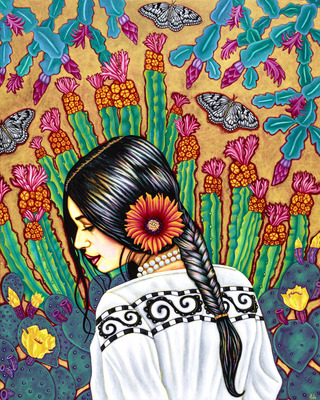
Deciding who to do my presentation on was a little hard
for me because I do not know of many artists. As I went through the list posted
by Professor Lopez, I saw “Pola Lopez” which is really similar to my dads name “Paul
Lopez.” I thought, “Maybe this is a sign.” So, I searched up her artwork and
fell in love. I love her bold, vibrant color choices and unique style. The
bright colors made Lopez’s art really stand out and made me decide to do my
presenation on her. I also find the cultural influence displayed In her art to
be pretty dope, such as the use of: nopales in the backgrounds, a pachuco
skeleton to represent her father, and butterflies.
Tuesday, April 3, 2018
Lopez, Audrey (Audrey)

Hello everyone! My name is Audrey Lopez. My preferred gender
pronouns are She/her/hers and I go just go by "Audrey." As a Chicana
myself, I am excited to learn about Chicana artists and see their works. I am
physiological sciences major but enjoy learning about art and getting to try my
hand at it myself.
Subscribe to:
Posts (Atom)